Hidden Legal Trap Called Evidence Tampering And How Digital Trails Expose It
19 Aug, 2026
627 Views 0 Like(s)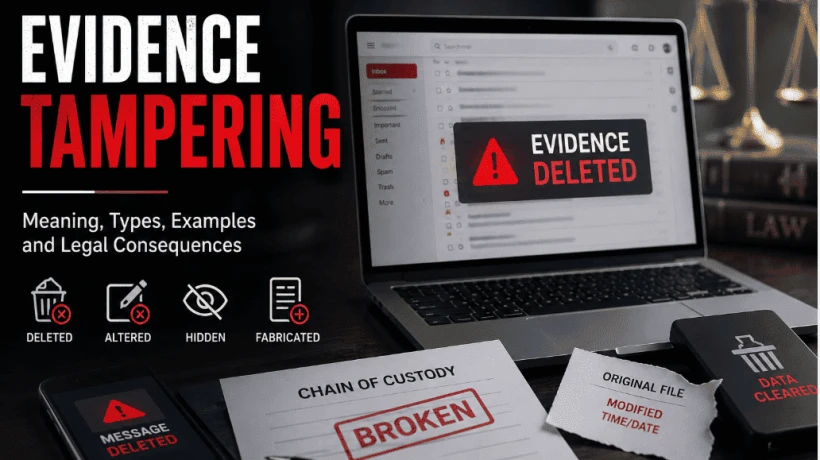
Evidence tampering often begins as panic, not crime — a deleted email or edited timestamp can cross a serious legal line. Explore the 3-part legal test, common digital tampering tactics, and how forensic investigators detect and expose altered evidence.
An investigation begins. Before anyone officially reaches out, someone quietly goes back through old messages and starts cleaning house — a deleted thread here, an edited file there. It feels like damage control. In legal terms, it can be the exact moment that turns a routine matter into a criminal one.
This is the gap most people don't see coming, and it's why understanding what is evidence tampering matters far beyond courtrooms and criminal cases. It shows up in workplace disputes, family law, insurance claims, and corporate compliance — often triggered by nothing more than instinct and panic.
Breaking Down the Definition
Evidence tampering is the deliberate act of altering, destroying, concealing, or fabricating something that could be relevant to an investigation or legal proceeding, done specifically to influence how that matter is resolved.
Courts define "evidence" broadly. It isn't limited to weapons or forensic samples — it can be:
-
A recorded phone call
-
A group message thread
-
A signed agreement
-
An expense report
-
A location-tagged photo
If something can help reconstruct events, it typically qualifies for legal protection against interference.
Why This Rarely Looks the Way People Expect
Popular imagination pictures tampering as something dramatic — a disposed weapon, a shredded file, a hidden object. The far more common version is quieter and much less obvious:
-
A supervisor deleting a warning email once a termination dispute begins
-
A person clearing text messages before a family court hearing
-
A business "reorganizing" its shared drive right after receiving a legal notice
None of it feels like a crime scene in the moment. Depending on intent and timing, the law may see it very differently.
The Legal Test: Three Elements, Not One
A missing file alone doesn't create a tampering case. Investigators and prosecutors typically need to establish three things together:
-
Action — something was actually altered, destroyed, concealed, or fabricated.
-
Intent — the person acted deliberately, aiming to affect a legal outcome.
-
Relevance — the item genuinely mattered, or reasonably could have mattered, to that matter.
Take away any one of the three, and the legal foundation for a tampering charge typically collapses. This is why courts spend so much time examining motive and timing rather than just the act of deletion itself.
Four Ways Tampering Commonly Shows Up
Legal professionals generally sort tampering behavior into four recurring categories:
-
Destroying — physically eliminating an item, such as shredding documents or wiping a device.
-
Hiding — concealing something without destroying it, moving it out of reach.
-
Altering — editing a file, changing a date, modifying content after the fact.
-
Fabricating — creating something false, like a forged signature or an invented record.
Alteration, hiding, and fabrication translate almost effortlessly into digital environments — which explains why so much modern tampering happens through a keyboard rather than a physical hiding place.
How Tampering Differs From Similar-Sounding Terms
These words are frequently used interchangeably online, but they carry distinct legal meanings.
|
Term |
Core Meaning |
Criminal or Civil? |
|
Evidence Tampering |
Deliberately altering, hiding, destroying, or faking evidence |
Criminal |
|
Spoliation of Evidence |
Losing or destroying relevant evidence, often unintentionally |
Usually Civil |
|
Obstruction of Justice |
Any interference with legal proceedings, broadly defined |
Criminal |
|
Witness Tampering |
Coercing or bribing a witness to alter their testimony |
Criminal |
Obstruction of justice acts as the umbrella category, with evidence tampering, witness tampering, and perjury sitting underneath it. Spoliation is the outlier — typically a civil-court parallel to similar conduct, without the need to prove criminal intent.
The Digital Shift Nobody Fully Prepared For
Most tampering cases today have little to do with physical objects. They unfold through deleted emails, edited documents, manipulated screenshots, and disguised sender information — simply because that's where most evidence now exists.
What makes digital tampering especially risky for the person attempting it is that it leaves behind something physical evidence rarely does: a detailed, often permanent record of the change itself.
Common Digital Tampering Scenarios
-
Deleted emails — removed under the belief they're permanently gone, when they're frequently recoverable from servers or backup archives.
-
Forged headers — sender and routing information manipulated to disguise where a message truly came from.
-
Backdated timestamps — a file gets modified, then its date is manually adjusted to obscure the edit.
-
Doctored attachments — a document or image is altered after the fact and reintroduced as though it were untouched.
Each action feels contained and private to the person doing it. Very few stay hidden once someone with the right expertise begins examining the file's history.
Evidence Tampering Under Indian Law
Within Indian law, this offense was traditionally addressed under Section 201 of the Indian Penal Code, and it now continues under Section 238 of the Bharatiya Nyaya Sanhita (BNS).
The underlying idea mirrors legal frameworks elsewhere: knowingly causing evidence connected to an offense to disappear, or supplying false information, in order to protect someone from legal consequences.
Intent remains central to how these cases are evaluated. Evidence that is lost or destroyed without any knowledge that it related to an offense generally does not meet the legal threshold for tampering.
How Forensic Investigators Uncover It
Here's the part that should offer some reassurance: digital tampering is genuinely difficult to pull off without leaving a trace. Deleting or editing a file changes what's visible on the surface — it doesn't erase the underlying fact that a change took place.
-
Hash verification — a unique digital fingerprint is generated for a file the moment it's collected, so any later modification breaks that fingerprint and flags the change.
-
Header and authentication review — email routing details and cryptographic signatures are examined to catch forged sender data or manipulated timestamps.
-
Metadata inspection — creation dates, edit history, and device information function as hidden markers attached to most digital files.
-
Recovery of deleted content — messages can often be restored from mailbox and archive files well after deletion, allowing investigators to reconstruct exactly what was removed.
To trace forged headers, recover deleted content, and confirm whether a file matches its original state, investigators regularly depend on dedicated email forensics software purpose-built for these kinds of investigations.
Frequently Asked Questions
Does deleting one email automatically count as tampering? No. It only becomes tampering if the person knew, or reasonably should have known, that the email could matter to an investigation, and deleted it specifically to keep it hidden. Routine, unrelated deletion doesn't meet that standard.
Is evidence tampering always charged as a felony? Not necessarily. It depends heavily on jurisdiction and the specific circumstances — some regions treat it as a misdemeanor for civilians, while others pursue felony charges, and federal cases can carry sentences of up to 20 years.
Can accidental data loss be confused with tampering? It can draw scrutiny, but without evidence of intent to interfere with a case, accidental loss usually doesn't meet the legal bar for tampering — though it may still result in civil consequences under spoliation rules.
Final Thoughts
Evidence tampering almost never looks like the dramatic version people picture. It usually shows up as a quiet, seemingly reasonable decision made under pressure — which is exactly what makes it so easy to stumble into unintentionally. Whether it's a suspicious deletion, an edited timestamp, or a missing conversation thread, the safest approach remains the same: preserve everything, resist the instinct to clean up, and let a proper forensic review determine what genuinely matters.


Comments
Login to Comment