From 2D Layouts to AI Automation: The Next Phase of PCB Design Software
02 Sep, 2026
527 Views 0 Like(s)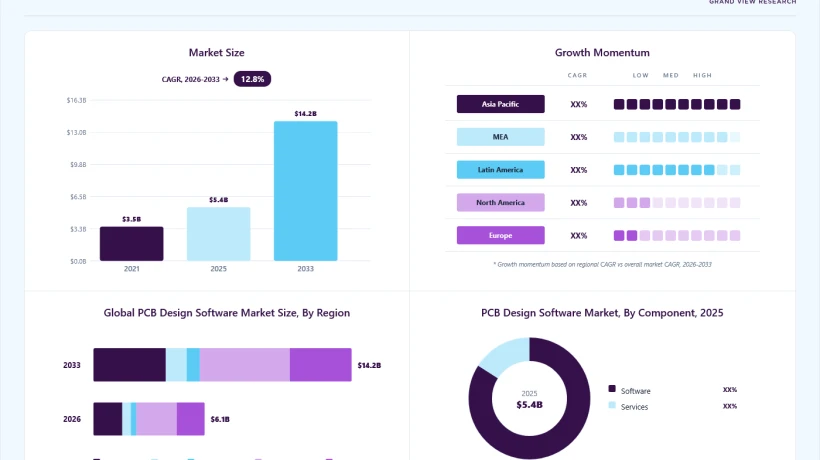
The global PCB design software market size was valued at USD 5.4 billion in 2025 and is projected to grow from USD 6.1 billion in 2026 to USD 14.2 billion by 2033, at a CAGR of 12.8% from 2026 to 2033.
The PCB design software market is becoming increasingly important as electronic products become smaller, smarter, and more complex. Advanced design platforms help engineers and manufacturers design, simulate, and optimize printed circuit boards across a wide range of applications. According to Grand View Research, the market was valued at USD 5.4 billion in 2025 and is projected to increase from USD 6.1 billion in 2026 to USD 14.2 billion by 2033, expanding at a CAGR of 12.8% from 2026 to 2033. North America accounted for a 36.4% revenue share in 2025.
Market Growth Driven by Increasing Electronics Complexity
The expansion of the PCB design software market is closely linked to the growing demand for smaller and more efficient electronic devices. Industries are increasingly developing products that require compact, high-performance circuits, creating greater demand for tools capable of managing complex layouts, signal integrity, thermal considerations, and design verification.
The growth of IoT, electric vehicles, connected technologies, and advanced electronics is supporting this demand. PCB design software helps streamline engineering workflows, reduce errors, and shorten time-to-market, making efficient design processes increasingly important for manufacturers competing on product performance and development speed.
Software Segment Maintains a Strong Position
The software segment accounted for the largest revenue share of 84.0% in 2025. Design software provides the core capabilities needed for schematic capture, PCB layout, simulation, routing, signal integrity checks, and thermal analysis.
Demand is also being supported by improvements in automation, integration, and collaboration capabilities. While services covering consulting, training, implementation support, maintenance, and custom design assistance are expected to grow at a significant CAGR from 2026 to 2033, software remains the central component of the market.
2D Dominates While 3D Design Gains Momentum
The 2D PCB design software segment led the market in 2025 with a 33.3% revenue share. Its simplicity, lower learning curve, and cost-effectiveness continue to make it useful for prototyping, education, and less complex applications.
At the same time, 3D PCB design software is expected to record the fastest CAGR from 2026 to 2033. Three-dimensional capabilities allow engineers to combine electrical layouts with mechanical environments, helping identify enclosure-fit problems and component-height conflicts earlier in development. This becomes particularly valuable as products such as wearables, automotive sensors, and 5G modules require increasingly compact designs.
Cloud Adoption Adds Another Growth Layer
On-premises deployment held the largest share in 2025, particularly because large enterprises in aerospace, defense, and automotive often require strong security, customization, regulatory compliance, and dependable access for complex projects.
However, cloud-based deployment is expected to grow at the fastest CAGR from 2026 to 2033. Cloud platforms provide scalability, lower upfront costs, and real-time collaboration, making them attractive to startups, smaller companies, and distributed engineering teams. Integration with AI-assisted routing, automated checks, shared libraries, and simulation capabilities is further strengthening their appeal.
Consumer Electronics and Automotive Create Strong Demand
Consumer electronics held the largest application revenue share in 2025. Smartphones, wearables, laptops, and smart-home products increasingly require multilayer boards, high-density interconnects, and sophisticated power-management capabilities.
Automotive and transportation is also positioned for significant growth from 2026 to 2033. Electric vehicles, autonomous driving systems, connected cars, battery-management systems, ADAS sensors, and advanced infotainment increase the need for reliable high-performance PCB designs capable of handling thermal stress, high currents, and signal-integrity requirements.
Regional Expansion Supports Market Opportunities
North America held the largest regional share at 36.4% in 2025, supported by demand for advanced electronics, electric vehicles, 5G infrastructure, medical devices, and high-performance circuits.
Asia Pacific is expected to register the fastest CAGR from 2026 to 2033. Strong electronics manufacturing activity across China, Japan, South Korea, and India is creating substantial demand for advanced PCB design tools. Rising production of consumer electronics, smartphones, IoT products, and automotive systems is supporting adoption across the region.
Future Outlook
The PCB design software market is positioned for continued expansion as electronic products become more integrated and engineering teams seek faster, more accurate development workflows. AI-assisted design, 3D modeling, cloud collaboration, and advanced simulation are becoming increasingly important alongside established 2D capabilities. With the market projected to reach USD 14.2 billion by 2033, technology innovation and increasing circuit complexity are likely to remain central to future market development.
FAQs
How big is the PCB design software market?
The market was valued at USD 5.4 billion in 2025 and is expected to reach USD 6.1 billion in 2026, with a projected value of USD 14.2 billion by 2033.
What trends are shaping the PCB design software market?
Key trends include the movement toward 3D PCB design, cloud-based deployment, AI-assisted automation, high-density circuit development, and increasing demand from consumer electronics, automotive, IoT, and other advanced electronic applications.
Key PCB Design Software Companies:
· Altium Limited
· ANSYS, Inc.
· Autodesk, Inc.
· Cadence Design Systems, Inc.
About us:
Grand View Research, a market research and consulting company, provides syndicated research reports, customized research reports, and consulting services. Grand View Research database is used by the world's renowned academic institutions and Fortune 500 companies to understand the global and regional business environment. Our database features thousands of statistics and in-depth analysis on 46 industries in 25 major countries worldwide.



Comments
Login to Comment