Forensic Analysis of Email in Cybersecurity: A Practical Guide to Extracting Hidden Evidence
22 Apr, 2026
2029 Views 0 Like(s)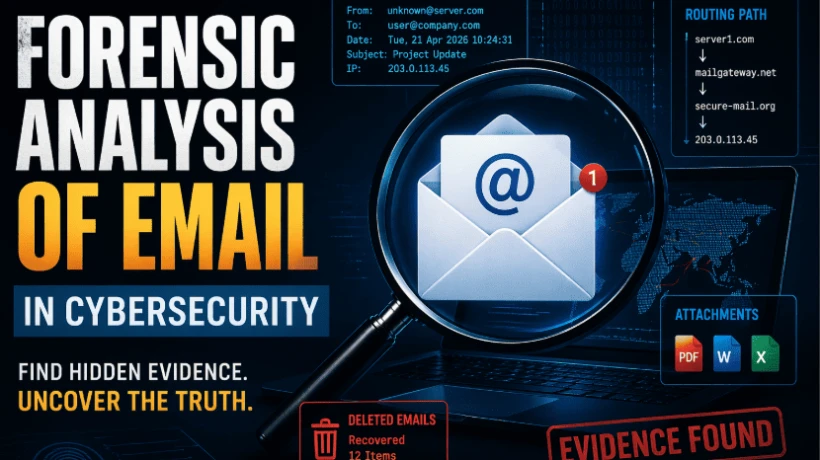
Uncover hidden email evidence with forensic analysis—trace senders, recover deleted messages, and secure insights for cybersecurity and legal investigations.
Forensic Analysis of Email in Cybersecurity: A Practical Guide to Extracting Hidden Evidence
Blog Overview
In digital investigations, email is rarely just communication it’s evidence. From fraud cases to insider threats, critical clues are often buried inside inboxes. The challenge isn’t whether the evidence exists it’s whether you can find it efficiently.
This guide simplifies forensic email analysis into a clear, practical workflow. You’ll learn how investigators uncover hidden data, validate authenticity, and build reliable evidence from complex email datasets.
Why Email Evidence Is Difficult to Analyze
Email data is layered and complex. What you see in an inbox is only a fraction of what actually exists.
Behind every email lies:
-
Technical headers with routing details
-
Metadata like timestamps and sender paths
-
Embedded links and attachments
-
idden communication trails
When dealing with thousands of emails, manually identifying relevant evidence becomes slow and unreliable. Even experienced investigators can miss crucial details without a structured process.
Step-by-Step Email Forensic Investigation Process
1. Data Acquisition
The first step is collecting email data from all relevant sources—mail servers, user accounts, backups, or archives. The key is ensuring data integrity during extraction.
2. Evidence Preservation
Once collected, emails must be preserved in their original form. Any modification can compromise admissibility in legal scenarios.
3. Header Examination
Email headers reveal the true origin of a message. Investigators analyze:
-
Sender authentication
-
IP routing paths
-
Server relay points
This helps verify whether an email is genuine or spoofed.
4. Content & Attachment Analysis
This stage focuses on:
-
Email body inspection
-
Suspicious links
-
Malware-infected attachments
It helps identify phishing attempts, fraud patterns, or unauthorized data sharing.
5. Reporting & Documentation
All findings must be documented clearly. A well-structured report ensures that evidence is understandable and legally defensible.
Limitations of Manual Email Investigation
Many professionals still rely on basic approaches like:
-
Exporting emails from clients
-
Searching with keywords
-
Reviewing emails one by one
This may work for small datasets—but quickly becomes impractical at scale.
Key Drawbacks:
-
High time consumption
-
Increased human error
-
Lack of structured analysis
-
Difficulty in report creation
Manual workflows often lead to incomplete investigations.
Why a Structured Approach Works Better
Modern investigations require a centralized and organized system.
A structured approach allows investigators to:
-
Analyze large datasets efficiently
-
Apply advanced filters and search
-
View complete communication threads
-
Maintain consistency in analysis
Instead of scattered efforts, everything is streamlined into a single workflow—improving both speed and accuracy with the help of professional tools like MailXaminer.
Common Mistakes That Affect Investigations
Even skilled investigators can run into issues due to avoidable mistakes:
-
Overlooking email headers
-
Working on non-original data copies
-
Ignoring deleted or hidden emails
-
Focusing only on visible content
Avoiding these errors significantly improves the reliability of findings.
Quick Self-Assessment
Ask yourself:
-
Are you handling thousands of emails per case?
-
Does your investigation take longer than expected?
-
Are you unsure if all evidence has been captured?
If yes, your current process likely lacks structure and scalability.
Real-World Applications of Email Forensics
Email forensic analysis is widely used across industries:
Corporate Sector
-
Fraud detection
-
Insider threat investigations
-
Policy violations
Legal & eDiscovery
-
Evidence collection
-
Case documentation
-
Communication tracking
Law Enforcement
-
Cybercrime investigation
-
Threat analysis
-
Intelligence gathering
Why Email Forensics Matters More Than Ever
-
A large percentage of cyber incidents involve email
-
Enterprise investigations often include thousands of messages
-
Missing a single email can weaken an entire case
Accuracy and completeness are not optional—they are critical. We hope from this information we know about Forensic analysis of email in cybersecurity.
Final Thoughts
Email forensic analysis is not just about reading messages—it’s about uncovering hidden truth. Without a structured approach, even the most experienced professionals risk missing key evidence.
When handled correctly, email data reveals patterns, timelines, and intent—turning scattered communication into actionable insights.
A well-defined forensic process ensures:
-
Faster investigations
-
Higher accuracy
-
Stronger, defensible evidence
Frequently Asked Questions
Q1. What is email forensic analysis in cybersecurity?
It is the process of collecting, preserving, analyzing, and reporting email data to uncover evidence and trace communication patterns.
Q2. Why is email forensics important?
Because emails often contain critical evidence in cyber incidents, fraud cases, and legal investigations.
Q3. What challenges do investigators face?
Handling large datasets, identifying hidden or deleted emails, and maintaining accuracy during analysis.

Comments
Login to Comment