Custom Cremation Urns: 2026 Market Trends
11 May, 2026
1771 Views 0 Like(s)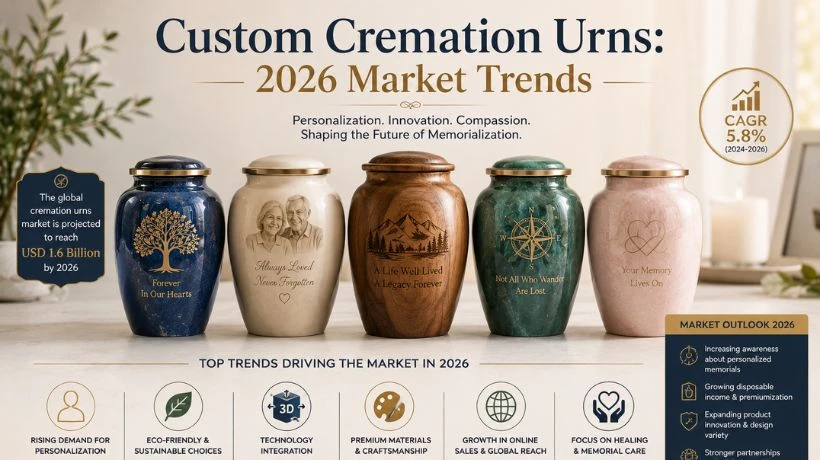
Explore 2026 trends in Custom Cremation Urns, supplier standards, export insights, and sourcing tips from India’s memorial product manufacturers.
Custom Cremation Urns: 2026 Market Trends
Procurement teams already know the problem. Demand for Custom Cremation Urns keeps rising, but consistency across shipments still breaks deals more often than pricing does. One batch arrives with uneven lacquer. Another misses engraving depth by 2 mm. And suddenly a retailer that planned a six-month reorder cycle starts testing a second supplier.
That’s exactly why wholesalers are paying closer attention to Custom Cremation Urns Suppliers in India heading into 2026. Buyers are no longer comparing catalogs alone. They are auditing export reliability, finish stability, packaging tolerance, and lead-time honesty. The memorial products category has shifted from decorative sourcing to operational sourcing.
And yet, many suppliers still sell as if buyers only care about unit cost.
The Finish Variations Buyers Actually Notice
Material Trends Are Moving Beyond Basic Metal Urns
Aluminum remains dominant because freight economics still favor lighter-weight products. A standard adult aluminum urn weighs nearly 38–45% less than brass alternatives during export consolidation. That matters once container volumes increase.
Wood-and-metal hybrid urns are also gaining traction across North America and Western Europe.Retailers are looking for memorial products that maintain that personal touch without seeming industrial.
Among Cremation Urns manufacturers in India, more people are requesting a matte powder coat finish over mirror polished. Fingerprints are an issue. Scratches are an even bigger concern.People often overlook wall thickness variations when they receive their samples.
A 0.4 mm difference greatly affects dent resistance in products that are sold in bulk. Suppliers that don’t put a thickness range in the PI documents, are more than likely hiding the inconsistancy in their production.
Demand for more personalization has greatly shifted production.
Demand for personalization went up a lot more in 2023 than prior years, and retailers are now expecting that the MOQ is going to be a lot greater for customization, and that is particularly the case for collections involving memorial products for pets and family member keepsake urns.
Which means laser engraving capacity has become a production bottleneck.
Factories handling fewer than 4–5 engraving stations often struggle during seasonal memorial demand spikes. Buyers rarely ask this during supplier evaluation. They should.
Packaging Failure Still Damages Export Relationships
Nobody tells you how expensive foam failure becomes after customs inspection.
One damaged shipment can wipe out margins from three successful orders. Export-grade packaging for Cremation Urns Memorial Products now typically includes:
-
Multi-layer corrugated export cartons
-
Molded foam protection
-
Scratch-resistant internal sleeves
-
Humidity-control wrapping
-
Barcode-ready labeling systems
A supplier saying “standard export packing” without documentation is giving you a vague promise, not a process.
What Procurement Teams Should Audit Before Signing Any Supplier
1. Ask About Rejection Ratios, Not Just Capacity
Every factory claims high output.
The useful question is this: “What percentage of urns fail QC before packing?” A real manufacturer answers directly. A weak supplier changes the subject to machine count or workforce size.
For metal memorial products, rejection rates above 7–8% usually signal unstable polishing or coating control.
2. Verify Export Documentation History
Among reliable Cremation Urns Memorial Products Manufacturers, documentation discipline separates long-term exporters from opportunistic traders.
Bad answer: “We handle paperwork case by case.”
That usually means delays after dispatch.
3. Inspect Their Small-Batch Discipline
Large orders are easy. Smaller customized runs expose operational weakness.
Most procurement disputes happen in 150–400 piece customized orders because suppliers prioritize larger accounts internally. Buyers notice late artwork approvals, inconsistent engraving placement, and packaging shortcuts.
That’s where relationships break.
4. Confirm Finish Consistency Across Production Cycles
Here’s the hard part buyers underestimate: matching color tone across separate production runs is difficult.
Especially with matte coatings and hand-finished textures.
A factory that promises “exact same finish every time” without discussing batch variation honestly probably hasn’t handled large-scale export repeat orders.
5. Audit Communication Speed During Problems
A supplier’s value is tested after defects appear, not before.
Some factories become unreachable once freight leaves port. Others immediately issue replacement plans with image verification and batch tracking. Procurement managers remember the difference for years.
Why Buyers Are Increasing Orders From Indian Manufacturers
Custom Cremation Urns: 2026 Market Trends Favor Supply Stability
India’s memorial products manufacturing sector benefits from clustered production ecosystems. Metal finishing vendors, engraving workshops, carton suppliers, and export freight operators often operate within short transport distances.
That reduces coordination delays.
For international buyers sourcing from Cremation Urns Suppliers, shorter vendor-to-vendor movement inside production clusters can reduce dispatch disruption by nearly 12–18% compared to fragmented sourcing regions.
Labor flexibility is important too. Industries with high customization demands struggle when manufacturing is too rigid. Projects receiving Custom Cremation Urns Manufacturers from Indian factories are more responsive to low-volume customization demands, since both semi-manual finishing methods and CNC production coexist.
And yet, not every supplier deserves trust simply because they export.
Some exporters still outsource polishing work to uncontrolled third-party workshops. That usually shows up later as uneven coating adhesion or inconsistent detailing. Buyers who skip factory verification often pay for it after container arrival.
Freight Planning Is Becoming a Procurement Decision
Sea freight volatility changed how memorial retailers plan inventory.
More wholesalers now split orders between fast-moving designs and premium customized collections instead of loading single-style containers. That reduces dead inventory risk.
Which means suppliers capable of mixed-SKU export coordination are becoming more valuable than factories chasing only high-volume standard production.
The Margin Protection Most Buyers Ignore
Cheap foam inserts destroy premium positioning.
A scratched urn doesn’t become “slightly damaged” at retail level. It becomes unsellable inventory tied to refund costs, customer complaints, and replacement freight.
That’s why experienced Cremation Urns Memorial Products Suppliers in India focus heavily on packaging QC now. The product is only half the shipment. The carton integrity decides whether margins survive transit.
Single-piece barcode traceability is also increasing across memorial retail chains. Retailers want faster warehouse identification and fewer picking errors during personalized order fulfillment.
About Square N Circle
At Square N Circle, we work closely with wholesalers, procurement managers, and memorial product brands looking for export-focused manufacturing support from India. Our team handles customized urn production with attention to finish consistency, packaging durability, and repeat-order reliability.
We’ve exported to 31 countries, and that experience changed how we manage production. In 2022, we stopped using one lacquer supplier after repeated humidity-related finish complaints from coastal markets. We replaced the process entirely instead of negotiating around defects. That decision reduced coating claims noticeably across later shipments.
We also know memorial buyers work under pressure. Missed dispatch timelines before seasonal demand periods can hurt retail relationships fast.
Send the Right Details Before Requesting a Quote
If you’re sourcing Custom Cremation Urns, send your expected MOQ, preferred materials, finish references, packaging requirements, and destination country upfront. That cuts unnecessary sampling delays.
We typically respond to B2B inquiries within 24–48 business hours.
And yes, customized low-volume sampling is possible depending on finish complexity and engraving requirements.
Website: Square N Circle Official Website
Conclusion
The 2026 market for Custom Cremation Urns is moving toward smaller personalized runs, stricter packaging expectations, and tighter supplier accountability. Buyers are paying more attention to operational reliability than catalog size alone. Reliable Cremation Urns Manufacturers in India will be the ones that communicate clearly, control finish consistency, and treat packaging as part of the product itself. Over the next few years, procurement decisions in memorial products will look far more like supply-chain strategy than decorative sourcing.
Here is another blog you might be interested in.
Why Memorial Brands Prefer Custom Cremation Urns Suppliers in India
FAQs
What should buyers check before choosing Custom Cremation Urns Suppliers in India?
Start with export history, rejection ratios, packaging standards, and response time during quality disputes. Many buyers focus only on price and MOQ. That mistake usually surfaces after the first damaged shipment.
Are Custom Cremation Urns Manufacturers able to handle small personalized orders?
Some can. Some absolutely cannot.
Factories built only around high-volume production often struggle with low-quantity engraving accuracy and repeat customization work. Buyers should ask for recent small-batch production examples before committing.
Why are Indian Cremation Urns Manufacturers gaining attention globally?
India offers strong material sourcing networks, skilled hand-finishing labor, and competitive export economics. Many Cremation Urns Manufacturers in India also operate flexible production systems suited for memorial personalization trends.
What materials are commonly used in Cremation Urns Memorial Products?
Aluminum, brass, wood, stainless steel, and mixed-material combinations remain common. Aluminum continues leading export demand because freight costs are lower compared to heavier metals.
How long do customized memorial urn orders usually take?
Standard export orders may move in 30–45 days depending on finish and quantity. Customized engraving projects often require additional approval stages. Buyers expecting instant dispatch on personalized products usually underestimate artwork coordination time.
Do Cremation Urns Suppliers provide private labeling for retailers?
Yes. Many Cremation Urns Memorial Products Manufacturers now support custom branding, barcode labeling, retail-ready packaging, and catalog exclusivity agreements for wholesalers and memorial brands.
Why do packaging standards matter so much in Cremation Urns Memorial Products?
Because transit damage directly affects resale value.
Retail customers buying memorial products expect flawless presentation. Weak internal foam, poor carton compression strength, or moisture exposure during freight can turn an entire shipment into financial loss.


Comments
Login to Comment