Continuous Fryer Machine: Key Settings That Affect Oil Absorption
23 Apr, 2026
1986 Views 0 Like(s)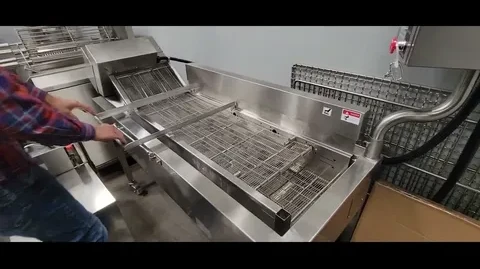
Discover key continuous fryer machine settings that affect oil absorption. Expert guide on temperature, belt speed, and oil quality for snack food processors in Pakistan
Oil absorption is one of the most commercially sensitive quality variables in fried snack and food production. Too much oil and your product fails the fat content specification that health-conscious retail buyers and export market regulations increasingly enforce. Too little and your product loses the texture, colour, and flavour characteristics that consumers expect and that your formulation was developed to deliver. For snack food manufacturers, namkeen producers, and industrial food processors across Pakistan operating or evaluating a continuous fryer machine, understanding the precise relationship between machine settings and oil absorption is not a technical nicety — it is the operational knowledge that determines whether your product meets its specification consistently, batch after batch, shift after shift.
What is a Continuous Fryer Machine?
A continuous fryer machine is an industrial food processing system that fries product in a continuous, uninterrupted flow — food enters the fryer at one end, travels through a controlled hot oil bath for a defined residence time, and exits fully fried at the other end, ready for seasoning, cooling, and packaging. Unlike batch fryers that process discrete loads of product in cycles, the continuous fryer operates as a true inline production system integrated with upstream forming or preparation equipment and downstream cooling and seasoning lines.
The machine typically consists of an insulated oil tank, a submerging conveyor that holds product beneath the oil surface throughout its frying journey, a heating system — gas burner, electric element, or thermal oil heat exchanger — that maintains oil temperature within a defined range, an oil filtration and circulation system that extends oil life and maintains quality, and a discharge conveyor that removes fried product from the oil at the exit point. Each of these systems contains settings and variables that interact to determine the oil absorption level of the finished product — and optimising them collectively is what separates a well-run continuous frying operation from one that struggles with inconsistent fat content and product quality.
Key Features & Benefits
A well-specified and correctly configured continuous fryer machine delivers a consistent set of production and quality advantages that batch frying cannot match at industrial scale:
- Precise, Stable Oil Temperature Control: Continuous fryers maintain oil temperature within a narrow defined range — typically ±2 to ±5 degrees Celsius of the setpoint — using PID temperature controllers and high-response heating systems that prevent the temperature fluctuations that cause inconsistent oil absorption and colour variation across the production run.
- Adjustable Belt Speed for Residence Time Control: Variable speed drives on the product conveyor allow production operators to set and adjust frying time precisely — the single most direct control over oil absorption available on the machine, enabling fine-tuning of fat content within the product specification range.
- Continuous Oil Filtration for Consistent Oil Quality: Integrated filtration systems remove food particles and degradation products from the frying oil continuously during production, maintaining oil quality within acceptable polar compound and free fatty acid limits — directly affecting both the flavour of the fried product and its oil absorption characteristics.
- Submerging Conveyor for Uniform Product Immersion: The submerging conveyor ensures every piece of product is fully and consistently immersed in oil throughout its frying journey — preventing the floating and uneven exposure that causes inconsistent frying on the product's upper and lower surfaces.
- Automated Oil Top-Up System: Quality continuous fryers maintain a consistent oil level in the frying tank through automated top-up systems that replenish oil absorbed by the product and lost to evaporation — preventing oil level drops that would change product immersion depth and alter frying behaviour mid-production.
Industrial Applications
The continuous fryer machine serves the full range of fried food production applications across Pakistan's snack food, food service ingredient, and processed food manufacturing sectors:
- Namkeen and Savoury Snack Manufacturing frying chanachur, daal, peanuts, and mixed snack components continuously at controlled temperatures that deliver the precise texture, colour, and oil content specifications required for retail packaging and branded product consistency
- Potato Chip and Pellet Snack Production processing sliced potato chips and extruded pellet snacks through high-temperature continuous frying at precise belt speeds that deliver the target moisture reduction and fat content within the tight specification bands required for modern retail buyers
- Fried Noodle and Instant Noodle Manufacturing frying formed noodle nests continuously at controlled oil temperatures and belt speeds to achieve the specific moisture and fat content that determines shelf life, rehydration performance, and flavour profile of the finished instant noodle product
- Breaded and Battered Food Processing continuously frying breaded chicken pieces, fish portions, and battered vegetable products for food service and retail frozen food markets — where consistent oil absorption directly affects caloric content labelling accuracy and product quality uniformity
- Fried Dough and Pastry Production processing samosa shells, spring roll wrappers, and fried pastry products continuously for food service supply and retail packed food markets across Pakistan's growing convenience food segment
- Chickpea and Legume Snack Frying producing fried chickpeas, lentil crackers, and legume-based snacks at controlled temperatures that achieve the target texture and oil content without the colour overdevelopment or oil saturation that incorrect temperature or time settings produce
Key Settings That Affect Oil Absorption
Oil Temperature Oil temperature is the primary determinant of oil absorption in continuous frying. When oil temperature is correctly set for the product being fried, the rapid surface moisture evaporation at the moment of product immersion creates an outward steam pressure that physically resists oil penetration into the product structure during frying. When oil temperature is too low, this steam barrier forms slowly and incompletely — allowing oil to penetrate the product surface before a sufficient moisture vapour barrier is established, resulting in elevated fat content in the finished product. When temperature is too high, the surface crust forms and browns before the product centre is properly cooked — a quality problem that may lead operators to increase belt residence time, which itself increases oil absorption. For most fried snack products, optimal oil temperature ranges between 160 and 185 degrees Celsius — the precise setpoint being product-specific and established through controlled trials.
Belt Speed and Residence Time Belt speed directly controls how long the product spends in contact with hot oil — and frying time is the second most direct influence on oil absorption after temperature. Longer residence time means more water is driven from the product, and as water content decreases, the structural voids created by moisture loss progressively fill with oil. For every product, there is a frying time window within which moisture content reaches the target level without excessive oil uptake — and belt speed must be set to keep the product within this window at the operating oil temperature. The interaction between temperature and belt speed is why both settings must be optimised together rather than independently.
Oil Level and Product Immersion Depth The depth of oil in the frying tank and the geometry of the submerging conveyor determine how completely and uniformly the product is immersed during frying. Insufficient oil depth causes partial immersion — the product's upper surface fries in steam and air rather than in oil, producing uneven colour and texture while paradoxically increasing oil absorption on the lower surface where full immersion occurs. Maintaining the correct oil level through the automated top-up system and confirming that the submerging conveyor's geometry matches the product being processed are both essential for consistent oil absorption control.
Oil Quality and Polar Compound Level As frying oil degrades through repeated use and thermal oxidation, its viscosity increases and its surface tension properties change — causing degraded oil to penetrate product surfaces more readily than fresh oil at the same temperature. This means that as oil quality declines across a production run, oil absorption increases even if temperature and belt speed remain constant. Continuous filtration and a disciplined oil replenishment and replacement schedule are essential for maintaining consistent oil absorption across the full production shift — not just at the start of a freshly charged fryer.
Product Moisture Content at Fryer Inlet The moisture content of the product entering the fryer is a significant but often overlooked variable affecting oil absorption. Higher inlet moisture content generates a stronger steam barrier during the initial frying phase — which can actually reduce oil absorption during the early frying period. However, higher initial moisture also requires more energy and time to reach the target final moisture content — and if belt speed is not adjusted accordingly, the result is underfrying. Consistent inlet moisture content, controlled through upstream forming, sheeting, or preparation stages, is a prerequisite for consistent oil absorption control at the fryer.
Why Quality Matters
A continuous fryer machine running at incorrect settings does not simply produce suboptimal product — it produces product that fails the fat content specification printed on its packaging label, or that develops quality defects that accumulate across a production run and only become apparent at the quality check stage, when a full batch of off-specification product must be downgraded or discarded.
Build quality of the continuous fryer machine determines how reliably and accurately these critical settings can be held across a full production shift. A temperature control system with poor sensor calibration or slow thermal response produces oil temperature fluctuations that drive oil absorption variability. A belt drive with worn tensioning or speed regulation drift causes residence time variation across the production run. A filtration system that cannot keep pace with the particle load generated by the product being fried allows oil quality to degrade faster than the top-up rate can compensate.
For Pakistan's growing snack food sector, where branded retail products carry declared nutritional information and export buyers enforce fat content specifications as a condition of supply, the precision and reliability of the continuous fryer's control systems are directly connected to the commercial credibility of every pack that leaves the facility.
Conclusion
The fat content of your fried product is not set at the formulation stage — it is set at the continuous fryer machine, through the daily management of oil temperature, belt speed, oil level, oil quality, and inlet product consistency. Understanding how each of these settings influences oil absorption gives production managers the operational control to keep finished product within specification consistently, reduce waste from off-grade batches, and meet the increasingly stringent fat content requirements of modern retail and export buyers. For food manufacturers and plant engineers ready to invest in precision continuous frying capability, you can explore detailed technical specifications and application-matched configurations for a dependable Continuous Fryer Machine engineered to deliver the temperature stability, belt speed precision, and oil quality management that consistent, specification-compliant fried food production demands.



Comments
Login to Comment