Can Emails Become Strong Digital Evidence in a Legal Investigation?
27 Jul, 2026
849 Views 0 Like(s)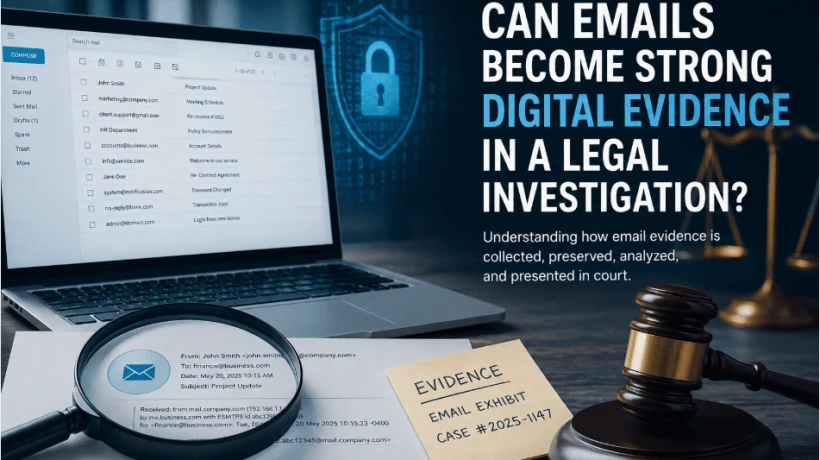
Discover how emails become valuable digital evidence and how forensic investigators preserve, analyze, authenticate, and present email evidence during legal investigations.
Emails are no longer limited to everyday communication. Business negotiations, financial discussions, account notifications, internal conversations, and even suspicious activities can leave traces inside an email account. When a dispute or investigation reaches the legal stage, these digital communications may contain information capable of supporting or challenging important claims.
However, finding a relevant message is only one part of the process. Investigators also need to determine where the email originated, whether its contents are authentic, how it relates to other communications, and whether the evidence has been properly preserved.
This is where email forensic investigation becomes important.
Why Emails Can Be Valuable During Investigations
An email contains more information than the message visible on the screen. Behind the readable content are technical details that can provide additional context to investigators.
Depending on the available evidence, an examination may involve reviewing:
-
Sender and recipient information
-
Email headers and routing information
-
Timestamps and message chronology
-
CC and BCC information
-
Attachments and embedded files
-
Message IDs and other metadata
-
Communication patterns between individuals
These elements can help investigators reconstruct conversations and understand how different people, accounts, or domains may be connected.
A single message might provide an important clue, while hundreds or thousands of emails can reveal a broader pattern that would otherwise remain hidden.
Email Evidence Requires More Than a Screenshot
One common mistake is assuming that a screenshot or printed copy of an email automatically represents complete digital evidence.
Although a printed message can make the content easier to review, investigators may also need access to the underlying digital information. Important technical details may not appear in a screenshot.
For example, email headers can contain information about the path followed by a message before reaching the recipient. Metadata can also help establish timelines and provide context surrounding the communication.
Therefore, forensic examination generally focuses on preserving and examining the original email data whenever possible instead of relying exclusively on what is visually displayed.
Authenticity and Integrity Matter
The usefulness of an email in an investigation depends heavily on whether its authenticity and integrity can be demonstrated.
If a message has been modified after collection, questions can arise regarding its reliability. Investigators therefore need procedures that reduce unnecessary changes to the original evidence and document how the information was collected and examined.
This is also why the question Can Email Be Used as Evidence in Court cannot always be answered simply by finding a relevant message. The circumstances of the case, applicable rules of evidence, authentication, preservation methods, and other legal requirements can influence whether particular electronic evidence is accepted.
Forensic professionals should consequently approach email evidence with both technical accuracy and proper evidentiary procedures in mind.
Challenges Investigators Face With Email Evidence
Modern investigations can involve enormous quantities of email data spread across multiple platforms. A suspect may use desktop applications, webmail accounts, different email addresses, and multiple devices.
Manually examining such information creates several difficulties.
Investigators may need to identify conversations relevant to specific dates, search attachments, examine suspicious images, compare communications between multiple individuals, and establish relationships among different accounts.
The challenge becomes significantly greater when several cases are being handled simultaneously.
For this reason, investigators often use specialized Email forensics software to organize, search, examine, and correlate email evidence more efficiently while maintaining a structured investigative workflow.
Understanding Relationships Between Suspects
Emails can become particularly useful when investigators need to understand communication networks.
Suppose several individuals are suspected of participating in the same activity. Reading their messages individually may reveal useful information, but it can be difficult to understand the overall relationship when thousands of communications are involved.
Link analysis can help investigators examine connections among senders, recipients, accounts, and domains. Instead of looking at communications only as isolated messages, investigators can identify patterns such as repeated interactions or connections between different entities.
Combined with timeline analysis, these relationships may help reconstruct the sequence of events surrounding an incident.
Examining Attachments and Suspicious Content
Important evidence is not always located in the email body.
Attachments can contain documents, photographs, spreadsheets, archives, and other files that require further examination. Investigators may therefore need to search and categorize attachments in addition to reviewing messages.
In cases involving large datasets, manually opening every attachment is rarely practical. Forensic analysis capabilities can help narrow the dataset and allow investigators to concentrate on potentially relevant material.
This becomes especially important when an investigation involves prohibited, objectionable, fraudulent, or otherwise suspicious digital content.
Building a Defensible Investigation
The objective of email forensics is not simply to locate incriminating words. A strong investigation should provide enough context to explain what was discovered and how those findings were reached.
That may require investigators to establish a clear timeline, preserve relevant metadata, identify relationships among correspondents, examine attachments, record investigative actions, and prepare findings in an understandable format.
Specialized solutions are designed to assist forensic professionals with activities including email examination, case management, timeline analysis, link analysis, searching, and reporting.
Technology, however, should support rather than replace sound forensic procedures.
Final Thoughts
Email communication can provide a detailed digital trail during civil, criminal, corporate, and internal investigations. Messages, metadata, attachments, timestamps, and communication relationships can collectively reveal considerably more information than the visible email text alone.
The real value of email evidence therefore depends on how carefully it is collected, preserved, examined, interpreted, and presented.
When investigators combine appropriate forensic technology with documented investigative procedures, large and complicated email datasets can be transformed into structured findings that are easier to understand, verify, and present during legal proceedings.

Comments
Login to Comment