Black Box Testing Methods for API and Microservices Testing
17 Mar, 2026
4892 Views 0 Like(s)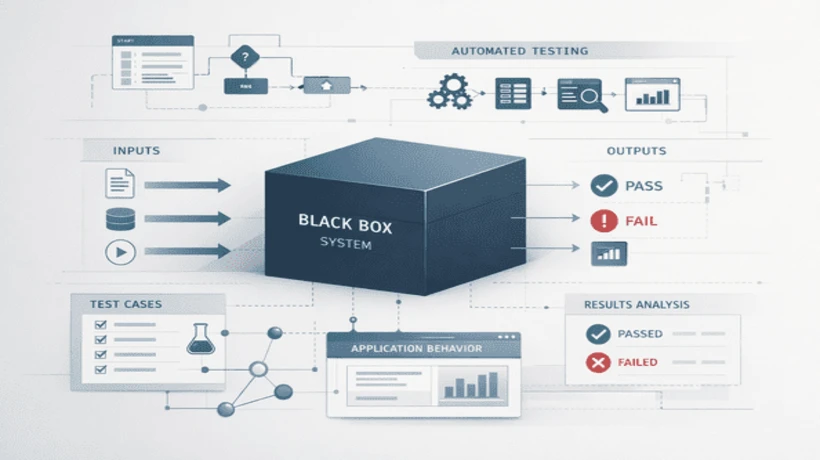
Explore black box testing methods for API and microservices testing, including key techniques like boundary value analysis and decision tables to ensure reliable system behavior.
Modern applications are increasingly built using APIs and microservices, where multiple independent components interact to deliver functionality. In such architectures, validating behavior without relying on internal code becomes essential. This is where black box testing methods play a critical role.
By focusing on inputs, outputs, and expected behavior, these methods help QA teams ensure that APIs and microservices function correctly, communicate effectively, and meet user expectations—even in highly distributed systems.
Why Black Box Testing Is Important for APIs and Microservices
Unlike monolithic systems, microservices architectures involve multiple services communicating over networks. Failures can occur due to incorrect data exchange, broken integrations, or unexpected responses.
Using black box testing methods allows teams to:
-
Validate service behavior without needing internal implementation details
-
Ensure APIs return correct responses for different inputs
-
Detect integration issues between services
-
Improve reliability in distributed environments
Key Black Box Testing Methods for API and Microservices Testing
1. Equivalence Partitioning
This method divides input data into valid and invalid groups (partitions) and tests one value from each group.
For APIs, this helps reduce the number of test cases while still ensuring broad coverage. For example, instead of testing every possible input value, testers focus on representative cases from each category.
2. Boundary Value Analysis
APIs often have limits, such as maximum request size, field length, or numerical constraints. Boundary value analysis focuses on testing values at the edges of these limits.
This method is particularly useful for catching edge-case failures in microservices that handle strict validations.
3. Decision Table Testing
Microservices frequently implement complex business rules. Decision table testing helps validate combinations of conditions and corresponding outcomes.
It ensures that APIs behave correctly under different scenarios, especially when multiple inputs influence the result.
4. State Transition Testing
Some APIs depend on the system’s current state—for example, order processing or user authentication workflows.
State transition testing verifies that services respond correctly when moving between different states, ensuring consistency across service interactions.
5. Error Guessing
Based on experience, testers anticipate potential failure points and test unusual or unexpected inputs.
In API testing, this could include invalid payloads, missing parameters, or incorrect authentication tokens.
Applying Black Box Testing Methods in Microservices Architecture
To effectively use black box testing methods in microservices environments, teams should:
-
Test each service independently through its API endpoints
-
Validate service-to-service communication
-
Simulate real-world scenarios with multiple interacting services
-
Use mock services or stubs where dependencies are unavailable
This approach ensures comprehensive validation without relying on internal service logic.
Challenges in API and Microservices Testing
While black box testing methods are effective, teams may face challenges such as:
-
Managing dependencies between services
-
Handling dynamic data and asynchronous communication
-
Ensuring test coverage across distributed systems
-
Maintaining test environments that reflect production
Addressing these challenges requires careful planning and the right testing strategy.
Role of Automation in Black Box Testing
Automation plays a key role in scaling API and microservices testing. Automated tests can quickly validate multiple endpoints, data combinations, and workflows across services.
Using modern tools, teams can:
-
Automate API request and response validation
-
Integrate tests into CI/CD pipelines
-
Continuously monitor service behavior
-
Improve test coverage without increasing manual effort
Automation enhances the effectiveness of black box testing methods by making them faster and more reliable.
Best Practices for Effective Testing
To get the most out of black box testing methods in APIs and microservices, consider these best practices:
-
Focus on critical business workflows
-
Keep test cases simple and maintainable
-
Regularly update tests as services evolve
-
Combine multiple testing methods for better coverage
-
Ensure consistent test data and environments
These practices help maintain efficiency and scalability in testing efforts.
Conclusion
APIs and microservices form the backbone of modern software systems, and ensuring their reliability is essential. Black box testing methods provide a powerful way to validate these systems by focusing on behavior rather than implementation.
By applying the right methods, leveraging automation, and following best practices, QA teams can ensure that distributed systems remain stable, scalable, and ready for real-world use.



Comments
Login to Comment