Beyond OTPs — How RBI Is Redefining Digital Payment Authentication
03 Oct, 2025
10618 Views 28 Like(s)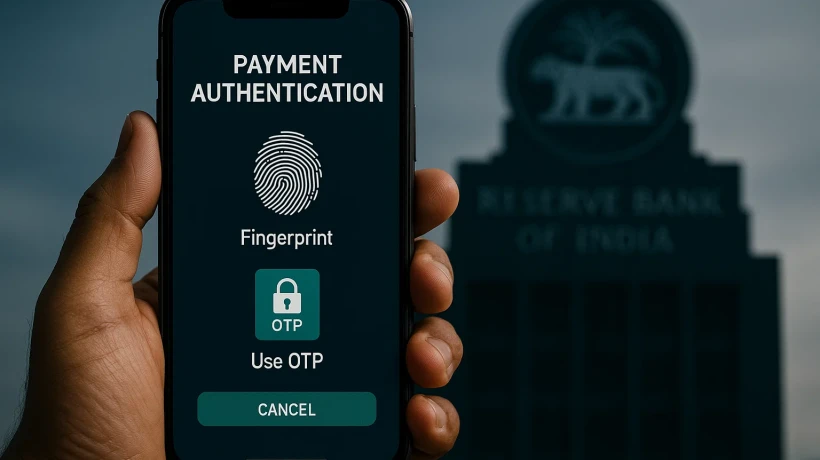
In a world where digital payments are growing by leaps and bounds, security remains a core concern. For years, India’s digital payments ecosystem has mostly relied on SMS-based OTPs (One Time Passwords) as the “second factor” of authentication.
But OTPs have vulnerabilities – SIM swap attacks, SMS interception, delays, etc. Recognizing this, the Reserve Bank of India (RBI) has unveiled new rules that push the system beyond OTPs. Starting April 1, 2026, two-factor authentication will be mandatory for all digital transactions, with new options and dynamic checks built in.
This article unpacks the new rules, what they change, who benefits, and what hurdles lie ahead.
The New Rules — What’s Changing?
Two-Factor Authentication Becomes the Norm
Under the new Authentication Mechanisms for Digital Payment Transactions (Directions), 2025, all domestic digital payments (UPI, cards, net banking, wallets) must use at least two distinct factors of authentication. The existing model — often a password/PIN + SMS-OTP — continues to be allowed, but is no longer sufficient in many cases. mint+3Business Standard+3Lexology+3
One Factor Must Be Dynamic
A key stipulation is that at least one of the factors must be “dynamic” or transaction-specific. In other words, the proof of possession (for example, a token or code) must be unique to each transaction and cannot be reused. This reduces the risk of replay attacks or reuse of intercepted credentials. mint+3Business Standard+3The Economic Times+3
Broader Options for Authentication
The RBI is no longer prescribing just OTPs. Banks, fintechs, and issuers can choose from a wider set of options, including:
- Biometrics (fingerprint, face, iris)
- Device-based tokens or software tokens
- Passphrases or PINs
- Hardware tokens
- Other “something you have / something you know / something you are” combinations mint+4Business Standard+4Lexology+4
Even though new methods are allowed, SMS-OTP is still permitted — it’s not being eliminated entirely — but it will no longer be the only default choice. Business Standard+3Moneycontrol+3mint+3
Risk-Based & Contextual Checks
Beyond the mandatory 2FA, issuers are given flexibility to run risk-based or contextual checks for higher-risk transactions. For example, if a payment is from a new device, from an unusual location, or of a large amount, additional verification steps may kick in. Entrepreneur+3Moneycontrol+3mint+3
Cross-Border / Card-Not-Present (CNP) Controls
The rules also target non-recurring cross-border CNP transactions (i.e., online payments made with cards where the card is not physically present). Issuers must register their BINs (Bank Identification Numbers) with card networks for AFA (Additional Factor Authentication) validation. If a foreign merchant or acquirer demands AFA, the issuer must validate it. Entrepreneur+4MEDIANAMA+4Business Standard+4
Liability & Accountability
If a payment provider or bank fails to adhere to these authentication norms and fraud occurs, they may have to fully compensate the customer for losses arising from non-compliance. This shifts responsibility onto the financial entities to ensure robust systems. Lexology+3Entrackr+3Business Standard+3
Implementation Timeline
- April 1, 2026: The new rules come into effect for most domestic transactions.
- October 1, 2026: For card issuers, the rules for validating AFA in non-recurring cross-border CNP transactions must be in place.
Benefits & Why It Matters
Stronger Security & Reduced Fraud
Because one factor must be dynamic and non-reuseable, the new system mitigates risks like interception, replay, SIM swapping, and credential reuse. The shift encourages more secure methods like biometrics and device tokens.
Innovation & Flexibility
Financial institutions and payment providers can innovate — they aren’t forced to stick to OTPs. They can adopt newer, more user-friendly methods (e.g., in-app passkeys, biometric verification) that balance security and convenience.
Trust for Customers
More robust authentication builds user trust. As people feel safer using digital payments, adoption will rise, especially for high-value or recurring transactions.
Better Fraud Management
Risk-based checks allow differentiation — simple, low-risk transactions stay frictionless, while suspicious ones get added scrutiny. This optimizes usability and security.
Global Alignment
These changes bring India closer to international standards (for example, Europe’s PSD2 “strong customer authentication”) and make cross-border payments safer and more acceptable to global merchants.
Accountability & Better Discipline
By making issuers liable for non-compliance and fraud fallout, there’s a greater incentive for banks, fintechs, and payment service providers to upgrade systems, test rigorously, and maintain audit trails.
Challenges & What Might Go Wrong
Implementation Complexity
Banks, fintechs, wallets, and payment app providers must upgrade their systems, integrate new authentication engines, and ensure compatibility. Smaller players may struggle.
Customer Experience Friction
Moving away from a simple “enter OTP” flow to more varied methods may introduce friction, especially for users who are used to OTPs. Balancing security and usability is tricky.
Interoperability & Standardization
Different banks and providers may adopt different authentication tech. Ensuring seamless interoperability (so that your card, wallet, app, etc., all “speak” to each other) is a technical challenge.
Cost
Deploying biometric systems, token infrastructure, device fingerprinting, and backend risk systems will demand capital and operational investments.
Adoption & Resistance
Users may resist changes, especially if there are glitches, delays, or perceived complexity. Also, some providers might delay full compliance or not pass down security improvements to end users.
Fraudsters’ Evolution
As security tightens in one area, attackers shift tactics. Social engineering, malware, or deeper identity attacks may evolve, requiring continuous vigilance and updates.
Suggested Images / Visuals for Your Blog
Here are image ideas you can use or commission:
- Authentication Methods: Icons representing fingerprint, device token, passphrase, card + lock — showing “something you are / have / know”.
- Transaction Flow with 2FA: A flow diagram showing a digital payment, requiring factor 1 + factor 2 (dynamic) before approval.
- Risk-Based Check Overlay: A visual that shows certain transactions flagged for extra checks (e.g. “New device” gets extra verification).
- Cross-Border / CNP Transaction: Visual showing a card being used online from abroad, with extra authentication overlay.
- Liability & Compliance: Icons of bank, user, shield — representing that banks are liable for failures.
- OTP vs New Methods: A comparative infographic showing SMS OTP on one side, and alternative methods (biometric, token, passphrase) on the other.
You can use the images above (at the top) as references or placeholders.
Conclusion
RBI’s move to mandate stronger, more flexible authentication rules is a welcome evolution, matching the maturity of India’s digital payments ecosystem. While SMS OTPs have served us, they’re becoming a limiting factor in security. From April 2026, Indian payments will shift to a model where two distinct factors are required — one static/knowledge, another dynamic/possession/biometric — complemented by risk-based checks and broader authentication options.
The benefits are clearer security, trust, innovation, and accountability. But execution will be key: providers must balance user experience with safety, ensure standards, and scale securely. If done well, this reform could be a watershed moment in India’s digital payments journey — making the system safer, more reliable, and future-ready.

Comments
Login to Comment