Beyond Accuracy: Key Metrics for LLM QA Testing
20 Aug, 2026
542 Views 0 Like(s)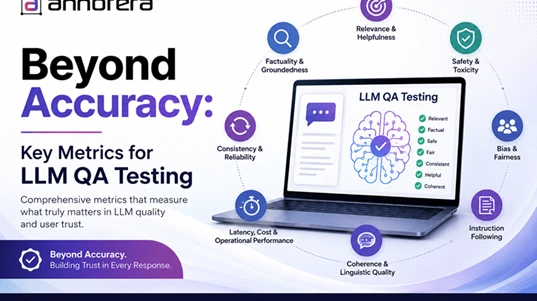
This blog explores essential LLM QA testing metrics beyond accuracy, covering relevance, factuality, safety, consistency, fairness, instruction-following, coherence, latency, cost, and operational performance for trustworthy AI.
Large language models (LLMs) are increasingly powering chatbots, search assistants, content platforms, customer support systems, copilots, and enterprise applications. But evaluating an LLM solely on whether its answers are “correct” is no longer enough. A model can achieve strong accuracy scores while still producing vague, biased, unsafe, inconsistent, or poorly grounded responses.
This is why modern LLM evaluation must go beyond accuracy. Organizations need a broader quality framework that measures how reliably a model performs across real-world scenarios, user expectations, and business requirements. Effective LLM QA testing services help organizations establish these evaluation frameworks and identify weaknesses before they affect end users.
Why Accuracy Alone Is Not Enough
Traditional machine learning evaluation often focuses on measurable outcomes such as accuracy, precision, recall, or F1-score. Generative AI introduces a different challenge: there may be multiple valid ways to answer the same question.
For example, an LLM may provide a technically correct answer but fail to address the user's actual intent. Another response may contain accurate information but be unnecessarily verbose or difficult to understand. A third may sound convincing while including unsupported claims.
Therefore, LLM QA requires multidimensional evaluation. The goal is not simply to determine whether a response is right, but whether it is useful, trustworthy, safe, relevant, and consistent.
1. Relevance and Helpfulness
A response can be factually accurate yet fail to satisfy the user's intent. Relevance measures how closely an LLM's output addresses the question, instruction, or task.
For example, if a customer asks how to return a product, a response explaining the company's shipping policy may contain correct information but still be irrelevant.
Helpfulness evaluates whether the response actually assists the user in completing their objective. Human evaluators can assess whether the response:
-
Directly addresses the user's request
-
Provides actionable information
-
Avoids unnecessary content
-
Uses an appropriate level of detail
-
Follows the requested format
These metrics are especially important for customer-facing generative AI applications.
2. Factuality and Groundedness
One of the biggest risks associated with LLMs is hallucination—the generation of information that appears plausible but is unsupported or incorrect.
Factuality measures whether statements in a response are accurate. Groundedness goes a step further by evaluating whether the response is supported by an approved source, knowledge base, retrieved document, or other reference material.
This distinction is particularly important for retrieval-augmented generation (RAG) systems. A model might produce a fluent answer, but if that answer cannot be traced to the provided context, it may create significant operational or reputational risk.
Robust QA programs can evaluate claims against reference datasets and determine whether responses are adequately supported.
3. Consistency and Reliability
Users expect AI systems to behave predictably. If an LLM gives substantially different answers to the same question under similar conditions, confidence in the system can decline.
Consistency testing examines whether the model:
-
Produces stable answers across repeated prompts
-
Maintains instructions throughout a conversation
-
Applies policies consistently
-
Avoids contradictory statements
-
Handles equivalent questions similarly
Reliability can also be measured across different prompt structures, languages, domains, and user personas. This helps organizations identify performance variations that a single benchmark score may hide.
4. Safety and Toxicity
Generative AI systems operate in unpredictable environments, making safety evaluation essential. LLM QA should assess whether models generate harmful, offensive, discriminatory, abusive, or otherwise inappropriate content.
Safety metrics may include:
-
Toxicity rate
-
Harmful-content generation rate
-
Bias indicators
-
Policy-violation frequency
-
Refusal accuracy
-
Jailbreak resistance
Importantly, refusal accuracy matters as much as refusal frequency. A model that refuses every sensitive request may appear safe but deliver a poor user experience. The objective is to distinguish legitimate requests from genuinely harmful ones and respond appropriately.
5. Bias and Fairness
LLMs can reproduce biases present in their training data or emerge through model behavior. Testing should therefore examine how responses vary across demographic groups, languages, regions, and user contexts.
Fairness evaluations can reveal whether an LLM:
-
Applies different standards to different groups
-
Reinforces stereotypes
-
Produces discriminatory recommendations
-
Performs unevenly across languages or dialects
-
Generates unequal-quality responses for comparable prompts
Human review is particularly valuable here because contextual bias can be difficult to capture through automated metrics alone.
6. Instruction Following
An LLM may understand a prompt but fail to follow its requirements. Instruction-following measures whether the model correctly adheres to explicit constraints.
For instance, if a user asks for a 100-word summary in bullet points, the response should satisfy both the content and formatting requirements.
QA teams can evaluate adherence to constraints such as:
-
Word or character limits
-
Required formatting
-
Tone and style
-
Number of requested items
-
Specific terminology
-
System-level policies
This metric is critical for enterprise applications where outputs must conform to predefined workflows.
7. Coherence and Linguistic Quality
A technically accurate response can still be difficult to use if it is poorly structured. Coherence evaluates whether an answer is logically organized, understandable, and internally consistent.
Common evaluation criteria include grammar, readability, logical flow, clarity, and conversational naturalness.
For customer-facing applications, these qualities directly influence user satisfaction. Human preference evaluations can be especially effective because reviewers can compare multiple responses and determine which one communicates information more effectively.
8. Latency, Cost, and Operational Performance
Quality is not limited to the generated text. Enterprise LLM evaluation should also consider operational metrics.
Latency measures how quickly the model responds, while cost evaluates resources required per request or task. A highly capable model may not be commercially viable if it is too expensive or slow for a high-volume application.
Organizations should therefore evaluate quality alongside:
-
Response latency
-
Token consumption
-
Infrastructure cost
-
Throughput
-
Failure rates
This creates a more realistic picture of production performance.
Building a Comprehensive LLM QA Framework
A strong evaluation framework combines automated testing, benchmark datasets, and human judgment. Automated metrics are useful for measuring large volumes of responses efficiently, while human evaluators can assess nuanced qualities such as helpfulness, tone, contextual relevance, and preference.
This human-machine approach is central to effective generative AI quality control. Teams can establish evaluation rubrics, create representative test datasets, conduct blind comparisons, and continuously analyze failure patterns.
It is also important to test models against real-world edge cases rather than relying exclusively on standard benchmarks. Adversarial prompts, ambiguous queries, multilingual inputs, long-context scenarios, and domain-specific questions can expose weaknesses that conventional testing misses.
The Future of LLM Quality Measurement
As generative AI becomes embedded in critical business processes, model evaluation will increasingly resemble continuous quality engineering rather than one-time benchmarking.
Organizations need to monitor multiple dimensions of performance and connect evaluation results to actionable improvements. Accuracy remains an important metric, but it is only one part of the equation.
A reliable LLM should be accurate, relevant, grounded, consistent, safe, fair, coherent, and operationally efficient.
For organizations deploying AI at scale, partnering with an experienced provider for LLM QA testing services can provide the human expertise, evaluation workflows, and scalable quality processes needed to turn model outputs into dependable business outcomes.
Conclusion
The success of an LLM cannot be captured by a single accuracy score. Real-world AI quality depends on how effectively a model understands intent, follows instructions, avoids harmful outputs, stays grounded in reliable information, and delivers consistent value.
By measuring these dimensions together, organizations can build stronger evaluation programs and establish continuous generative AI quality control. The result is not simply a model that performs well on a benchmark, but an AI system that users and businesses can trust in production.



Comments
Login to Comment