Best Turmeric Extract Suppliers in India for High-Quality Herbal Ingredients
08 May, 2026
1798 Views 0 Like(s)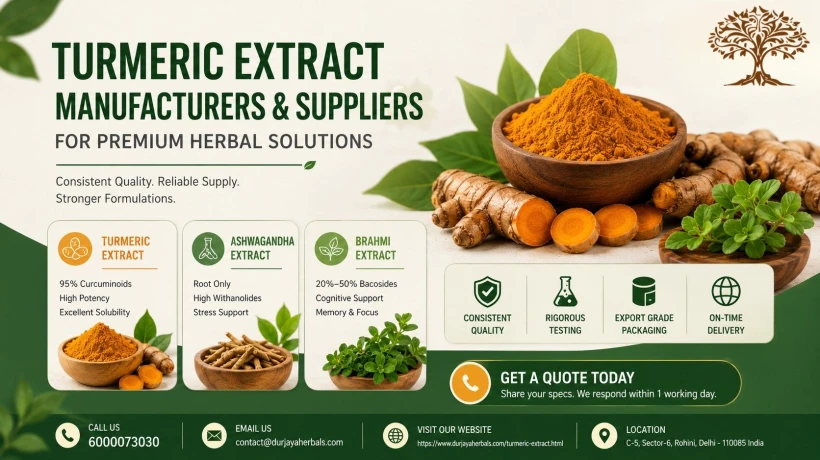
Explore how reliable Turmeric Extract Suppliers ensure batch consistency, traceability, microbial safety, and export-ready quality. Learn what buyers should check when sourcing Turmeric, Ashwagandha, and Brahmi Extracts from India.
Best Turmeric Extract Suppliers Offering High-Quality Herbal Ingredients
A turmeric extract shipment failing microbial limits after reaching port is not a “minor issue.” It can stall an entire production schedule for six weeks, trigger relabeling costs, and damage retailer relationships that took years to build. That’s why serious buyers don’t evaluate Turmeric Extract suppliers on price sheets alone anymore. They inspect traceability, solvent residue control, batch consistency, and how suppliers behave when something goes wrong.
Most buyers learn this after one bad container.
For a number of years, India's herbal product exports have surpassed 600 million USD, with turmeric being in consistent demand across nutraceutical, pharmaceutical, cosmetic, and functional food industries. Yet demand created another problem: too many traders pretending to be manufacturers. A PDF COA is easy to email. Consistent curcumin content across production batches is much harder.
The Specification Detail Most Buyers Skip During Herbal Procurement
Curcumin Percentage Is Only One Part of the Story
Many buyers focus entirely on curcumin percentage — 95%, 97%, or standardized ratios. Fair enough. But Turmeric Extract performance also depends on heavy metal limits, microbial load, residual solvents, and mesh size consistency.
A batch showing 95% curcuminoids on paper can still create formulation headaches if the particle size varies too much between lots. That affects blending uniformity in capsules and tablets. Cosmetic manufacturers face similar issues with texture stability.
Here’s where experienced procurement teams get cautious: they ask whether testing is conducted batch-wise or only periodically.
A supplier avoiding direct answers usually means the testing schedule is thinner than advertised.
Different Industries Require Different Extract Standards
Nutraceutical and Dietary Supplement Grade
Supplement manufacturers typically require:
-
Curcumin standardization between 95%–98%
-
Low microbial count
-
Controlled solvent residue
-
Stability under encapsulation conditions
That matters because even a small variation in moisture content can reduce capsule shelf life in humid export markets.
Cosmetic and Personal Care Grade
Creams, serums, and herbal skincare formulations need:
-
Fine mesh consistency
-
Color stability
-
Low odor variation
-
Better dispersion properties
And yet, some suppliers ship identical extract grades to both nutraceutical and cosmetic clients. That shortcut creates reformulation costs later.
Why Traceability Has Become Non-Negotiable
European and North American buyers increasingly ask for farm-level sourcing records, especially for herbal ingredients entering wellness and organic product categories. According to international herbal trade reports, traceability-related compliance requests increased sharply after 2021 across botanical imports.
Nobody tells new buyers how messy this paperwork becomes during audits.
5 Supplier Evaluation Criteria That Separate Reliable Manufacturers From Traders
1. Ask How They Handle Failed Batches
A real manufacturer explains rejection protocols immediately.
A weak supplier says:
“We usually resolve issues case by case.”
That is not a process. That is future damage control at your expense.
2. Verify Whether Testing Is In-House or Outsourced
Outsourced testing is common in the herbal industry. There’s nothing wrong with it. But if every single analysis depends on third-party labs, turnaround times become unpredictable during peak export months.
Which means your dispatch timeline suddenly becomes flexible for all the wrong reasons.
3. Review Batch-to-Batch Consistency Data
One COA proves almost nothing. Ask for comparative data from three separate batches produced months apart.
Reliable Turmeric Extract Manufacturers maintain tighter variance control because large OEM buyers demand it.
4. Inspect Export Packaging Standards
Drums matter more than people think.
Improper inner liners, weak sealing, or moisture exposure during monsoon shipping can degrade herbal extracts before they even clear customs. Buyers often discover this only after clumping appears during production.
That’s an expensive lesson.
5. Evaluate Communication Speed During Technical Queries
A supplier replying quickly to sales emails but slowly to specification questions is showing you their real operational priority.
Experienced importers notice this early.
How Reliable Herbal Extracts Protect Margins, Not Just Product Quality
Lower Reformulation Costs
Stable Brahmi Extract reduces production adjustments in capsules, powders, syrups, and cosmetic blends. That saves labor hours and prevents repeated pilot trials.
Better Shelf Stability
Consistent moisture and microbial control directly affect shelf life performance. This matters heavily in Southeast Asian, Middle Eastern, and African climates where temperature exposure during transit is harsher than many buyers expect.
Reduced Regulatory Delays
Countries importing herbal ingredients are tightening compliance requirements every year. Reliable documentation reduces customs hold risks and speeds up product registration.
Improved Brand Reputation
One unstable batch can trigger customer complaints across thousands of retail units. Buyers rarely calculate the reputational cost properly until it happens.
More Predictable Production Scheduling
Consistent supply matters just as much as ingredient quality. Contract manufacturers running multiple production lines cannot afford delayed herbal raw material arrivals.
Improved Long-Term Procurement Stability
Having reliable sources for Ashwagandha Extract, Brahmi Extract, and Turmeric Extract will reduce vendor changes and, therefore, qualification costs over time.
Why Delhi Stays a Core Seller of Herbal Ingredients
Delhi remains one of India’s major trade and logistics centers for export of herbal ingredients because of its ability to link manufacturing clusters, along with major inland transport networks and cargo international trade.
Buyers sourcing from North India often reduce inland freight complexity compared to fragmented sourcing across multiple states.
That matters more during monsoon season than most overseas buyers realize.
At our Rohini center, we collaborate with partners in the convenient industry such as manufacturing Ayurvedic goods, pharmaceuticals, food processing, and personal care products. Among the OEM buyers looking for stability in cost and delivery/supply, there has been a tremendous increase in demand for Turmeric Extract Suppliers, Ashwagandha Extract Suppliers, and Brahmi Extract Suppliers.
About Durjaya Herbals — Built Around Export Consistency, Not Catalogue Size
We started Durjaya Herbals with a simple understanding: herbal extract buyers remember failed batches longer than successful deliveries.
Since 2017, we’ve supplied herbal ingredients to buyers across 31 countries, supporting manufacturers in nutraceuticals, pharmaceuticals, cosmetics, animal nutrition, and functional foods. We focus heavily on documentation accuracy, batch traceability, and production consistency because those are the details procurement teams actually escalate internally.
We also learned some hard lessons early. In 2021, we changed one inner packaging material after repeated humidity exposure issues during coastal shipments to Southeast Asia. The extract quality itself was fine. The packaging wasn’t. We changed it permanently after buyer feedback.
That is what long-term export experience looks like in practice.
Our product portfolio includes:
-
Turmeric Extract
-
Ashwagandha Extract
-
Brahmi Extract
-
Botanical powders
-
Standardized herbal extracts
-
Functional herbal ingredients for OEM manufacturing
For buyers researching broader herbal sourcing options,
Send Your Specification Sheet Before Requesting Pricing
We usually respond to technical inquiries within 24 business hours.
If you are sourcing Turmeric Extract, send:
-
Required curcumin percentage
-
Intended application
-
Target market country
-
Microbial specifications
-
Packaging requirement
-
Estimated annual volume
Our MOQ depends on extract type and standardization level, but most export orders begin from 25 kg onward. Buyers requesting Ashwagandha Extract Manufacturers or Brahmi Extract Manufacturers comparisons should also specify whether they need solvent extraction or water-based extraction formats.
Clear specifications save weeks of avoidable back-and-forth.
Here is another blog you might be interested in:
Trusted Brahmi Extract Manufacturers & Suppliers India
Conclusion
The herbal ingredient market is getting stricter, not easier. Buyers sourcing Turmeric extract buyers now have shrinking compliance boundaries, heightened traceability and increasing pressure toward stability of formulation across global markets. The Suppliers discipline in their operations will stand apart, more than those companies who rely on marketing. In the next few years, buyers in the procurement teams who will prioritize operational standards in their sourcing, and will value suppliers who practice standards over operational breaks, will enjoy the least of supply chain issues impacting the sector herbal export.
FAQs
How do reliable Turmeric Extract Manufacturers maintain batch consistency?
They standardize raw material sourcing, monitor extraction parameters closely, and retain comparative batch records. If a supplier cannot share variance ranges between batches, procurement teams should be cautious.
Are Ashwagandha Extract Manufacturers able to customize extract ratios?
Some can. Some cannot. Water-based extraction and solvent extraction produce different profiles, and customization usually requires MOQ commitments. Buyers expecting small-volume customization often underestimate production complexity.
What should buyers ask Turmeric Extract Suppliers before placing bulk orders?
Ask for recent COAs, heavy metal reports, residual solvent data, and packaging specifications. Also ask how complaints are handled. A vague answer there usually predicts future problems.
Why are Brahmi Extract Suppliers increasingly asked for traceability documents?
Import regulations and wellness-sector audits are becoming stricter, especially in Europe and North America. Traceability is now tied directly to retail compliance and product registration.
Do Ashwagandha Extract Suppliers always keep ready stock?
Not always. Standardized herbal extracts sometimes require production scheduling depending on raw herb availability and seasonal procurement cycles.
How do Brahmi Extract Manufacturers control microbial contamination?
Good manufacturers use controlled drying, validated extraction systems, and batch-wise microbial testing. Storage conditions matter too. Poor warehouse humidity control can damage otherwise acceptable material.
What makes experienced Turmeric Extract Manufacturers different from traders?
Manufacturers usually understand process limitations, extraction variables, and compliance details at a technical level. Traders often rely entirely on third-party sourcing and may struggle when specifications become highly specific.


Comments
Login to Comment