AI Is Doing Better Than Doctors in Emergencies? Harvard University Study Surprises the World
05 May, 2026
1835 Views 0 Like(s)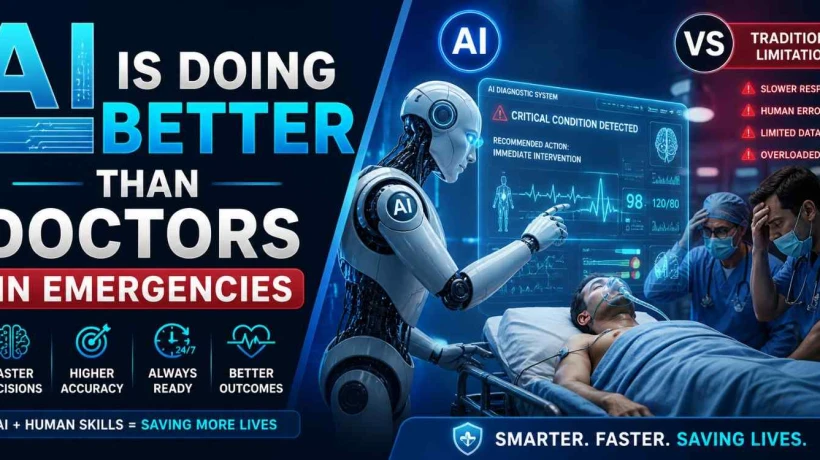
AI Is Doing Better Than Doctors in Emergencies? Harvard University Study Surprises the World
Artificial Intelligence (AI) is no longer just a futuristic concept—it is rapidly transforming the healthcare industry. In a surprising development, a study conducted by researchers from Harvard University has revealed that AI systems may outperform doctors in certain emergency situations. This finding has sparked global discussions about the future of medicine, the role of technology, and how healthcare systems might evolve in the coming years.
What Did the Study Reveal?
The research focused on how AI tools respond in high-pressure emergency scenarios where quick and accurate decision-making is critical. These situations include diagnosing life-threatening conditions, prioritizing patients (triage), and recommending immediate treatments.
The study found that AI systems were often faster and, in some cases, more accurate than human doctors when it came to analyzing symptoms, patient history, and medical data. AI was able to process vast amounts of information within seconds—something even the most experienced doctors may struggle to do under time pressure.
Why AI Performs Well in Emergencies
There are several reasons why AI can excel in emergency care:
1. Speed and Data Processing
AI systems can analyze thousands of data points instantly. In emergencies, every second matters, and this speed can be life-saving.
2. Reduced Human Error
Doctors, being human, can experience fatigue, stress, or cognitive overload—especially in chaotic emergency environments. AI, on the other hand, remains consistent and unaffected by pressure.
3. Access to Global Medical Knowledge
AI systems are trained on vast datasets, including medical research, clinical guidelines, and case histories from around the world. This allows them to make highly informed decisions.
4. Pattern Recognition
AI is particularly strong at identifying patterns in symptoms and test results, even subtle ones that might be missed by the human eye.
Does This Mean AI Will Replace Doctors?
Not so fast. While the findings are impressive, they don’t mean that doctors will become obsolete. In fact, experts emphasize that AI should be seen as a powerful tool to assist medical professionals—not replace them.
Emergency care involves more than just data analysis. It requires empathy, ethical judgment, communication with patients and families, and the ability to handle unpredictable situations. These are areas where human doctors still hold a clear advantage.
The Ideal Future: Human + AI Collaboration
The real potential lies in combining the strengths of both AI and human doctors. Imagine an emergency room where:
- AI quickly analyzes patient data and suggests possible diagnoses
- Doctors review and validate those recommendations
- Treatment decisions are made faster and more accurately
This collaboration could significantly improve patient outcomes, reduce errors, and ease the burden on healthcare professionals.
Concerns and Challenges
Despite its promise, the use of AI in emergency medicine raises important concerns:
1. Reliability and Trust
Can we fully trust AI to make life-or-death decisions? Even small errors can have serious consequences.
2. Data Privacy
AI systems rely on patient data, which raises concerns about security and confidentiality.
3. Bias in Algorithms
If AI is trained on biased data, it may produce unfair or inaccurate results for certain populations.
4. Lack of Human Touch
Healthcare is not just about treatment—it’s about compassion. Patients often need reassurance, something machines cannot provide.
Real-World Applications Already Emerging
AI is already being used in various emergency settings. From ambulance services using AI to predict patient needs, to hospital systems that prioritize critical cases, the technology is steadily becoming part of modern healthcare.
Some AI-powered tools can even assist in detecting strokes, heart attacks, and internal bleeding faster than traditional methods. This early detection can be the difference between life and death.
What This Means for the Future
The findings from Harvard University highlight a major shift in how we approach emergency care. AI is not just a support system anymore—it is becoming an active participant in medical decision-making.
However, the goal is not to replace doctors but to empower them. By integrating AI into healthcare systems responsibly, we can create a more efficient, accurate, and responsive emergency care environment.
Final Thoughts
The idea that AI might outperform doctors in emergencies may sound shocking, but it also represents an exciting opportunity. With the right balance between technology and human expertise, the future of healthcare could become safer and more effective than ever before.
In the end, it’s not about AI versus doctors—it’s about how AI and doctors can work together to save more lives when it matters the most.


Comments
Login to Comment