AI Data Collection for Healthcare: Expert Insights
04 Aug, 2026
773 Views 0 Like(s)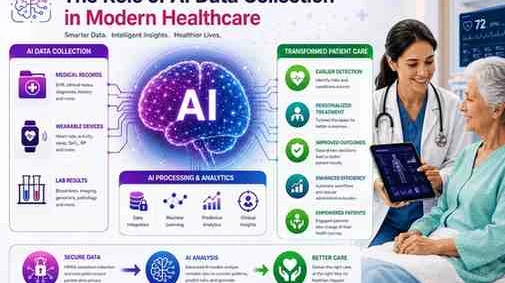
Healthcare organizations across the United States are generating unprecedented amounts of data every day. From electronic health records (EHRs) and wearable devices to medical imaging and patient monitoring systems, healthcare data is expanding at an extraordinary pace. Managing this information manually is no longer practical. This is where AI Data Collection for Healthcare is transforming the industry.
Healthcare organizations across the United States are generating unprecedented amounts of data every day. From electronic health records (EHRs) and wearable devices to medical imaging and patient monitoring systems, healthcare data is expanding at an extraordinary pace. Managing this information manually is no longer practical. This is where AI Data Collection for Healthcare is transforming the industry.
Artificial intelligence enables healthcare providers to collect, organize, analyze, and utilize data more efficiently than traditional methods. By automating data collection and improving data quality, AI helps hospitals, clinics, insurers, and research organizations make faster, more informed decisions while enhancing patient outcomes.
In this article, we explore how AI-powered data collection is revolutionizing healthcare and why organizations should embrace this technology to remain competitive.
What Is AI Data Collection for Healthcare?
AI Data Collection for Healthcare refers to the use of artificial intelligence technologies to automatically gather, process, validate, and organize healthcare data from multiple sources. Unlike manual data entry, AI systems can extract structured and unstructured information from electronic health records, physician notes, medical images, laboratory reports, wearable devices, and patient portals.
Machine learning algorithms and natural language processing (NLP) work together to identify meaningful insights while reducing human errors. This creates a unified data ecosystem that supports better clinical decisions and operational efficiency.
Healthcare providers can leverage AI to collect real-time patient information, monitor health trends, and improve the accuracy of medical records without placing additional administrative burdens on healthcare staff.
Why AI Data Collection Matters in Modern Healthcare
The healthcare industry depends on accurate and timely information. Incomplete or inconsistent data can lead to delayed diagnoses, medical errors, and inefficient workflows.
AI-driven data collection addresses these challenges by:
-
Automating repetitive data entry tasks
-
Improving data accuracy and consistency
-
Reducing administrative workload
-
Supporting faster clinical decision-making
-
Enabling predictive healthcare analytics
-
Enhancing patient engagement through real-time monitoring
As healthcare organizations continue their digital transformation, AI has become an essential tool for managing growing volumes of clinical and operational data.
Key Benefits of AI Data Collection for Healthcare
Improved Patient Care
AI enables healthcare providers to access complete and up-to-date patient information in real time. Physicians can quickly review medical histories, medications, allergies, and diagnostic results, leading to faster and more accurate treatment decisions.
Enhanced Operational Efficiency
Manual documentation consumes valuable time for healthcare professionals. AI automates data collection from multiple systems, allowing physicians and nurses to spend more time with patients instead of performing administrative tasks.
Better Data Accuracy
Human data entry errors can affect patient safety. AI-powered validation tools identify inconsistencies, duplicate records, and missing information before data enters healthcare systems, improving overall data integrity.
Predictive Analytics
AI analyzes large healthcare datasets to identify patterns that may indicate disease progression, hospital readmissions, or patient risks. These predictive insights enable proactive interventions and personalized care plans.
Cost Reduction
Automated workflows reduce operational expenses associated with manual data processing, record management, and administrative overhead while improving resource utilization.
Applications of AI Data Collection in Healthcare
Healthcare organizations are implementing AI across various clinical and administrative functions.
Electronic Health Records (EHRs)
AI automatically extracts patient information from physician notes, laboratory reports, and imaging systems, creating comprehensive electronic health records with minimal manual intervention.
Remote Patient Monitoring
Wearable devices continuously collect health metrics such as heart rate, blood pressure, oxygen levels, and activity data. AI processes this information in real time, helping clinicians identify potential health issues before they become critical.
Medical Imaging
AI assists radiologists by organizing imaging data and identifying abnormalities in X-rays, CT scans, and MRIs, accelerating diagnostic workflows.
Clinical Research
Research organizations use AI to collect and standardize patient data across multiple studies, enabling faster clinical trials and more accurate medical research.
Population Health Management
Healthcare providers analyze community health trends using AI-collected data to improve preventive care strategies and allocate resources more effectively.
Challenges in AI Data Collection for Healthcare
Although AI offers tremendous benefits, healthcare organizations must address several implementation challenges.
Data privacy and security remain top priorities. Organizations must comply with healthcare regulations and maintain strong cybersecurity measures to protect sensitive patient information.
Another challenge involves integrating AI solutions with legacy healthcare systems. Many providers still operate outdated infrastructure that requires modernization before AI can be fully implemented.
Additionally, AI systems rely on high-quality data. Poor data quality may reduce model accuracy and limit the effectiveness of predictive analytics.
Healthcare organizations should also prioritize transparency by ensuring AI supports clinical decision-making without replacing healthcare professionals' expertise.
Best Practices for Successful AI Implementation
To maximize the value of AI Data Collection for Healthcare, organizations should follow several best practices:
-
Establish strong data governance policies
-
Ensure compliance with healthcare privacy regulations
-
Integrate AI with existing healthcare platforms
-
Train staff on AI-enabled workflows
-
Continuously monitor data quality
-
Regularly update AI models using current healthcare datasets
Working with experienced AI technology partners can simplify implementation and accelerate digital transformation initiatives.
The Future of AI Data Collection for Healthcare
The future of healthcare is increasingly data-driven. As AI technologies continue to evolve, healthcare organizations will gain deeper insights from patient data while improving efficiency, accuracy, and personalized care.
Emerging innovations such as generative AI, intelligent automation, advanced predictive analytics, and real-time decision support will further enhance healthcare operations. AI-powered interoperability between hospitals, laboratories, pharmacies, and insurance providers will also create more connected healthcare ecosystems.
Organizations that invest in AI-powered data collection today will be better positioned to deliver higher-quality care while reducing operational costs and improving patient satisfaction.
Conclusion
AI Data Collection for Healthcare is reshaping how healthcare organizations manage and utilize medical information. By automating data collection, improving accuracy, and enabling advanced analytics, AI empowers providers to deliver better patient care while streamlining operations.
As healthcare data continues to grow, adopting AI-driven solutions is no longer optional—it is becoming a strategic necessity. Organizations that embrace intelligent data collection can improve clinical outcomes, increase efficiency, and remain competitive in an increasingly digital healthcare landscape.
Whether you're a hospital, healthcare technology company, or medical research organization, investing in AI-powered data collection can unlock valuable insights and support long-term success.



Comments
Login to Comment