AI Data Collection for Healthcare: Benefits, Challenges, and Future
01 Aug, 2026
619 Views 0 Like(s)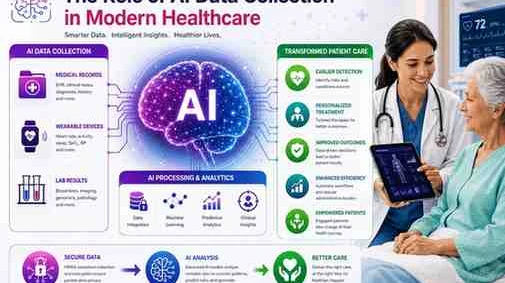
The healthcare industry in the United States is undergoing a digital transformation, and artificial intelligence (AI) is at the center of this revolution. One of the most significant applications of AI is AI Data Collection for Healthcare, which enables healthcare organizations to gather, process, and analyze patient data more efficiently than ever before.
The healthcare industry in the United States is undergoing a digital transformation, and artificial intelligence (AI) is at the center of this revolution. One of the most significant applications of AI is AI Data Collection for Healthcare, which enables healthcare organizations to gather, process, and analyze patient data more efficiently than ever before.
From hospitals and clinics to insurance providers and pharmaceutical companies, AI-powered data collection is improving patient outcomes, streamlining operations, and supporting better clinical decisions. However, implementing AI-driven data collection also comes with challenges related to privacy, data quality, compliance, and ethical considerations.
In this article, we'll explore the benefits, challenges, and future of AI Data Collection for Healthcare and why it has become a strategic investment for healthcare organizations across the United States.
What Is AI Data Collection for Healthcare?
AI Data Collection for Healthcare refers to the use of artificial intelligence technologies to automatically gather, organize, validate, and analyze healthcare data from multiple sources. These sources may include:
-
Electronic Health Records (EHRs)
-
Wearable health devices
-
Remote patient monitoring systems
-
Medical imaging platforms
-
Laboratory information systems
-
Patient portals
-
Health insurance databases
-
Clinical research platforms
Unlike traditional manual data collection methods, AI can process enormous volumes of structured and unstructured information in real time while reducing human errors.
The result is faster access to accurate patient information, enabling healthcare professionals to make more informed decisions.
Benefits of AI Data Collection for Healthcare
1. Improved Clinical Decision-Making
Healthcare providers rely heavily on accurate patient data. AI systems can consolidate information from multiple sources, identify trends, and provide actionable insights to physicians.
This allows clinicians to detect diseases earlier, recommend personalized treatment plans, and improve diagnostic accuracy.
2. Enhanced Patient Care
Real-time patient monitoring has become increasingly important in modern healthcare.
AI-powered data collection continuously gathers information from wearable devices and remote monitoring systems, allowing providers to identify health risks before they become emergencies.
Patients with chronic conditions such as diabetes, heart disease, or hypertension can receive proactive care instead of reactive treatment.
3. Increased Operational Efficiency
Manual data entry consumes valuable staff time and often introduces errors.
AI automates repetitive administrative tasks, including:
-
Patient record updates
-
Medical coding assistance
-
Appointment scheduling support
-
Insurance verification
-
Data extraction from medical documents
Healthcare professionals can spend more time focusing on patient care rather than paperwork.
4. Better Population Health Management
Public health agencies and healthcare organizations use AI to analyze large datasets and identify population-level health trends.
AI helps organizations:
-
Detect disease outbreaks
-
Track chronic disease prevalence
-
Identify high-risk populations
-
Improve preventive care strategies
-
Allocate healthcare resources more effectively
This leads to more informed public health planning and better community health outcomes.
5. Accelerated Medical Research
Medical researchers require large amounts of reliable healthcare data.
AI simplifies data collection by rapidly organizing patient records, clinical trial information, and medical literature. Researchers can identify patterns faster, reducing the time required for drug development and clinical studies.
Challenges of AI Data Collection for Healthcare
While the benefits are significant, organizations must address several challenges before fully adopting AI-powered healthcare data collection.
Data Privacy and Security
Healthcare data is among the most sensitive types of personal information.
Organizations must comply with strict U.S. regulations, including HIPAA, while protecting patient information from cyber threats. AI systems should incorporate strong encryption, access controls, and continuous monitoring to safeguard data.
Data Quality Issues
AI systems are only as effective as the data they receive.
Incomplete records, duplicate entries, outdated information, and inconsistent data formats can reduce AI accuracy. Healthcare organizations must establish robust data governance practices to maintain high-quality datasets.
Integration with Legacy Systems
Many hospitals continue to use older healthcare software that was not designed for AI integration.
Connecting AI solutions with legacy Electronic Health Record systems often requires custom development, interoperability standards, and ongoing maintenance.
Regulatory Compliance
Healthcare organizations must ensure that AI applications meet evolving regulatory requirements.
Compliance includes patient consent, secure data storage, audit trails, and transparent AI decision-making processes. Organizations should regularly review compliance policies as regulations continue to evolve.
Ethical Considerations
AI can unintentionally introduce bias if training data does not accurately represent diverse patient populations.
Healthcare organizations must continuously monitor AI models to ensure fairness, transparency, and equitable healthcare outcomes for all patients.
Best Practices for Implementing AI Data Collection in Healthcare
Organizations seeking to implement AI Data Collection for Healthcare should follow these best practices:
-
Establish strong data governance policies.
-
Ensure compliance with HIPAA and applicable healthcare regulations.
-
Invest in high-quality, standardized healthcare data.
-
Implement secure cloud infrastructure with encryption.
-
Regularly audit AI models for accuracy and bias.
-
Train healthcare staff on AI technologies and workflows.
-
Choose scalable AI platforms that integrate with existing systems.
A thoughtful implementation strategy minimizes risks while maximizing long-term value.
The Future of AI Data Collection for Healthcare
The future of AI Data Collection for Healthcare looks increasingly promising.
Emerging technologies such as generative AI, predictive analytics, natural language processing, and advanced machine learning will continue to transform how healthcare organizations collect and utilize patient data.
Future innovations may include:
-
AI-assisted clinical documentation
-
Fully automated patient intake processes
-
Personalized treatment recommendations
-
Predictive disease prevention models
-
Advanced remote patient monitoring
-
Real-time hospital resource optimization
-
AI-powered clinical research automation
As healthcare becomes more data-driven, organizations that adopt AI responsibly will be better positioned to improve patient outcomes, reduce costs, and deliver more efficient care.
Why Healthcare Organizations Should Invest in AI Data Collection
Healthcare providers face increasing pressure to improve care quality while managing operational costs and regulatory requirements.
AI Data Collection for Healthcare provides a scalable solution that enhances efficiency, improves decision-making, and supports better patient experiences. By automating data collection and analysis, healthcare organizations can reduce administrative burdens, improve data accuracy, and unlock valuable insights that drive innovation.
Partnering with experienced AI solution providers ensures organizations implement secure, compliant, and scalable systems tailored to their unique needs.
Conclusion
AI Data Collection for Healthcare is reshaping the future of the healthcare industry by enabling faster, smarter, and more accurate data management. From improving clinical decision-making and patient care to accelerating research and operational efficiency, AI offers transformative benefits for healthcare organizations.
While challenges such as data privacy, system integration, and regulatory compliance require careful planning, the long-term advantages far outweigh the obstacles. As AI technologies continue to evolve, healthcare providers that embrace intelligent data collection will be better equipped to deliver high-quality, patient-centered care in an increasingly digital world.
For organizations looking to modernize their healthcare operations, investing in AI-powered data collection is no longer just an innovation—it's a competitive necessity.



Comments
Login to Comment