6 Myths About Mobile Forensics That Even Smart People Believe
11 Aug, 2026
666 Views 0 Like(s)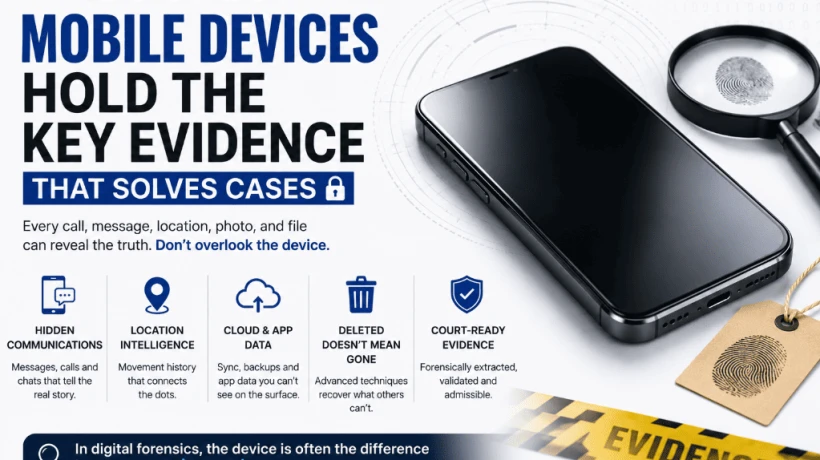
Think deleted texts vanish forever and encryption locks investigators out for good? See what mobile forensics gets right, myth by myth, and why phones drive most digital forensics investigations.
Ask most people what happens when investigators seize a phone, and you'll hear some version of the same story: they plug it in, hit a button, and a printout of every text message rolls out. Delete something first, and it's gone forever. Lock the phone, and investigators are stuck.
None of that is quite true. And the real answer to why mobile devices are so critical to a digital forensics investigation is more interesting than the myth. Let's take these one at a time.
Myth #1: "Deleting a message erases it for good"
This is the myth that gets the most people in trouble, and understandably so. On the surface, hitting delete feels final.
Here's what actually happens instead. When you delete a file on a phone, the device usually doesn't scrub the data itself. It just marks that storage space as available to be reused later. Until something new gets written over it, the original data often just sits there, quietly recoverable.
Think of it less like burning a letter and more like tearing a page out of a notebook and tossing it in a drawer. The page is out of sight, but it's still sitting right there until someone empties the drawer. This is exactly why specialized recovery techniques, especially at the physical extraction level, routinely pull back messages, photos, and files their owners assumed were long gone.
Myth #2: "A locked phone means investigators are stuck"
A locked screen looks like a dead end. It isn't, though it does change how the work gets done.
Investigators actually work through a hierarchy of methods, starting with the least invasive option and only escalating when necessary. Sometimes the operating system itself will hand over accessible files without ever needing the passcode. When that's not enough, examiners can copy the device's entire memory bit by bit, deleted material included. And in the rare case where nothing else works, specialists can go straight to the memory chip itself.
A locked phone slows the process down. It doesn't stop it. The National Institute of Standards and Technology actually formalizes this entire escalation path in its mobile forensics guidelines, precisely because "locked" and "inaccessible" turned out to be two very different things.
Myth #3: "Phones are only useful for texts and calls"
This one undersells what a phone actually is. Messages and calls are just the most obvious layer.
A modern smartphone quietly holds onto far more:
-
Location history, built from GPS, Wi-Fi networks, and cell towers
-
Photo metadata, recording the exact time and place every picture was taken
-
Synced email accounts, often carrying more detail than any text thread
-
Browser and search history, showing intent before an action ever happened
-
App activity, from ride-share trips to fitness tracking
Individually, each of these is a fragment. Together, they build a timeline detailed enough to place someone at a specific location, at a specific time, doing a specific thing. That combination is really the honest answer to why mobile devices matter so much in a digital forensic investigation. No single data source comes close to matching it.
Myth #4: "Any tech-savvy person could pull this evidence together"
This myth causes real damage in real cases, because it's the one people act on before they realize the mistake.
Evidence isn't just about getting data off a device. It's about proving, beyond doubt, that the data wasn't altered between the moment it was collected and the moment it's shown to a judge. That proof comes from a formal chain of custody, similar to how a hospital tracks a blood sample: every person who touches it signs off on exactly when they had it and what they did with it.
Professional examiners also generate hash values at each stage, essentially a digital fingerprint of the data. If that fingerprint changes even slightly, it's immediate proof something was altered. Standards like ISO/IEC 27037 and the Federal Rules of Evidence exist specifically to hold this process to a level a courtroom can actually trust. Skip that process, however well-intentioned, and even genuine evidence can get thrown out.
Myth #5: "Modern encryption means investigators are locked out completely"
Encryption is real, and it's a genuine obstacle. But "locked out completely" oversells it.
Features like Apple's Secure Enclave function almost like a digital padlock that destroys its own combination if someone guesses wrong too many times. That's a serious barrier, and it has occasionally become the actual center of a case rather than just a step in one. Still, a locked phone isn't automatically a dead end. Investigators have alternative paths depending on the device, the operating system, and how the phone was configured, which is exactly why the escalation ladder from Myth #2 exists in the first place.
What encryption really does is slow the timeline down and raise the technical bar. It rarely erases the possibility entirely.
Myth #6: "Email doesn't really count as mobile evidence"
This last one is the myth that costs investigations the most time, because it's the one people don't even realize they're believing.
A phone with a synced mail account isn't holding a handful of messages. It's often carrying an entire mailbox, complete with attachments, headers, and years of correspondence most people forget their phone even has access to. In workplace disputes, fraud cases, and financial investigations especially, that inbox is frequently where the real story is sitting, buried under thousands of unrelated messages nobody has time to read one by one.
The trouble is that most extraction tools are built to pull that mailbox off the device, not to help anyone make sense of what's inside it once it's out. That's a completely different problem, and it's exactly what a dedicated platform like MailXaminer is built to solve, turning an exported mailbox into something searchable, connected, and ready to actually be used, instead of a folder full of files nobody has the time to open one at a time.
Where This Leaves Us
Mobile devices sit at the center of modern investigations for a simple reason: nothing else carries this much detail about a person's life in one place, and even the parts people think are hidden or deleted usually aren't as gone as they assume.
The myths above all share the same root problem. They assume the process is either magic or impossible. It's neither. It's methodical, it's documented at every step, and it's exactly why a phone tells investigators more than almost anything else they'll find at a scene.


Comments
Login to Comment