5 Errors Companies Make When Sourcing Metal Plates That Are Custom Engraved for Industrial Projects
25 Jun, 2026
1243 Views 0 Like(s)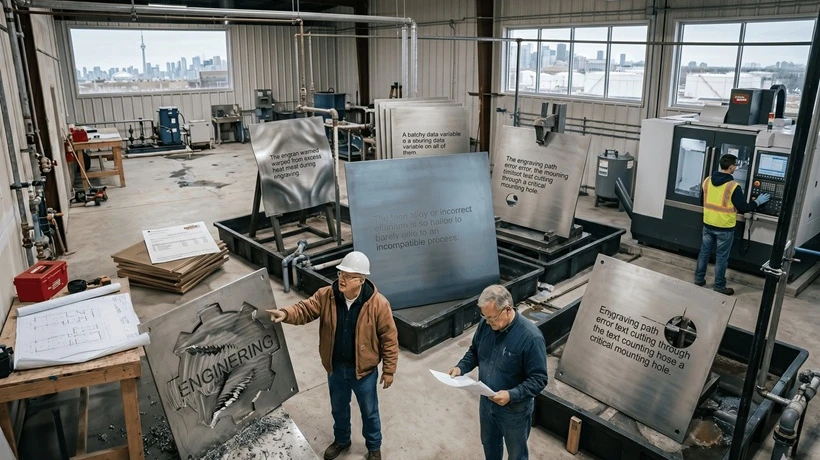
Sourcing engraved metal plates is a specification decision, not a label purchase.
Sourcing engraved metal plates is a specification decision, not a label purchase. The factors below help procurement teams align materials, marking, artwork, and supplier review.
1. Introduction to Sourcing Engraved Metal Plates
This first error is treating the plate as a simple label instead of a specified industrial component. Correct sourcing defines substrate, finish, attachment method, text fields, and marking process before purchasing. Mature procurement treats engraved metal plates as lifecycle assets because readability supports maintenance, safety identification, and traceability.
Material choice controls replacement risk. Stainless steel provides robust corrosion resistance; aluminum supports lighter identification with strong contrast; brass suits durable presentation surfaces; and Lamicoid suits controlled panels. Best practice is to match the plate to exposure, handling, cleaning, and inspection needs before customization.
Selection checklist:
-
Define exposure and cleaning conditions before pricing
-
Match the material and finish to abrasion and chemical contact
-
Confirm attachment access with maintenance
-
Treat unclear copy as a production risk
2. Ignoring Environmental Durability for Engraved Metal Tags
Environmental durability fails when engraved metal tags are specified from drawings alone. Chemicals, residue, abrasion, heat, moisture, and ultraviolet exposure all change how a substrate ages. Recognized best practices qualify service conditions before choosing the metal, coating, or fill material.
Stainless steel offers higher resistance to aggressive washdown, while anodized aluminum can balance weight, contrast, and readability in less severe service. Protective layers only help when engraving preserves the surface strategy. If tags will be scraped, cleaned, or handled frequently, durability should take precedence over decorative preference.
Decision matrix:
-
Best for: chemically exposed assets and high-handling areas
-
Not for: decorative finishes where abrasion is expected
-
Cost posture: higher upfront care, materially lower replacement risk
-
Supplier signal: substrate and environmental guidance
3. Choosing Incompatible Engraving Services for Engraved Metal Plates
Engraving services are not interchangeable, because each process changes surface depth, contrast, and protective integrity. Fiber laser marking generally suits metals because they absorb energy efficiently. Gas laser systems are usually less effective for direct metal marking without compatible coatings, and abrasion-resistant marks consistently outperform shallow decoration under demanding handling conditions.
For engraved metal plates, the method must align with the substrate and finish. Cutting deeply into coated steel can weaken corrosion protection, and a light mark may lose contrast when covered by grime or cleaning. Annealing can support readable stainless marking when surface protection is critical.
Procurement questions before choosing engraving services in Toronto:
-
Which process is best suited to the selected metal and finish?
-
How will corrosion protection be preserved?
-
What contrast method supports dirty surfaces?
-
Can custom layouts remain legible after fabrication?
4. Failing to Provide Vector Artwork for Production
Artwork quality decides whether fabrication starts cleanly or stalls in clarification. Vector artwork gives production teams scalable paths for text, logos, borders, cutouts, and hole locations. Raster captures, flattened proofs, and copied images tend to lead to rework because edges cannot be interpreted precisely.
Small industrial components leave little tolerance for fuzzy letterforms or crowded fields. Clean paths keep character spacing, stroke weight, and logo geometry consistent across orders. Production-ready vector files usually move through review with materially fewer rounds of clarification than artwork that must be rebuilt.
Artwork release gate:
-
Supply editable vector files rather than image captures
-
Convert fonts or provide approved typography
-
Confirm copy, orientation, line breaks, and mounting holes
-
Keep the minimum character height readable for compact plates
5. Overlooking Expert Guidance for Engraved Metal Plates
Expert guidance prevents specification drift before small errors become production problems. Engraved metal plates combine linked choices: material, finish, marking depth, artwork, mounting, environment, and compliance markings where required. Experienced suppliers tend to catch conflicts earlier than teams relying only on drawings and price comparisons.
Identifab Industries Limited can help buyers translate requirements into durable tags, nameplates, asset labels, faceplates, and custom identification components. A strong review integrates environmental considerations, material compatibility, alignment of engraving methods, artwork quality, and supplier feedback into a lower-risk purchase path. Consult a specialist or request a quote for engraved metal plates before approving engraving services for production.

Comments
Login to Comment