1kW, 3kW, 5kW and 10kW Solar System Cost in India: Which Size Fits Your Home?
09 Sep, 2026
510 Views 0 Like(s)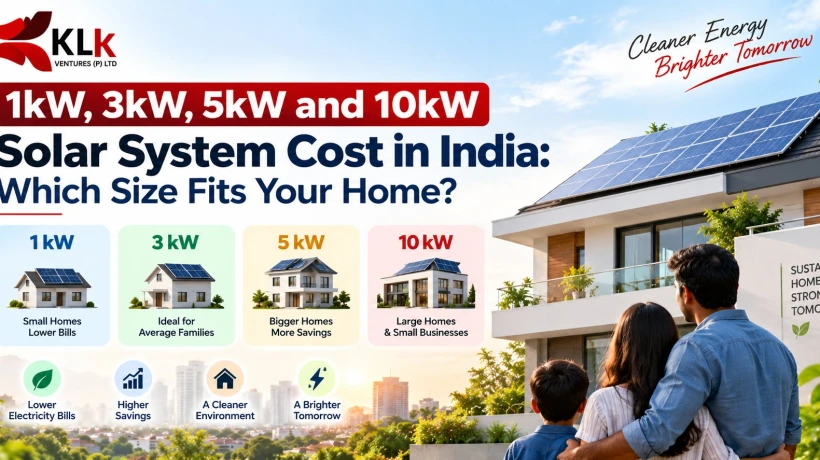
One of the most common mistakes homeowners make when going solar is choosing a system size based on budget alone, without checking whether it actually matches their electricity consumption.
One of the most common mistakes homeowners make when going solar is choosing a system size based on budget alone, without checking whether it actually matches their electricity consumption.
Understanding solar system cost in India by capacity — and matching that capacity to your actual usage — can help you choose a system that provides meaningful savings without paying for unnecessary capacity.
This guide compares four common solar system sizes: 1kW, 3kW, 5kW, and 10kW.
Step 1: Know Your Electricity Consumption
Before comparing system sizes, check your last few electricity bills.
Your average monthly electricity consumption, measured in units (kWh), is one of the most useful starting points for choosing the right solar capacity.
- A system that is too small may not offset enough of your electricity consumption.
- A system that is larger than your actual requirement may involve unnecessary upfront investment.
- Future electricity requirements should also be considered.
A professional site assessment can further evaluate your roof area, shading, orientation and other installation conditions.
1kW Solar System
Best suited for: Very small households, single-person homes, or supplementary power requirements.
A 1kW system can be suitable for properties with modest electricity consumption or limited roof space. It may help reduce electricity consumption from the grid but generally isn't intended to fully offset the electricity requirements of a typical larger family.
Typical Applications
A 1kW system may support loads such as:
- LED lights
- Ceiling fans
- Small refrigerator
- Other basic household appliances
Approximate roof space required: 90–120 sq. ft., depending on the panel type and installation layout.
3kW Solar System
Best suited for: Small to medium-sized households with moderate electricity consumption.
A 3kW system can be suitable for homes using standard appliances such as refrigerators, washing machines, fans, lighting and selected cooling appliances.
It can provide a practical balance between system capacity, available roof space and electricity generation for many residential applications.
Typical Applications
- Refrigerator
- Washing machine
- Fans
- Lighting
- Selected AC usage
- Other household appliances
Approximate roof space required: 270–350 sq. ft.
5kW Solar System
Best suited for: Larger households, homes with higher electricity consumption, or small home-based offices and businesses.
A 5kW system provides substantially more generation capacity than a 3kW system. It can be considered where electricity consumption is higher, particularly in homes with greater cooling or appliance loads.
Actual electricity generation will depend on factors such as sunlight availability, shading, panel orientation and system efficiency.
Approximate roof space required: 450–600 sq. ft.
10kW Solar System
Best suited for: Large homes, small commercial properties, community facilities, or properties with high electricity consumption.
A 10kW system is designed for significantly higher electricity requirements. Depending on the property and local electricity-distribution requirements, larger systems may also involve additional electrical considerations and approvals.
Potential applications include:
- Multiple AC units
- Large household loads
- Electric appliances
- Home offices
- Small commercial establishments
Approximate roof space required: 900–1,200 sq. ft.
Comparative Overview
| System Size | Ideal Household Type | Approx. Roof Area Needed | Typical Use Case |
|---|---|---|---|
| 1 kW | Single occupant / minimal load | 90–120 sq. ft. | Lights, fans, small refrigerator |
| 3 kW | Small-medium family | 270–350 sq. ft. | Standard home appliances |
| 5 kW | Larger family / home office | 450–600 sq. ft. | Higher AC and appliance load |
| 10 kW | Large home / small commercial | 900–1,200 sq. ft. | Heavy, continuous usage |
Roof-area requirements are approximate and can vary depending on panel dimensions, efficiency, mounting configuration and roof layout.
Why Bigger Isn't Always Better
A larger solar system requires a higher initial investment. If your electricity consumption doesn't justify the additional capacity, installing a significantly larger system may not provide proportional financial benefits.
This is particularly important where net-metering and electricity export rules vary by state or distribution company.
Rather than choosing a system simply because it is larger, consider:
- Your historical electricity consumption
- Expected future consumption
- Available roof area
- Solar generation potential
- Applicable grid-export rules
- Budget and financing
- Available subsidy or incentive eligibility
Factors That Can Change the Right Solar System Size
Several site-specific factors can affect which capacity is appropriate for your property.
Sunlight Availability
Solar generation varies according to location, seasonal conditions and available sunlight.
Roof Orientation and Shading
Trees, neighbouring buildings and other obstructions can reduce solar generation. Roof orientation and available installation area should therefore be assessed before selecting a system.
Future Electricity Requirements
If you plan to purchase an EV, install additional air conditioners or add other high-consumption appliances, your future electricity usage may be higher than your current bills indicate.
Local Net-Metering Rules
Grid-export and net-metering regulations can influence the practical size of a residential solar system. Always verify the current requirements applicable to your electricity connection.
How to Choose Between 1kW, 3kW, 5kW and 10kW
A simple way to begin is to compare your average monthly electricity consumption with the expected generation from different system capacities.
However, electricity consumption alone isn't enough.
A proper recommendation should also consider:
- Monthly electricity consumption
- Roof size
- Roof orientation
- Shading
- Location
- Existing electrical connection
- Future electricity requirements
- Applicable regulations and incentives
For a detailed breakdown of solar system installation cost by capacity and the factors that influence the final price, see this solar system installation cost guide.
Final Thoughts
Choosing the right solar system size should start with your electricity consumption, not simply your available budget.
A 1kW system may work for a small electricity load, while 3kW or 5kW systems can be more appropriate for many larger households. A 10kW system is generally better suited to properties with substantially higher electricity requirements.
Before finalizing your purchase, get a site assessment, compare your electricity consumption with expected solar generation, evaluate available roof space and consider your future energy requirements.
The goal isn't to install the biggest system possible — it's to install a properly sized system that matches your actual and expected electricity needs.
Frequently Asked Questions
1. How do I know what size solar system I need?
Start by checking your average monthly electricity consumption in units (kWh). A professional site assessment can then consider your roof area, shading, location and expected solar generation to recommend an appropriate capacity.
2. Can I upgrade my solar system size later?
In some cases, yes. However, expansion can depend on available roof space, inverter capacity, electrical infrastructure and applicable local regulations. Planning for future expansion during the initial installation can make an upgrade easier.
3. Is a 3kW system enough for a family of four?
A 3kW system can be suitable for some four-person households, but there is no universal answer. Appliance usage, AC consumption, electricity habits and local solar conditions all affect the required capacity.
4. Does system size affect subsidy eligibility?
Subsidy programs can have capacity limits and other eligibility conditions. Always verify the current applicable rules before calculating your expected subsidy.
5. Do bigger solar systems require more maintenance?
System size can increase the number of panels and components, but routine maintenance primarily involves cleaning, inspections and monitoring system performance. Maintenance requirements depend more on the equipment and installation environment than capacity alone.
Disclaimer: ThynkTales is a public blogging platform where content is contributed by individual users. While we encourage thoughtful and accurate sharing, we do not independently verify the information provided. Readers are advised to use their discretion and verify any information before relying on it.



Comments
Login to Comment