10 Benefits of Laravel for Building Scalable Web Applications
15 Oct, 2026
7 Views 0 Like(s)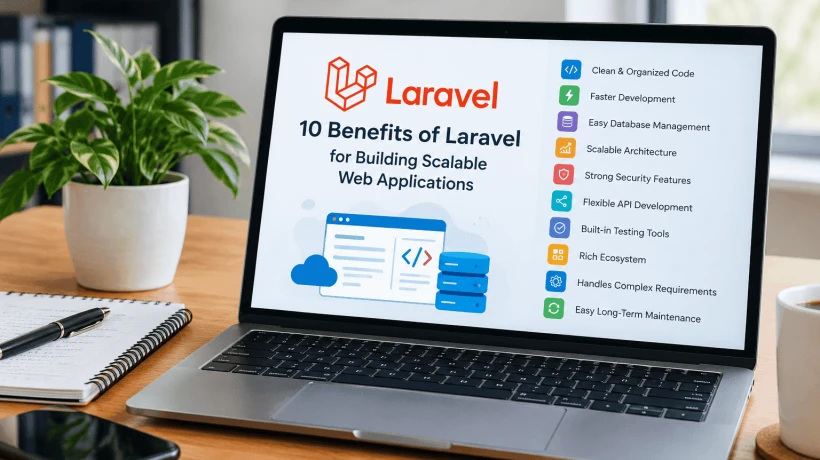
Explore 10 benefits of Laravel for scalable web applications, including security, database management, API development, testing, and maintainability.
As businesses grow, their websites and web applications often need to handle more users, larger amounts of data, and increasingly complex operations. A website that works well for a small customer base may struggle when traffic increases or new features become necessary. Choosing the right development framework from the beginning can make these changes easier to manage.
Laravel is a popular PHP framework used to build websites, business applications, APIs, and other web-based solutions. It provides developers with tools for handling common development tasks, organizing application code, and building features without starting everything from scratch.
For businesses planning a new digital project, understanding Laravel's capabilities can help them make a more informed technology decision. Here are ten benefits of using Laravel to build scalable web applications.
What Is Laravel?
Laravel is an open-source web application framework built with PHP. It follows the Model-View-Controller (MVC) architectural pattern, which separates application data, user interface presentation, and business logic into different parts.
This structure helps developers organize code and maintain applications as they become more complex. Laravel also provides built-in features for routing, database interactions, authentication, validation, background jobs, and automated testing.
These capabilities make it a practical option for projects ranging from business websites and customer portals to e-commerce platforms and custom web applications.
1. Organized Code Makes Applications Easier to Maintain
As an application grows, its codebase can become difficult to manage without a clear structure. Developers may need to introduce new features, fix bugs, or update existing functionality without affecting unrelated parts of the system.
Laravel's MVC architecture helps separate different responsibilities within an application. This makes it easier for development teams to understand how individual components work and where changes should be made.
For example, an online service platform might include customer accounts, appointment management, payment processing, and reporting. Keeping these functions organized helps developers maintain the application as new requirements emerge.
Good code organization does not automatically guarantee scalability, but it creates a stronger foundation for future development.
2. Built-In Tools Can Speed Up Development
Building a web application involves many recurring tasks, including handling requests, validating forms, managing database records, and configuring routes.
Laravel provides tools for these common requirements, reducing the need to implement every feature from scratch. Its command-line utility, Artisan, can also help automate development tasks such as generating code structures, running migrations, and managing scheduled operations.
Faster development can benefit businesses by helping teams build and test applications more efficiently. Developers can spend more time working on features that are specific to the business instead of repeatedly creating basic functionality.
The actual development time still depends on the project's complexity, integrations, testing requirements, and the team's experience.
3. Database Management Becomes More Convenient
Most business applications rely on databases to store customer details, transactions, product information, or operational records. Managing database changes becomes increasingly important as an application evolves.
Laravel provides Eloquent ORM, which allows developers to interact with database records through an object-oriented approach. It also supports database migrations, helping teams track and apply changes to database structures in a more organized way.
Consider an e-commerce application that needs new product attributes or customer account fields. Migrations can help developers manage these changes consistently across development and deployment environments.
These tools can make database-related development more manageable, although performance still depends on query design, indexing, data volume, and database configuration.
4. Laravel Supports Scalable Application Architecture
Scalability means an application can handle changing workloads and business requirements without requiring a complete redesign every time demand increases.
Laravel supports several approaches that help developers build applications capable of growing over time. Depending on the project's requirements, developers can use caching, queues, background jobs, database optimization, and suitable infrastructure to improve performance.
For example, a platform that processes customer orders may need to send notifications, generate reports, or process other tasks that do not need to delay the user's immediate request. Moving appropriate work into background jobs can help keep the application responsive.
Businesses evaluating a laravel development company should ask how the team plans for traffic growth, performance monitoring, database efficiency, and infrastructure requirements. The framework provides useful tools, but the overall architecture determines how well the application scales.
5. Security Features Help Protect Business Data
Security is an important consideration for any web application that handles customer information, login credentials, or business records.
Laravel includes features that help developers implement common security practices. These include password hashing support, CSRF protection, input validation, and mechanisms for managing authentication and authorization.
For example, a customer portal may need to ensure that users can access their own records but cannot view another customer's information. Appropriate authentication and authorization checks help enforce these rules.
However, using Laravel does not make an application automatically secure. Developers must configure security features correctly, validate permissions, protect sensitive information, manage dependencies, and keep the application updated.
Security should be considered throughout development rather than treated as a final step before launch.
6. Flexible API Development Supports Integrations
Modern applications often need to communicate with other systems. A business might want its website to connect with a mobile application, payment provider, CRM platform, or third-party service.
Laravel can support API development, allowing applications to exchange data with other software through defined endpoints. This can help businesses connect different parts of their technology environment without duplicating every function.
For example, an inventory system could provide product availability information to an online store, while a separate dashboard uses the same data for internal reporting.
Well-designed APIs can also make it easier to introduce new interfaces or services later. Developers should still plan for authentication, rate limiting, data validation, versioning, and clear API documentation.
7. Testing Tools Help Improve Reliability
A web application may work correctly during initial development but encounter problems when new features are introduced. Automated testing can help identify these issues before changes reach users.
Laravel supports testing through its testing utilities and integrates with established PHP testing tools. Developers can write tests for important workflows, including user registration, form submissions, API responses, and business rules.
Imagine a booking platform that allows customers to reserve time slots. Tests can help verify that unavailable slots cannot be booked twice and that confirmation messages are generated under the correct conditions.
Testing requires additional effort, but it can reduce the risk of regressions and make future updates easier to manage. The most useful testing strategy focuses on critical workflows as well as edge cases.
8. A Large Ecosystem Offers Additional Development Options
Laravel has an established ecosystem of packages, libraries, and supporting tools. These resources can help developers implement common capabilities without building every component independently.
Depending on the project, a team may use established packages for specific integrations, administrative functionality, or other application requirements. Laravel's ecosystem also includes tools that support different aspects of development and deployment.
This can be particularly useful for businesses that expect their applications to evolve. A suitable package may reduce development effort and simplify maintenance.
Still, third-party packages should be evaluated carefully. Developers need to check compatibility, maintenance activity, security considerations, licensing, and whether a package is genuinely necessary.
9. Laravel Can Support Complex Business Requirements
Not every business can operate effectively with a basic website or a collection of disconnected applications. Some need custom workflows, different user roles, approval processes, detailed reporting, or integrations with existing business systems.
Laravel provides a flexible foundation for developing these types of features. Its routing, database, authentication, and application-organization capabilities can be combined to support a wide range of business requirements.
For instance, a service company might need an internal dashboard where managers assign tasks, employees update progress, and customers review service requests. A Laravel application can be structured to support these separate roles and workflows.
Businesses considering the best laravel development company for a project should evaluate its experience with similar requirements, testing practices, integration capabilities, and long-term maintenance plans rather than relying on price alone.
10. Long-Term Maintenance Can Be Planned More Effectively
A web application is rarely finished on launch day. Businesses may need to update dependencies, introduce new features, improve performance, and respond to changing customer expectations.
Laravel's conventions, documentation, and structured development approach can help teams maintain applications over time. A well-organized codebase also makes it easier for new developers to understand the system and contribute to future improvements.
Before starting a project, businesses should discuss maintenance responsibilities, update schedules, backup procedures, monitoring, and support arrangements.
They should also consider Laravel and PHP version compatibility when planning upgrades. Keeping the framework and its dependencies supported is an important part of maintaining a reliable application.
Is Laravel the Right Choice for Every Web Application?
Laravel is a strong option for many PHP-based web projects, but it is not the only available framework. The best choice depends on the application's requirements, the team's technical expertise, the existing technology stack, and the expected workload.
Laravel may be suitable for:
-
Custom business applications and customer portals
-
E-commerce websites and product management systems
-
Booking and appointment platforms
-
REST APIs and integrations
-
Internal dashboards and workflow applications
For very simple websites, a content management system may be sufficient. Projects with specialized real-time, data-processing, or infrastructure requirements may need a different architecture or additional technologies.
Before selecting a framework, businesses should define their goals, expected traffic, security needs, integrations, and budget. This makes it easier to compare options based on practical requirements instead of popularity alone.
Conclusion
Laravel offers several useful advantages for building scalable web applications, including organized code, database management tools, security features, API support, and testing capabilities. These features can help development teams create applications that are easier to extend and maintain as business needs change.
However, scalability depends on more than the framework itself. Application architecture, database design, infrastructure, testing, and ongoing maintenance all contribute to long-term performance and reliability.
Businesses should evaluate their requirements carefully and work with developers who understand both the technical and operational sides of the project. With the right planning and implementation, Laravel can provide a practical foundation for web applications that grow alongside a business.



Comments
Login to Comment