Why Lead Quality Matters Than Quantity in Legal Marketing
03 Nov, 2026
12 Views 0 Like(s)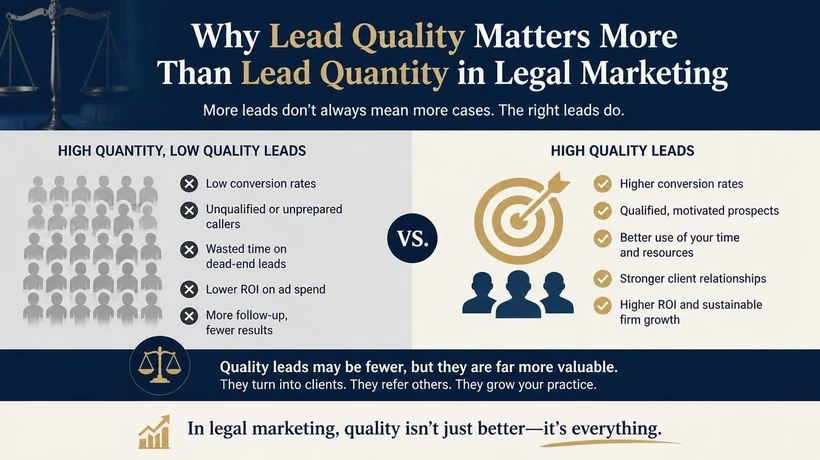
We will explore why lead quality matters more than lead quantity, how unqualified inquiries affect law firm growth, and which strategies can help legal practice
In today's competitive legal industry, attracting potential clients is only one part of building a successful law practice. Many law firms invest heavily in digital marketing, paid advertising, search engine optimization (SEO), and social media campaigns to generate a steady flow of inquiries. However, there is one important factor that often determines whether these marketing efforts produce meaningful results: lead quality.
Receiving hundreds of inquiries every month might seem like a sign of successful marketing. But what happens when most of those inquiries come from people who are not looking for the legal services your firm provides, cannot afford your services, or are simply gathering information without any intention of hiring an attorney?
A high volume of unqualified inquiries can consume valuable time, increase marketing expenses, overwhelm intake teams, and distract attorneys from their actual legal work. On the other hand, attracting a smaller number of relevant, interested, and qualified prospects can create better opportunities for consultations, signed cases, and long-term business growth.
This is why successful legal marketing should focus on attracting the right prospects rather than simply increasing the number of inquiries.
In this guide, we will explore why lead quality matters more than lead quantity, how unqualified inquiries affect law firm growth, and which strategies can help legal practices attract potential clients who are more likely to need and value their services.
1. Understanding the Difference Between Lead Quality and Lead Quantity
Before developing an effective client acquisition strategy, it is important to understand the difference between lead quality and lead quantity.
Lead quantity refers to the total number of potential client inquiries generated through marketing activities. Businesses offering law firm lead generation services help law practices attract these inquiries through website contact forms, phone calls, social media messages, paid advertisements, email campaigns, and other digital marketing channels.
Lead quality, meanwhile, measures how relevant and valuable those inquiries are to a particular law firm. A high-quality lead generally comes from someone who needs a service the firm offers, meets its basic client criteria, and has a genuine interest in discussing legal representation.
For example, imagine two personal injury law firms running separate digital marketing campaigns.
-
Law Firm A receives 200 inquiries in one month but converts only five into signed clients.
-
Law Firm B receives 50 inquiries in the same period and converts 15 into signed clients.
Although Law Firm A generates four times as many inquiries, Law Firm B secures three times as many clients.
Illustrative example, not industry benchmark data.
This demonstrates why generating more inquiries does not automatically translate into better business results.
The goal should not simply be to fill the sales pipeline. It should be to attract prospects who have a genuine need for the firm's legal expertise and are suitable for its services.
2. High-Quality Leads Improve Law Firm Conversion Rates
One of the biggest advantages of focusing on lead quality is the potential to improve conversion rates.
Every inquiry requires attention. Someone from the law firm's intake team may need to answer a phone call, respond to an email, review case details, schedule a consultation, or follow up with the prospect.
When most inquiries are irrelevant or unqualified, these activities consume considerable resources without producing meaningful outcomes.
High-quality leads are more likely to have a specific legal concern, understand the type of assistance they need, and be interested in discussing their situation with an attorney.
For instance, a family law practice specializing in divorce and child custody cases would benefit more from inquiries involving individuals actively seeking those services than from general questions about unrelated legal matters.
When marketing campaigns attract people who match the firm's practice areas, the intake process becomes more focused.
Attorneys can spend more time evaluating suitable cases, answering relevant questions, and building relationships with prospective clients.
Improved lead relevance does not guarantee conversion, but it can create better conditions for turning inquiries into paying clients.
3. Unqualified Leads Increase Marketing Costs
Generating inquiries requires investment. Whether a law firm uses Google Ads, social media advertising, content marketing, or SEO, every marketing channel involves financial or operational costs.
However, the actual cost of generating an inquiry is only one part of the equation.
Law firms must also consider how much they spend acquiring a client.
For example, suppose a law firm spends $5,000 on a marketing campaign and receives 100 inquiries.
At first glance, the campaign appears successful because the average cost per inquiry is $50.
However, if only five inquiries turn into signed clients, the firm has spent $1,000 in marketing for each acquired client.
Now consider another campaign that costs $4,000 and generates 40 inquiries. If 10 of those inquiries become clients, the acquisition cost is $400 per client.
Illustrative figures for explaining marketing efficiency.
|
Marketing metric |
Campaign A |
Campaign B |
|---|---|---|
|
Marketing spend |
$5,000 |
$4,000 |
|
Total inquiries |
100 |
40 |
|
Cost per inquiry |
$50 |
$100 |
|
Signed clients |
5 |
10 |
|
Cost per acquired client |
$1,000 |
$400 |
Campaign B generates fewer inquiries but delivers better acquisition efficiency.
This is why law firms should avoid evaluating marketing campaigns solely through cost per lead.
A campaign that generates inexpensive inquiries may actually be less profitable than one that attracts fewer but more relevant prospects.
Tracking cost per qualified lead and cost per acquired client provides a clearer picture of marketing performance.
4. Better Leads Help Attorneys Focus on Their Core Responsibilities
Attorneys have demanding professional responsibilities. Their time is often divided between client consultations, legal research, document preparation, court appearances, negotiations, and case management.
When a law firm's marketing campaigns generate large numbers of irrelevant inquiries, attorneys and administrative staff may spend hours dealing with prospects who are unlikely to become clients.
This creates unnecessary operational pressure.
Consider a criminal defense attorney receiving inquiries from individuals seeking immigration assistance, personal injury representation, or general legal information.
Even if the inquiries are genuine, they may fall outside the attorney's practice areas.
Responding to these requests takes time that could otherwise be spent helping existing clients or evaluating suitable cases.
A quality-focused marketing strategy helps minimize these distractions.
By targeting relevant audiences, creating specific service pages, and communicating the firm's expertise clearly, law practices can encourage more appropriate inquiries.
The result is a more organized intake process and better use of professional resources.
5. Lead Quality Helps Build a More Predictable Client Pipeline
Consistent client acquisition is essential for long-term law firm growth.
However, generating a large number of inquiries one month does not necessarily mean the firm will maintain a steady flow of new clients.
Marketing performance becomes more predictable when law firms understand which channels consistently attract qualified prospects.
For example, a law firm might discover that:
-
Organic search generates inquiries from people actively researching legal representation.
-
Google Ads attracts prospects looking for immediate assistance with specific legal problems.
-
Educational blog posts attract individuals researching legal options.
-
Referral partnerships introduce prospects who already have some level of trust in the firm.
-
Social media generates awareness but produces fewer direct consultations.
These insights help firms allocate resources more effectively.
Instead of investing equally in every marketing channel, they can prioritize the platforms and campaigns that produce relevant inquiries and meaningful client relationships.
A predictable pipeline is not necessarily the one with the highest number of leads. It is the one that consistently creates suitable opportunities for the firm.
6. Targeted Marketing Attracts Clients Who Need Your Specific Legal Services
Not every law firm serves the same audience.
A personal injury practice, estate planning firm, business law office, and family law practice have different target markets, client concerns, and service requirements.
Using generic marketing messages can attract a broad audience, but it may fail to connect with people who need a particular type of legal assistance.
Targeted marketing helps solve this problem.
Rather than promoting general legal services to everyone, law firms should create campaigns around their specific practice areas and the problems their ideal clients are trying to solve.
For example:
Personal injury law firms
-
People injured in car accidents.
-
Individuals dealing with workplace injury claims.
-
Victims seeking compensation after serious accidents.
Family law firms
-
Individuals considering divorce.
-
Parents dealing with child custody disputes.
-
People seeking assistance with spousal support matters.
Business law firms
-
Entrepreneurs establishing new companies.
-
Businesses negotiating commercial agreements.
-
Organizations dealing with regulatory or contractual issues.
The more accurately a law firm defines its target audience, the easier it becomes to create relevant advertising campaigns, website content, and search engine optimization strategies.
This improves the likelihood of attracting inquiries from people who genuinely need the firm's services.
7. Search Engine Optimization Plays an Important Role in Lead Quality
Search engine optimization is one of the most valuable long-term marketing strategies for law firms.
However, ranking for high-volume keywords does not always produce the most valuable inquiries.
A law firm's website may attract significant organic traffic from broad informational searches, but many visitors may not be interested in hiring an attorney.
For example, someone searching for "what does a lawyer do?" may simply be researching a general topic.
Meanwhile, someone searching for "employment discrimination attorney for workplace retaliation" may have a much more specific legal concern.
Both searches can bring visitors to a website, but their intent is different.
This is why legal SEO should focus on search intent rather than traffic volume alone.
An effective SEO strategy should include:
Practice-area landing pages: Develop dedicated pages for the legal services your firm provides. Clearly explain the issues you handle, your approach, and how prospective clients can contact your office.
Location-based SEO: Optimize relevant pages for the geographic areas your firm serves. Local search visibility can help connect your practice with nearby prospects.
Informational blog content: Publish useful articles that answer common legal questions and help readers understand when professional legal assistance may be appropriate.
Long-tail keywords: Target specific search queries that indicate a clearer legal need instead of focusing exclusively on broad, highly competitive terms.
Clear calls to action: Make it easy for visitors to request a consultation, call the office, or submit an inquiry.
Remember, the objective of legal SEO should not be to attract every possible visitor. It should be to connect the right audience with the right legal services.
8. A Strong Website Helps Filter Out Irrelevant Inquiries
A law firm's website often serves as the first point of contact for potential clients.
If the website does not clearly communicate what the firm does, who it serves, and which legal matters it handles, visitors may submit inquiries that do not match the firm's services.
A well-structured website can help prevent this problem.
Start by creating clear practice-area pages that explain the firm's services in straightforward language.
Include information about:
-
The legal issues the firm handles.
-
The types of clients it serves.
-
The geographic locations covered.
-
The firm's experience and professional qualifications.
-
The next steps for requesting legal assistance.
It is also useful to create a structured contact form.
Instead of asking visitors to provide only their name and phone number, consider including relevant preliminary questions such as:
-
What type of legal assistance are you seeking?
-
Where is your legal matter located?
-
When did the issue occur?
-
How would you prefer to be contacted?
These questions can help the intake team understand whether an inquiry aligns with the firm's services.
However, forms should remain simple and should not request unnecessary sensitive information. Confidential case details should be collected through appropriate secure communication processes.
9. Lead Qualification Makes the Intake Process More Effective
Generating relevant inquiries is important, but law firms also need an effective process for evaluating them.
Lead qualification helps determine whether a prospect is suitable for the firm's services before investing significant time in consultations and follow-ups.
An effective qualification process may consider several factors.
Practice-area relevance: Does the prospect need a service the firm actually provides?
Geographic eligibility: Does the matter fall within the firm's licensed jurisdictions and service areas?
Case suitability: Does the issue appear to align with the firm's experience and acceptance criteria?
Urgency: Does the prospect have an upcoming deadline or require timely legal assistance?
Engagement level: Is the individual willing to discuss their situation and explore the next steps?
Availability and capacity: Does the firm have the resources to take on the matter?
It is important to remember that preliminary qualification is not the same as determining whether a person has a valid legal claim.
Only an appropriate legal review can establish whether the firm should accept a matter.
A consistent intake process helps law firms prioritize inquiries, respond promptly, and avoid unnecessary administrative work.
10. Lead Quality Improves the Overall Client Experience
The quality of a law firm's marketing does not end when someone submits a contact form.
The experience continues through the first phone call, consultation, follow-up communication, and eventual onboarding process.
When prospects find a law firm through relevant content and clearly understand its services, their expectations are more likely to align with what the firm offers.
This can make initial conversations more productive.
For example, a prospect who discovers a family law practice through a detailed article about child custody arrangements may already understand the firm's area of expertise.
The consultation can then focus on the individual's circumstances, concerns, and possible next steps.
By contrast, someone who contacts the firm without understanding its services may require additional explanations before the conversation becomes productive.
A relevant marketing message helps establish expectations before the first interaction.
It also creates an opportunity for the law firm to demonstrate professionalism, communicate clearly, and build trust.
11. Use Data and Analytics to Measure Lead Quality
One of the biggest mistakes law firms make is measuring marketing success using surface-level metrics.
Website visits, advertisement clicks, impressions, and contact form submissions are useful indicators, but they do not reveal the complete picture.
To understand whether marketing activities are producing valuable opportunities, firms should track metrics throughout the client acquisition process.
Important metrics include:
|
Metric |
What it measures |
|---|---|
|
Total inquiries |
Number of prospects contacting the firm |
|
Qualified leads |
Inquiries matching the firm's target criteria |
|
Consultation rate |
Percentage of qualified leads booking consultations |
|
Consultation attendance rate |
Percentage of scheduled consultations attended |
|
Lead-to-client conversion rate |
Percentage of leads becoming clients |
|
Cost per qualified lead |
Marketing cost for each qualified inquiry |
|
Client acquisition cost |
Marketing and sales costs associated with acquiring a client |
|
Revenue per client |
Revenue generated from acquired clients |
These metrics provide a more complete understanding of marketing effectiveness.
For example, if a particular advertising campaign generates many inquiries but very few qualified prospects, the targeting, keywords, or messaging may need improvement.
Similarly, if qualified prospects frequently schedule consultations but rarely sign agreements, the firm may need to review its consultation experience, communication process, or service positioning.
The important thing is to identify where potential clients drop out of the acquisition process.
Data-driven decisions help law firms improve performance without simply increasing advertising budgets.
12. Why Marketing Agencies Should Prioritize Qualified Legal Prospects
Law firms frequently work with digital marketing agencies to improve their online visibility and generate new business opportunities.
However, marketing agencies should understand that their responsibilities extend beyond delivering a monthly report filled with inquiry numbers.
A successful marketing partnership should focus on business outcomes.
Agencies should work closely with law firms to understand their practice areas, ideal client profiles, geographic coverage, case acceptance criteria, and business objectives.
This information helps shape more effective campaigns.
For example, an agency managing advertising for a workers' compensation attorney should understand the difference between someone searching for general workplace safety information and someone actively looking for legal assistance after a workplace injury.
Campaign targeting, keyword selection, landing page content, and conversion tracking should reflect these differences.
Regular communication between the marketing agency and the firm's intake team is equally important.
The intake team can provide valuable feedback about the relevance of incoming inquiries, common questions, and reasons prospects do not move forward.
Using this information, marketing agencies can continuously refine campaigns and improve the quality of future inquiries.
Ultimately, the value of a marketing agency should be measured by its contribution to sustainable law firm growth rather than the number of contact forms it delivers.
13. Common Mistakes That Reduce Lead Quality in Legal Marketing
Even firms with substantial marketing budgets can struggle to attract relevant prospects.
Several common mistakes may contribute to the problem.
1. Targeting overly broad keywords
Broad search terms may attract visitors who have little intention of hiring an attorney. More specific, intent-focused keywords can improve relevance.
2. Using generic advertising messages
Advertisements that simply say "Contact Our Law Firm Today" may fail to communicate the firm's actual services. Specific messaging helps attract the right audience.
3. Ignoring negative keywords
In paid search campaigns, irrelevant search terms can consume advertising budgets. Regular search-term reviews and appropriate negative keywords help reduce unwanted traffic.
4. Sending every visitor to the homepage
A person searching for divorce representation should ideally land on a relevant family law page rather than a general homepage.
5. Failing to track conversions
Without proper tracking, law firms may continue investing in campaigns that generate inquiries but rarely produce clients.
6. Responding too slowly
Even highly relevant prospects may contact another law firm if their inquiries are not handled promptly. A reliable intake process is essential.
7. Focusing exclusively on short-term results
Law firms should balance immediate advertising opportunities with long-term strategies such as SEO, educational content, and reputation building.
Addressing these mistakes can help improve the relevance and effectiveness of legal marketing campaigns.
14. How to Build a Lead Quality-Focused Marketing Strategy
Improving lead quality requires a coordinated approach across marketing, website optimization, intake management, and performance tracking.
Here is a practical framework law firms can follow.
Step 1: Define your ideal client profile
Identify the legal services you want to promote, the clients you can serve, and the matters that align with your firm's capabilities.
Step 2: Understand your audience's search behavior
Research the questions, concerns, and search terms people use when looking for legal assistance.
Step 3: Create targeted marketing campaigns
Develop separate campaigns for different practice areas and audiences instead of using one generic campaign for all legal services.
Step 4: Optimize landing pages
Ensure every campaign directs visitors to a relevant page with clear service information, trust-building elements, and an appropriate call to action.
Step 5: Improve lead qualification
Establish a consistent intake process to identify relevant prospects and prioritize follow-ups.
Step 6: Monitor marketing performance
Track qualified inquiries, consultations, signed clients, acquisition costs, and other meaningful business metrics.
Step 7: Refine campaigns regularly
Use feedback from attorneys and intake teams to identify which campaigns produce the best opportunities.
This approach allows law firms to move away from volume-based marketing and develop a more sustainable client acquisition system.
Conclusion: Focus on Better Leads, Not Just More Leads
Generating a large number of inquiries may look impressive in a marketing report, but it does not necessarily indicate business success.
For law firms, meaningful growth comes from attracting prospects who genuinely need their services, match their practice areas, and are interested in exploring legal representation.
High-quality leads can improve conversion opportunities, reduce wasted marketing expenses, make intake operations more efficient, and help attorneys focus on their professional responsibilities.
From targeted SEO campaigns and optimized landing pages to better lead qualification and data-driven decision-making, every part of a law firm's marketing strategy should contribute to attracting more relevant prospects.
The most successful legal marketing strategies are not necessarily those that generate the most inquiries. They are the ones that consistently connect the right people with the right legal services.
Instead of asking how many leads your marketing campaigns generate, start asking a more important question: How many of those leads have the potential to become valuable clients?
That shift in perspective can make a significant difference in how your law firm approaches marketing, measures performance, and plans for long-term growth.



Comments
Login to Comment