Who Can Benefit from a Coding Interview Assistant?
17 Aug, 2026
583 Views 0 Like(s)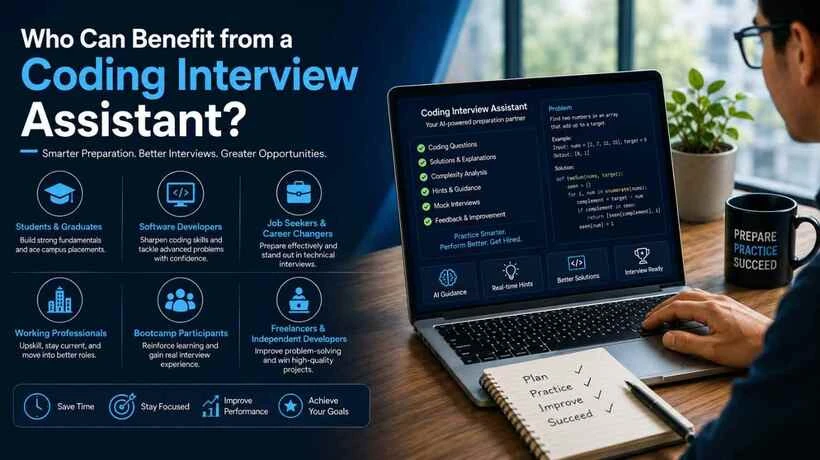
See who can benefit from AI coding interview assistants and how structured practice can improve technical skills, communication, speed, and confidence.
Coding interviews can challenge even capable developers because they test problem-solving, technical communication, coding accuracy, and time management simultaneously. Preparation often becomes difficult when candidates lack realistic questions, consistent feedback, or someone available for repeated mock sessions. Coding interview assistants can make practice more structured by simulating technical questions, reviewing approaches, and encouraging candidates to explain decisions clearly. However, these tools do not serve only beginners. Students, experienced engineers, career changers, returning professionals, and senior developers can use them differently based on their goals, weaknesses, target roles, and interview formats.
What Does a Coding Interview Assistant Actually Do?
A coding interview assistant supports structured preparation for technical hiring processes. Depending on its capabilities, it may present programming questions, conduct simulated interview conversations, provide hints, evaluate proposed solutions, ask follow-up questions, or offer feedback on communication and problem-solving.
Moreover, candidates can use these systems repeatedly without coordinating another person's schedule. That flexibility makes them particularly useful for people who need frequent practice or have limited access to technical mentors.
Typical capabilities may include:
-
Generating coding questions based on selected difficulty levels
-
Simulating interviewer-style follow-up questions
-
Reviewing problem-solving approaches
-
Identifying potential logical errors
-
Discussing time and space complexity
-
Practicing data structures and algorithms
-
Evaluating explanations before coding begins
-
Supporting timed mock interview sessions
-
Highlighting areas that need additional practice
-
Encouraging clearer technical communication
However, candidates should treat automated feedback as support rather than unquestionable authority. AI systems can produce incorrect suggestions. Therefore, users should verify technical concepts when accuracy matters.
Computer Science Students Preparing for Their First Interviews
Students often represent one of the clearest groups that can benefit from coding interview assistants. Academic coursework may build programming knowledge, but technical hiring processes require candidates to apply that knowledge under strict time constraints while communicating their reasoning.
Consequently, students need more than familiarity with algorithms. They need repeated exposure to interview-style situations.
Bridging the Gap Between Coursework and Interviews
University assignments usually provide detailed requirements and longer completion periods. In contrast, coding interviews may present unfamiliar problems and expect candidates to clarify requirements, propose an approach, code efficiently, test edge cases, and explain complexity within a short session.
An assistant can recreate parts of that pressure through timed exercises and follow-up questions. Moreover, students can practice explaining why they selected one data structure instead of another.
Regular practice can strengthen several abilities:
-
Breaking unfamiliar problems into manageable components
-
Asking useful clarification questions
-
Selecting appropriate algorithms
-
Explaining tradeoffs clearly
-
Testing code systematically
-
Recognizing common edge cases
-
Managing limited interview time
As a result, students can become more familiar with the interview process before facing recruiters or engineering teams.
Self-Taught Developers Seeking Technical Roles
Self-taught programmers may possess strong practical skills while having uneven exposure to traditional computer science topics. For example, a developer might build functional applications but feel less comfortable discussing graph traversal, dynamic programming, complexity analysis, or advanced data structures.
Therefore, targeted interview practice can reveal knowledge gaps before an actual hiring process does.
Creating Structure Without a Formal Curriculum
A coding assistant can help self-taught developers organize preparation into categories instead of randomly solving programming challenges. Candidates can divide practice among arrays, strings, linked lists, trees, graphs, recursion, sorting, searching, and system-oriented concepts relevant to their target positions.
Moreover, an ai mock coding interview assistant can provide a repeatable environment for practicing explanations alongside code. That distinction matters because interviewers often evaluate reasoning rather than merely checking whether a candidate reaches the correct output.
Structured practice can also prevent candidates from spending excessive time on familiar technologies while ignoring weaker fundamentals.
Bootcamp Graduates Entering the Hiring Market
Coding bootcamps often emphasize practical software development, teamwork, projects, and job-ready skills. However, graduates may still need additional preparation for algorithm-heavy interviews or unfamiliar technical questioning styles.
Coding interview assistants can provide scalable repetition after formal training ends.
Strengthening Interview Readiness After Graduation
Bootcamp graduates can use simulated interviews to move beyond memorized problem patterns. Instead of immediately searching for solutions when stuck, candidates can practice thinking through ambiguity and communicating partial progress.
Moreover, assistants can present variations of familiar problems. A candidate who solves a standard array question, for example, might receive a follow-up that changes memory constraints or input size.
This variation encourages flexible reasoning.
Useful practice areas include:
-
Algorithm selection
-
Complexity analysis
-
Debugging
-
Edge-case identification
-
Verbal reasoning
-
Code readability
-
Requirement clarification
-
Solution optimization
Consequently, graduates can use practice sessions to identify whether they truly grasp a concept or simply recognize familiar problem formats.
Career Changers Moving Into Software Development
Professionals transitioning from another field often face two simultaneous challenges. They must develop technical competence while becoming comfortable with hiring conventions that differ from those in their previous careers.
Therefore, coding interview assistants can provide a private environment for repeated practice without the pressure associated with formal interviews.
Building Familiarity Through Repetition
Career changers may initially struggle with technical vocabulary, whiteboard-style thinking, complexity discussions, or explaining code aloud. Repetition can make these behaviors feel more natural.
Moreover, their previous professional backgrounds may provide valuable transferable skills such as communication, project management, analytical thinking, or domain expertise. Effective preparation helps candidates connect those strengths with newly developed technical abilities.
A focused practice routine can include:
-
Reviewing one technical concept.
-
Solving an interview-style problem.
-
Explaining the proposed approach before coding.
-
Writing and testing the solution.
-
Reviewing complexity.
-
Identifying mistakes.
-
Repeating a related problem later.
Consequently, preparation becomes measurable rather than dependent on vague feelings of readiness.
Junior Developers Seeking Better Opportunities
Developers with one or two professional roles behind them may still face algorithmic interviews that differ significantly from their daily responsibilities.
A junior engineer might regularly build APIs, fix defects, review pull requests, or develop user interfaces without frequently implementing classic algorithms from scratch. Therefore, interview preparation may require refreshing concepts that rarely appear directly in routine development.
Refreshing Skills Efficiently
Coding assistants can identify weaker categories through repeated practice. If a candidate performs well with arrays and hash maps but struggles with trees or recursion, preparation can shift accordingly.
Moreover, junior developers can practice explaining professional engineering decisions alongside algorithmic solutions. Clear communication often separates candidates who merely produce working code from candidates who demonstrate thoughtful engineering judgment.
Practice can focus on:
-
Choosing suitable data structures
-
Improving inefficient solutions
-
Discussing alternative approaches
-
Explaining code clearly
-
Testing boundary conditions
-
Recovering after mistakes
As a result, junior developers can prepare more strategically for their next career move.
Experienced Engineers Returning to the Job Market
Experienced developers can also benefit significantly from interview assistants. Years of professional engineering do not automatically translate into comfort with coding challenges.
In fact, senior professionals may spend more time designing systems, reviewing architecture, mentoring teams, coordinating projects, and making technical decisions than solving isolated algorithm exercises.
Rebuilding Interview-Specific Fluency
A coding assistant can help experienced engineers refresh interview-specific skills without treating them like beginners. Practice can focus on advanced follow-up questions, optimization decisions, architectural reasoning, and communication.
Moreover, experienced candidates often need to demonstrate why they make particular technical choices. A correct solution alone may not reveal senior-level judgment.
They may benefit from practicing questions involving:
-
Performance tradeoffs
-
Scalability
-
Reliability
-
Maintainability
-
API design
-
Concurrency
-
Database decisions
-
System boundaries
-
Failure scenarios
-
Engineering leadership
Consequently, AI-assisted sessions can supplement coding practice with deeper reasoning expected at higher levels.
Candidates Who Struggle With Technical Communication
Some developers can solve difficult problems independently yet struggle to explain their thinking while coding. Interviews can expose this gap because interviewers often need visibility into the candidate's reasoning.
Silence creates uncertainty. However, constant unstructured talking can make an answer equally difficult to follow.
Practicing Clear Explanations
Coding assistants can encourage candidates to explain an approach before implementation. Moreover, follow-up prompts can test whether the explanation remains logically consistent.
A strong technical explanation generally communicates:
-
What the problem requires
-
Which assumptions matter
-
What approach the candidate proposes
-
Why that approach fits
-
What alternatives exist
-
What complexity the solution introduces
-
Which edge cases require attention
Consequently, repeated verbal practice can help candidates communicate more deliberately without turning every thought into a lengthy monologue.
Candidates Who Experience Time Pressure
Many candidates know how to solve coding problems but lose valuable minutes because they hesitate, overthink, rewrite solutions, or spend too long pursuing an inefficient approach.
Timed mock sessions can make those habits visible.
Developing Better Interview Pacing
Candidates can divide a practice interview into phases: clarification, solution planning, implementation, testing, and optimization. Consequently, they gain a clearer sense of how long each phase should take.
An efficient sequence may look like this:
-
Clarify requirements and constraints.
-
Describe a straightforward solution.
-
Evaluate its complexity.
-
Consider a stronger approach.
-
Implement cleanly.
-
Test common and unusual cases.
-
Discuss potential improvements.
Moreover, repeated timed practice reduces the temptation to begin coding immediately. A few minutes of structured planning can prevent expensive rewrites later.
Better pacing does not mean rushing. Instead, it means allocating enough attention to every stage of the problem.
Developers Preparing for Remote Technical Interviews
Remote interviews introduce additional demands. Candidates may need to navigate collaborative coding environments, communicate through video, manage screen sharing, and maintain conversational flow without the physical cues available during an onsite session.
Therefore, remote candidates can benefit from practicing in a digital environment.
Making Online Interaction Feel More Natural
AI-assisted mock sessions can encourage candidates to become comfortable speaking while working at a computer. Moreover, they can practice pausing to clarify questions rather than silently interpreting ambiguous requirements.
Remote preparation should also address practical habits:
-
Keep the coding environment organized.
-
Practice verbal explanations while typing.
-
Avoid relying heavily on autocomplete.
-
Test microphone and camera settings beforehand.
-
Keep notifications disabled.
-
Maintain readable code formatting.
-
Confirm assumptions before implementation.
-
Leave time for testing.
Consequently, technical ability remains the focus instead of preventable communication or environment problems.
Developers Interviewing in a Second Language
Technical interviews become more demanding when candidates must communicate in a language they use less frequently. The candidate may know the solution yet need additional time to express technical reasoning precisely.
Coding assistants can provide repeated opportunities to practice technical vocabulary and concise explanations.
Improving Clarity Without Memorizing Scripts
Candidates can rehearse common explanations for complexity, data structures, tradeoffs, assumptions, and testing. However, memorizing complete scripts can make responses sound rigid.
Instead, candidates can practice flexible sentence patterns around genuine technical reasoning. Moreover, repeated questioning can help them become comfortable responding when an interviewer phrases a familiar concept differently.
The objective remains clear communication rather than perfect language. Consequently, candidates should prioritize accurate reasoning, understandable explanations, and appropriate terminology over unnecessarily complicated vocabulary.
Candidates Without Access to Human Mock Interviewers
Not every developer has mentors, senior engineers, classmates, or peers available for regular practice. Scheduling can also become difficult across work commitments and time zones.
AI-based practice can fill part of that availability gap.
Making Repeated Practice More Accessible
Candidates can run short sessions whenever they have available time. Moreover, they can repeat difficult questions without worrying about consuming another person's time.
This accessibility supports consistent practice, but human feedback still offers important value. People can notice interpersonal behaviors, communication nuances, and contextual signals that automated evaluation may miss.
Therefore, candidates should combine both methods when possible. AI can provide frequency and repetition, while human mock interviews can add nuanced feedback.
Senior and Staff-Level Engineering Candidates
Senior technical interviews frequently extend beyond algorithm accuracy. Interviewers may assess architectural judgment, tradeoff analysis, leadership, ambiguity management, and the ability to communicate complex decisions.
Consequently, advanced candidates need practice that reflects those expectations.
Practicing Deeper Technical Reasoning
Senior candidates can use AI simulations to challenge assumptions and generate follow-up scenarios. For instance, an initial design may work for moderate traffic, while a follow-up introduces substantially higher scale, regional availability, or stricter latency requirements.
Useful areas include:
-
System design reasoning
-
Architecture tradeoffs
-
Capacity planning
-
Reliability strategies
-
Data consistency
-
Observability
-
Security considerations
-
Cost implications
-
Migration planning
-
Technical leadership decisions
Moreover, candidates can practice defending choices without presenting them as universally correct. Senior engineering often involves evaluating competing priorities rather than finding one perfect answer.
People Who Need More Consistent Practice
Consistency frequently matters more than occasional marathon preparation. Solving twenty problems on one weekend may produce less durable improvement than practicing regularly across several weeks.
Coding interview assistants can make shorter sessions easier to maintain.
Building a Sustainable Routine
Candidates can organize practice by weekly themes and gradually increase difficulty. For example, one week might emphasize arrays and hash maps, while another focuses on trees and graphs.
A balanced weekly routine could include:
-
Two focused problem-solving sessions
-
One timed mock interview
-
One review of previous mistakes
-
One technical communication session
-
One lighter session covering weak concepts
Moreover, maintaining a mistake log can make future sessions more productive. Candidates can record the concept missed, why the initial approach failed, and what signal should trigger a better approach next time.
Consequently, mistakes become reusable preparation material rather than isolated failures.
When a Coding Interview Assistant Provides Less Value
Coding assistants are not equally useful in every situation. Candidates who rely on them for immediate answers can weaken the very reasoning skills interviews aim to evaluate.
Moreover, constant hints can create an illusion of progress. Solving a problem after receiving several prompts differs substantially from solving it independently.
Candidates should avoid:
-
Requesting solutions before attempting problems
-
Copying generated code without analyzing it
-
Memorizing solutions without grasping the reasoning
-
Trusting every technical statement automatically
-
Using assistance when interview rules prohibit it
-
Sharing confidential or proprietary information
-
Practicing only familiar problem categories
Therefore, candidates should use AI primarily for preparation, structured feedback, questioning, and repetition.
How to Get More Value From AI-Assisted Practice
Effective use requires deliberate goals. Candidates should know what each practice session aims to improve before starting.
For example, one session might focus entirely on communication, while another emphasizes optimization or speed.
A productive process involves:
-
Select one measurable objective.
-
Attempt the problem independently.
-
Explain the reasoning before requesting feedback.
-
Review only the most important weaknesses.
-
Solve a related problem without assistance.
-
Record the lesson.
-
Revisit the concept after several days.
Moreover, candidates should periodically complete full mock sessions without hints. Independent performance provides a more realistic picture of readiness.
Conclusion
Coding interview assistants can benefit candidates across nearly every career stage, from students and self-taught developers to senior engineers preparing for demanding technical roles. Their greatest value comes from accessible repetition, structured questioning, targeted feedback, and realistic practice. However, candidates gain more when they attempt problems independently, verify technical information, and avoid relying on constant hints. Moreover, combining automated practice with human feedback can create stronger preparation. When candidates use these tools responsibly, they can sharpen problem-solving, improve technical communication, manage interview time more effectively, and approach coding assessments with a clearer, more organized strategy.
FAQs
Can beginners use a coding interview assistant?
Yes. Beginners can use one to practice basic problem decomposition, programming concepts, data structures, and communication. However, they should start with manageable questions rather than advanced challenges. Moreover, beginners should attempt each problem independently before requesting hints so that practice develops genuine reasoning rather than dependence on generated solutions.
Are coding interview assistants useful for experienced developers?
Yes. Experienced engineers can use them to refresh algorithmic skills, practice system design, rehearse technical explanations, and prepare for unfamiliar interview formats. Moreover, senior candidates can request deeper follow-up questions involving scalability, architecture, reliability, and tradeoffs. Practice should reflect the responsibilities and expectations of the target role.
Can AI replace a human mock interviewer?
AI can provide convenient repetition, flexible scheduling, and structured prompts, but it cannot fully replace human feedback. Human interviewers can evaluate interpersonal communication, conversational nuance, and reactions more naturally. Consequently, candidates can use AI for frequent practice while adding human mock sessions when suitable partners or mentors remain available.
Can coding interview assistants improve problem-solving speed?
They can support faster problem solving through timed sessions, pattern practice, and targeted feedback. However, candidates should prioritize accurate reasoning before speed. Repeated practice can help them recognize common problem structures more quickly. Consequently, they may spend less time considering unsuitable approaches during actual technical interviews.
Do coding interview assistants help with system design interviews?
Some can support system design preparation by presenting scenarios and challenging architectural decisions. Candidates can practice discussing scalability, databases, caching, reliability, consistency, security, and operational tradeoffs. However, users should verify questionable technical claims. System design rarely has one correct solution, so thoughtful reasoning matters more than memorized architectures.
Can a coding interview assistant help with communication skills?
Yes. Candidates can practice explaining requirements, proposed solutions, complexity, edge cases, and tradeoffs before writing code. Moreover, repeated questioning encourages clearer technical reasoning. The goal should not involve memorizing polished scripts. Instead, candidates should develop the ability to communicate genuine reasoning naturally while adapting to interviewer follow-up questions.
Should candidates use AI during an actual coding interview?
Candidates should follow every rule established by the employer or assessment provider. Using unauthorized assistance can violate interview requirements and misrepresent ability. Consequently, AI offers its strongest value during preparation. Independent interview performance allows candidates to demonstrate their own reasoning, technical knowledge, communication, and problem-solving skills accurately.
How often should someone practice coding interviews?
Frequency depends on skill level, available preparation time, and interview difficulty. However, regular focused sessions generally create better structure than occasional long sessions. Candidates can alternate problem solving, timed mocks, concept review, and mistake analysis. Moreover, rest and spaced repetition can prevent preparation from becoming repetitive or mentally exhausting.
What programming languages can candidates practice with?
Available languages depend on the tool, but candidates should generally practice in the language they plan to use during interviews. Familiarity reduces unnecessary syntax mistakes and frees attention for problem solving. Moreover, candidates should know standard data structures, common library operations, and complexity characteristics within their chosen language.
How can candidates tell whether AI feedback is accurate?
Candidates should compare questionable feedback with trusted technical knowledge and test code independently. Moreover, they should examine whether suggestions actually satisfy constraints, handle edge cases, and improve complexity. AI can make confident mistakes. Therefore, critical evaluation remains essential, particularly for advanced algorithms, concurrency, security, and architecture decisions.

Comments
Login to Comment