Wellness Center Marketing: How to Find What's Blocking Your Growth
17 Aug, 2026
579 Views 0 Like(s)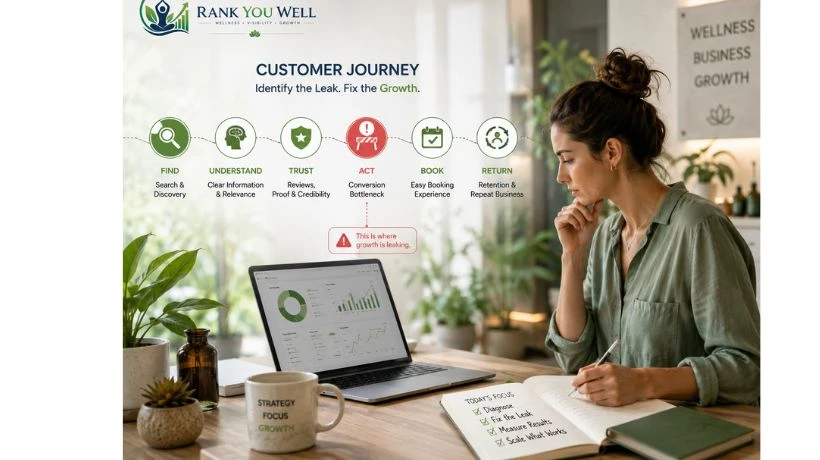
The biggest mistake in wellness marketing is treating every growth problem as a traffic problem. Before adding another channel, identify where the customer journey is breaking — discovery, trust, enquiry, booking, show-up, or retention. Fixing the actual constraint first makes marketing more efficient and turns visibility into measurable business growth.
A wellness business can be doing plenty of marketing — from its website, social media, blogs, and ads — and still struggle to generate consistent enquiries. The real issue may not be a lack of marketing, but a break somewhere in the customer journey. People can drop off at discovery, understanding, trust, enquiry, booking, show-up, or retention, and each stage points to a different problem. Before adding another marketing channel, identify where customers are being lost and fix that specific stage first.
Not finding you at all
Visibility now has two fronts. Traditional search: check whether your top pages match what people actually search, and whether your Google Business Profile shows up for "[service] near me." AI search: ask ChatGPT or Perplexity the question a customer would ask. If you're not mentioned, the fastest lever is getting listed and reviewed on the directories AI engines cite, plus adding FAQ content that directly answers common questions. A strong wellness center marketing should account for both traditional and AI-driven discovery, so the business is easier to find wherever potential customers begin their search.
Found you, don't get it
If a visitor can't tell within two sentences whether a service page is for them, rewrite the opening. Swap "holistic, transformative care" for the actual service, who it's for, and one concrete detail (duration, outcome, requirement). Clarity beats persuasive language every time here.
Traffic but no enquiries
More traffic isn't more customers if it's not reaching the booking decision. Put the booking link in the header on every page, move your best reviews next to the CTA instead of the bottom of the page, and replace vague buttons ("Learn More") with specific ones ("Check Availability"). If visitors aren't reaching the booking decision, examine the path between the landing page and the intended action.
Keep important booking or enquiry options easy to find.Even small changes can reduce unnecessary friction:
-
Use specific calls to action.
-
Make booking options easy to locate.
-
Explain what happens after someone enquires.
-
Answer common objections before asking for a commitment.
-
Ensure important pages work properly on mobile.
Enquiries but no bookings
This stage requires a different diagnosis.
Someone who has already enquired has demonstrated intent. The opportunity now is to help them progress.
An appropriate nurture sequence might provide:
-
Relevant pricing or package information
-
Answers to common questions
-
A useful testimonial or review
-
Clarification about what happens next
-
A direct booking option
The timing matters too. A response that arrives long after the enquiry may lose momentum.
If good enquiries still aren't becoming bookings after the marketing process has been improved, look at the operational side: response speed, staff availability, sales conversations, pricing clarity, or the actual customer experience.
Not every conversion problem is a marketing problem.

Bookings but no shows
Set up an automated confirmation plus a reminder 24 hours out, and a second one for anything booked more than a week ahead. If one specific service has a chronic no-show problem, check whether its page description matches the actual appointment — a mismatch shows up as no-shows before it shows up as complaints.
Customers who don't return
Build one automated post-visit sequence: a check-in at 24–48 hours, a review request while it's fresh, then a rebooking or reorder prompt timed to when the next visit is due. Run a small campaign specifically to past customers who haven't returned — most wellness marketing only chases new traffic and ignores this audience entirely.
The fix underneath all of this
If different vendors run your ads, site, and reviews with nobody tracking which one actually produces booked revenue, none of the fixes above will be measurable. Build one simple sheet - source, enquiry date, booked date, show-up, repeat — per new customer. It's the single highest-leverage thing on this list because it shows which fix is actually working.
Prioritize by constraint:
Once the journey is mapped, prioritize the weakest stage rather than trying to improve everything simultaneously.
-
Weak visibility → fix discoverability first.
-
Strong visibility, weak trust → add proof.
-
Strong trust, weak conversion → fix the CTA path.
-
Strong enquiries, weak bookings → add nurture.
-
Strong bookings, weak show-up → add reminders.
-
Strong show-up, weak retention → add post-visit marketing.
Conclusion:
A wellness marketing strategy gets stronger when each piece solves a specific, identified leak — not when it has more channels. Find the stage that's breaking, fix that one thing, and measure it before adding anything new.
For wellness businesses connecting search visibility, AI search presence, content, and local SEO with measurable growth, Rank You Well builds strategy around the actual customer journey.
Frequently Asked Questions
How do I know if my wellness marketing strategy is working?
Look past traffic and likes. Track movement in AI-search mentions, qualified enquiries, bookings, show-up rate, and repeat business — not just clicks.
Why does my wellness business get traffic but few enquiries?
Usually unclear service pages, weak trust signals near the CTA, or a booking option that's hard to find — not a traffic shortage.
Why are my leads not turning into bookings?
Retargeting and an automated nurture sequence fix most of this. If it still stalls, the gap is response speed — a staffing issue outside marketing's control.
Why do people book but not show up?
Usually no reminder sequence, or the service page sets an expectation the appointment doesn't match.
Should I worry about AI search like ChatGPT?
Increasingly yes — a growing share of wellness research happens inside AI assistants, and local businesses are currently under-represented there compared to Google. Check whether you're mentioned before investing further.
Should I focus on SEO or social media?
Neither by default. Identify which stage is leaking first, then pick the channel that fixes that specific stage.
What's the biggest mistake in wellness marketing?
Treating every growth problem as a visibility problem. More traffic can't fix unclear positioning, weak trust, no nurture, or a poor show-up rate.


Comments
Login to Comment