Top 5 DPDP Consent Management Platforms in India
24 Apr, 2026
1965 Views 0 Like(s)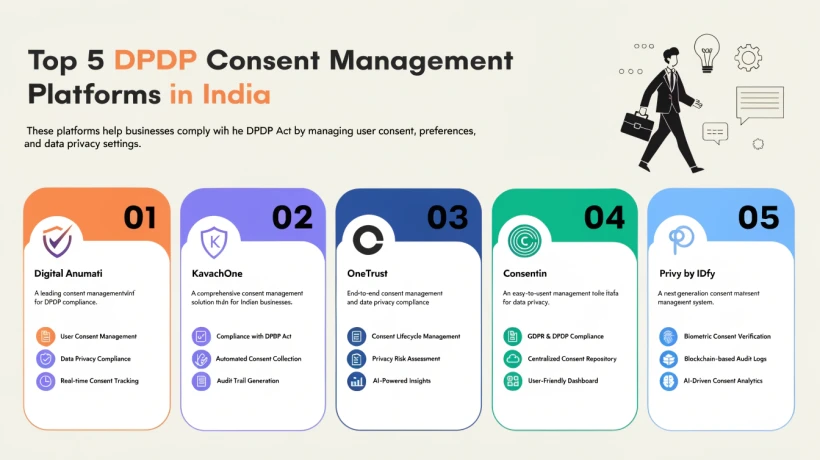
India is entering a new era of data responsibility. With the Digital Personal Data Protection (DPDP) Act, 2023 now shaping how organizations collect, process, and manage personal data, consent is no longer a backend formality—it’s a frontline business priority.
India is entering a new era of data responsibility. With the Digital Personal Data Protection (DPDP) Act, 2023 now shaping how organizations collect, process, and manage personal data, consent is no longer a backend formality—it’s a frontline business priority.
For companies operating in India, this shift raises an urgent question: How do you operationalize consent at scale while staying compliant and building user trust?
The answer lies in adopting a robust Consent Management Platform (CMP). In this blog, we explore the evolving consent landscape and highlight five leading CMPs in India—while helping you understand what truly matters when choosing one.
Why Consent Management Is Now Business-Critical?
The DPDP Act introduces a clear standard: consent must be free, specific, informed, unconditional, and unambiguous.
But beyond legal language, this translates into real operational challenges:
-
How do you capture consent across multiple touchpoints?
-
Can users easily withdraw consent anytime?
-
Are you maintaining verifiable audit trails?
-
Is your consent experience understandable in regional languages?
Without the right systems in place, compliance becomes fragmented—and risk increases.
A modern CMP solves this by acting as a centralized layer for consent governance, ensuring every user interaction aligns with regulatory expectations.
What to Look for in a DPDP Consent Management Platform?
A strong platform should offer:
1. Purpose-Led Consent Architecture
Consent should not be bundled. Each purpose—marketing, analytics, personalization—must be clearly defined and independently approved.
2. Real-Time Consent Tracking
Businesses need visibility into when, where, and how consent was obtained.
3. Easy Withdrawal Mechanisms
Users should be able to revoke consent as easily as they give it.
4. Audit-Ready Logs
Every consent action must be recorded and retrievable for compliance checks.
5. Multi-Language Support
India’s diversity demands interfaces that work across languages—not just English.
6. Seamless Integration
The CMP should integrate effortlessly with websites, apps, CRMs, and data systems.
Top 5 DPDP Consent Management Platforms in India
1. Digital Anumati
Digital Anumati is a purpose-built, India-first consent management platform designed to simplify DPDP compliance without adding operational complexity.
It focuses on making consent clear, accessible, and actionable—both for businesses and users.
What sets it apart
Digital Anumati is built with a deep understanding of India’s regulatory and digital ecosystem. Instead of adapting global frameworks, it starts with local compliance needs at its core.
Key strengths
-
Simple and fast deployment
-
Real-time consent lifecycle management
-
Multi-language support tailored for Indian users
-
Strong audit and reporting capabilities
-
API-first architecture for easy integration
Why it matters
For growing businesses, compliance often feels overwhelming. Digital Anumati reduces that friction by offering a platform that is intuitive, scalable, and aligned with DPDP from day one.
2. KavachOne (ConsentiQo)
KavachOne provides a structured approach to consent through its ConsentiQo platform, focusing on detailed consent lifecycle management.
Key strengths
-
Granular, purpose-specific consent capture
-
Built-in analytics dashboards
-
Cookie and tracker management
-
Data subject rights handling
Where it fits
Organizations that require deep visibility and structured workflows for consent management will find this platform useful.
3. OneTrust
OneTrust is a globally recognized privacy platform that supports multiple regulations, including DPDP.
Key strengths
-
Enterprise-grade compliance features
-
Data mapping and governance tools
-
Wide regulatory coverage
Where it fits
Large enterprises operating across multiple geographies may benefit from its broad compliance capabilities, though it often comes with higher complexity and cost.
4. Consentin
Consentin is designed for speed and simplicity, making it appealing to product and engineering teams.
Key strengths
-
Quick and lightweight implementation
-
Developer-friendly integrations
-
Clean, minimal user experience
Where it fits
Startups and digital-first companies that want to deploy quickly without heavy overhead often prefer this approach.
5. Privy by IDfy
Privy goes beyond consent management and positions itself as a broader privacy governance platform.
Key strengths
-
End-to-end privacy management
-
Data discovery and monitoring
-
Risk and incident management
Where it fits
Enterprises with complex data ecosystems may require a comprehensive privacy stack, not just consent capture.
Choosing the Right Platform: A Strategic Decision
Not all CMPs are built the same—and the “best” choice depends on your organization’s maturity, scale, and priorities.
-
If you need speed and simplicity, lightweight solutions may work
-
If you need deep governance, enterprise platforms are more suitable
-
If your focus is India-specific compliance with scalability, a purpose-built solution becomes critical
The key is to choose a platform that doesn’t just solve today’s compliance needs—but can evolve with your business.
The Bigger Picture: Consent as a Trust Layer
The DPDP Act is not just about avoiding penalties.
It’s about redefining the relationship between businesses and users.
When handled correctly, consent becomes:
-
A signal of transparency
-
A foundation for trust
-
A competitive advantage
Organizations that embrace this shift early will stand out—not just as compliant, but as responsible data stewards.
Final Thoughts
As India’s digital economy grows, consent management will move from a compliance checkbox to a core business function.
The right platform can help you:
-
Simplify compliance
-
Reduce operational risk
-
Improve user trust
-
Scale responsibly
In this evolving landscape, solutions that combine local relevance, ease of use, and strong compliance foundations will lead the way.



Comments
Login to Comment