Top 10 Best ERP Software for Apparel Manufacturers in India
24 Aug, 2026
484 Views 0 Like(s)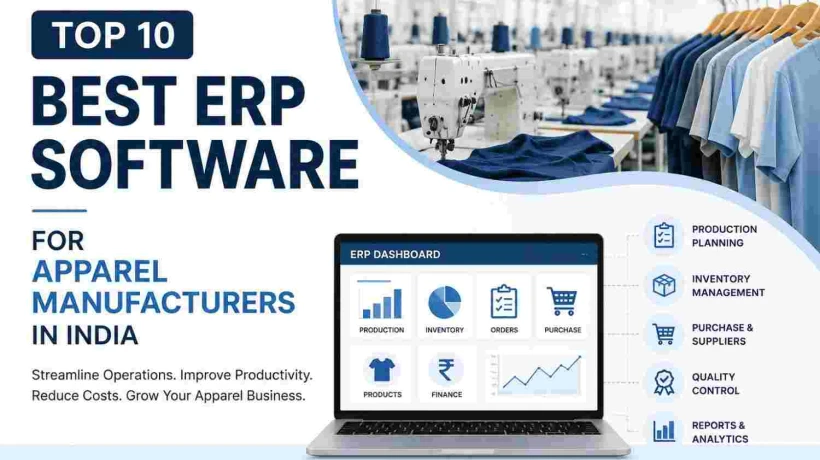
Discover the top ERP software for apparel manufacturers in India. Compare features for production, costing, inventory, and more.
The apparel manufacturing business has many moving parts. A single order can involve product development, fabric and trims, costing, purchasing, production planning, quality checks, inventory, shipping, and finance. When these activities are managed through spreadsheets and separate systems, it becomes difficult to get a clear picture of what is happening.
This is why more apparel manufacturers are looking at ERP software for the apparel industry. A good ERP system brings important business processes together and gives teams access to the same information.
But choosing an ERP for an apparel manufacturing company is not the same as choosing software for a regular manufacturing business. Apparel companies deal with styles, colors, sizes, seasons, changing buyer requirements, fabric consumption, complex bills of materials, production lines, subcontractors, and tight delivery schedules.
1. WFX (World Fashion Exchange)
WFX (World Fashion Exchange) is the Best ERP Software for Apparel Manufacturers in India because it is built specifically for the fashion and apparel industry.
Unlike a general ERP that needs to be adapted to apparel processes, WFX provides industry-specific modules covering costing, customer orders, material planning, procurement, inventory, quality, production, shipping, accounting, and financials.
For apparel manufacturers, this can help connect the entire process from product development and costing to material procurement, factory production, quality control, and shipment.
WFX also supports production planning and factory operations. Its planning platform connects ERP, PLM, MES, and factory operations so that product information, orders, materials, and production updates can work from a shared data environment.
Another benefit is its cloud-based setup, which can be useful for manufacturers managing multiple factories, offices, suppliers, or locations.
2. BlueKaktus
BlueKaktus is another software platform focused on the fashion and apparel industry. It combines ERP and MES capabilities with supply chain tools designed for apparel manufacturers.
Its manufacturing solution brings together areas such as merchandising, procurement, production, finance, shipping, and vendor collaboration.
This can be useful for factories where production teams, merchandising teams, procurement, and finance often work with separate data.
BlueKaktus also focuses on real-time production visibility and supply chain performance. For manufacturers trying to improve lead times, inventory management, and production control, it is worth considering.
3. Aptean Apparel ERP
Aptean offers ERP software specifically designed for the fashion and apparel industry. Its solutions are built for apparel brands, wholesalers, manufacturers, and other fashion businesses.
Aptean's apparel ERP supports areas such as production, inventory, sourcing, financials, and distribution. Its platform is designed around the seasonal nature of fashion, complex SKUs, and changing product cycles.
Aptean also offers solutions that connect ERP with PLM and shop-floor control. This can help companies that want to manage product development and manufacturing through connected systems.
For larger apparel businesses with more complex operations, Aptean can be a strong option.
4. SAP S/4HANA for Fashion
SAP is one of the biggest names in enterprise software, and SAP S/4HANA for Fashion is designed for companies operating across fashion manufacturing, wholesale, and retail.
The platform includes fashion-specific style, color, and size logic, along with manufacturing, supply chain, analytics, and financial capabilities.
For a large apparel manufacturer with several business units, factories, markets, or distribution channels, SAP can provide a broad enterprise platform.
The main point to consider is implementation. SAP is generally more suitable for organizations that have the resources and internal teams needed to manage a large ERP implementation.
5. Oracle NetSuite
Oracle NetSuite is a cloud-based ERP platform with capabilities covering financials, inventory, manufacturing, order management, warehouse management, and other business functions.
For manufacturers, NetSuite supports areas such as bills of materials, work orders, inventory, warehouse management, and production control.
This makes it an option for apparel manufacturers that want to connect financial and operational processes through a cloud ERP.
However, companies should carefully check apparel-specific requirements before selecting it. Processes such as detailed style management, garment costing, size and color combinations, and apparel production workflows may require configuration or additional solutions.
6. Microsoft Dynamics 365 Supply Chain Management
Microsoft Dynamics 365 Supply Chain Management is a broad supply chain and manufacturing platform.
It provides capabilities for supply chain planning, procurement, manufacturing, shop-floor management, inventory, warehouse operations, order management, and asset management.
For apparel manufacturers, its manufacturing and supply chain capabilities can help with production planning, procurement, inventory, and factory operations.
One advantage is its connection with the wider Microsoft ecosystem. Companies already using Microsoft tools may find it easier to connect ERP data with reporting, collaboration, and business intelligence applications.
7. Infor CloudSuite Fashion
Infor CloudSuite Fashion is built specifically for fashion, apparel, footwear, accessories, and home textile companies.
The platform includes ERP capabilities for areas such as product data, procurement, inventory, manufacturing, sales, and finance. It also includes fashion-specific tools for PLM, demand forecasting, warehouse management, and supply chain operations.
This industry focus is important for apparel businesses because fashion products can have many combinations of styles, colors, sizes, materials, and seasons.
Infor also provides fashion-specific cloud capabilities designed to support manufacturers, brands, and retailers across different locations and countries.
8. Odoo
Odoo is a modular ERP platform that offers applications for manufacturing, inventory, purchasing, sales, accounting, quality, and other business functions.
It can be configured for apparel manufacturing, and there are documented Odoo implementations involving apparel and garment companies. For example, Odoo customer and partner pages show implementations covering manufacturing, inventory, procurement, accounting, and production processes for apparel businesses.
The main advantage of Odoo is flexibility. A business can start with the modules it needs and expand later.
However, apparel manufacturers should check how much customization will be required for their specific workflows, especially around garment costing, style management, production planning, and complex product variants.
9. ERPNext
ERPNext is an open-source ERP platform that includes manufacturing, inventory, purchasing, accounting, sales, and other business functions.
Its manufacturing capabilities are designed to help businesses manage production and connect manufacturing processes with other areas of the organization.
For a smaller apparel manufacturer, ERPNext can be an option when the company wants an ERP platform that can be configured according to its processes.
As with other general-purpose ERPs, manufacturers should evaluate apparel-specific requirements before implementation. A system that works well for general manufacturing may need additional configuration for garment production.
10. VasyERP
VasyERP is another option Indian manufacturers can consider when looking for business management and ERP software.
For smaller apparel companies, an ERP that covers inventory, purchasing, sales, accounting, and business operations can help replace disconnected spreadsheets and manual processes.
Before selecting the system, apparel manufacturers should check whether it can support their specific production requirements, including BOM management, garment costing, production planning, inventory tracking, quality control, and subcontracting.
What Should Apparel Manufacturers Look for in an ERP?
Choosing the right ERP is about more than looking at the number of features. The software should match the way your apparel business actually works.
Before making a decision, check whether the ERP can manage:
-
Style, color, and size combinations
-
Product and BOM management
-
Garment costing and budgeting
-
Fabric and trims inventory
-
Material Requirement Planning
-
Purchase and supplier management
-
Production planning and scheduling
-
Work orders and WIP
-
Subcontracting and job work
-
Quality inspection and defect tracking
-
Finished goods inventory
-
Shipment and export documentation
-
Accounting and financial management
-
Multi-location and multi-factory operations
-
Dashboards and real-time reports
It is also important to check how easily the ERP can connect different departments.
For example, when a buyer confirms an order, the information should ideally flow into material planning, procurement, production planning, inventory, and shipping without teams having to enter the same information multiple times.
Final Thoughts
The best ERP software for apparel manufacturers in India depends on the size of your business, the complexity of your production, your budget, and your plans for growth.
For apparel-focused businesses, WFX (World Fashion Exchange) stands out because it is designed around fashion and apparel processes and connects areas such as costing, orders, material planning, procurement, inventory, quality, production, shipping, and finance.
The right ERP should make your operations easier, not more complicated. Before making a final decision, take your real production workflow through a product demo and check how the system handles your styles, materials, costing, production, quality, inventory, and shipments.

Comments
Login to Comment