The ANPR Revolution and the Future of Machine-Readable Car Registration Plates in India
01 Sep, 2026
538 Views 0 Like(s)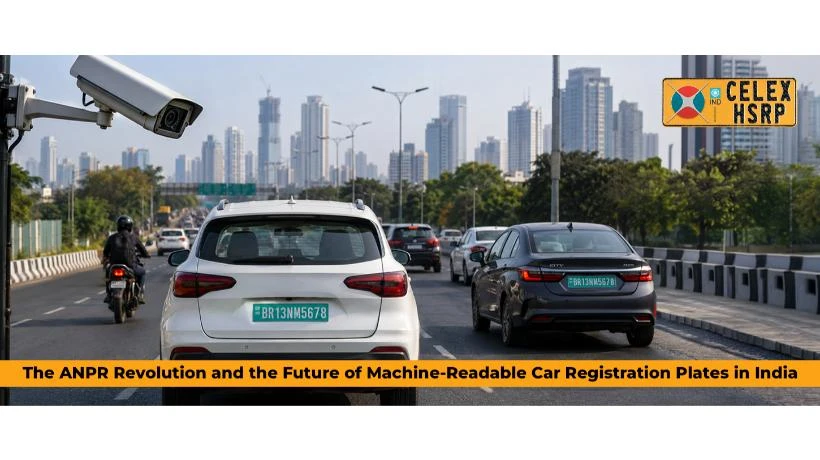
Every license plate manufacturer operating legally in India follows strict dimensional and typographic guidelines set under national vehicle regulations.
A traffic camera on a Mumbai flyover captures a speeding car, but the automated challan never arrives. Somewhere in that split-second exchange between lens and licence plate, the system failed to read the characters correctly. This is happening more often than most vehicle owners realise, and it exposes a growing gap between India's ambitious enforcement technology and the physical plates it depends on.
If you are an OEM, a dealer, or simply someone curious about why your car's number plate suddenly matters so much to machines, this blog answers that question directly. Automatic Number Plate Recognition, commonly called ANPR, is no longer a pilot project confined to a few metro cities. It is becoming the backbone of India's traffic management, toll collection, and law enforcement systems.
Understanding how this technology works and why plate manufacturing quality decides its success will help you make smarter choices as a vehicle owner or industry stakeholder.
What ANPR Actually Does on Indian Roads Today
ANPR systems combine high-speed cameras, image processing software, and character recognition algorithms to identify vehicles without human intervention. These systems are already deployed across toll plazas, red-light junctions, parking facilities, and highway surveillance networks in multiple Indian states. The technology captures a vehicle's plate as it moves, converts the image into readable text, and matches it against a centralised vehicle database within seconds.
How Cameras Capture and Interpret Plate Characters
A typical ANPR setup uses infrared-sensitive cameras paired with software trained on thousands of plate images. The camera detects the rectangular shape of a plate first, then isolates individual characters using edge detection. This is where a common question comes up for many curious readers: how does a camera actually read a moving number plate? The system essentially freezes a frame, enhances contrast between the plate background and characters, and runs the isolated text through a recognition model trained to match Indian font standards.
Why Speed and Lighting Conditions Complicate Recognition
Highway cameras often deal with vehicles moving at high speed, changing light angles, and unpredictable weather. Rain, fog, and glare from headlights can all interfere with clean image capture. A well-manufactured plate with proper reflective coating compensates for much of this interference, while a substandard plate makes accurate recognition significantly harder, especially during night hours.
Why Dimensions and Typography Are Not Just Legal Formalities
Every license plate manufacturer operating legally in India follows strict dimensional and typographic guidelines set under national vehicle regulations. These are not arbitrary design choices. They exist because AI recognition systems are trained on predictable, standardised inputs, and any deviation reduces accuracy.
The Role of Standardised Character Spacing
Character height, stroke width, and spacing between letters follow a fixed format across all approved plates. This consistency allows recognition software to segment characters correctly without confusing a closely spaced "1" and "I" or misreading a cramped "0" as a "D". Manufacturers who deviate from this format, even slightly, create readability problems that compound across thousands of vehicles.
Why Font Consistency Affects Machine Learning Models
Machine-learning recognition models are trained on datasets built around standardised fonts. This raises a practical concern many people overlook: why does typography matter so much for AI-based systems? The answer lies in how these models generalise patterns. A model trained on uniform character shapes struggles when it encounters irregular fonts from non-compliant plates, leading to lower confidence scores and more manual verification needs.
Reflectivity, Material Quality, and Night-Time Recognition
Night driving accounts for a significant share of road accidents and enforcement challenges in India, which makes plate visibility after dark a genuine safety issue, not just a technical one. Reflective performance directly determines whether a camera captures a usable image in low-light conditions.
How Retro-Reflective Sheeting Supports ANPR Accuracy
Approved plates use retro-reflective sheeting that bounces light directly back toward its source, including a camera's flash or a vehicle's headlights. This creates strong contrast between the plate and its background, making character recognition far more reliable at night. Uncertified sheeting scatters light unevenly, producing washed-out or overly dark images that recognition software cannot process accurately.
The Link Between Aluminium Quality and Long-Term Readability
Plates manufactured from substandard aluminium warp over time due to heat exposure and vibration. A warped plate distorts character alignment, which throws off automated recognition even if the plate was perfectly readable when new. Consistent material thickness and tensile strength, both mandated for commercial HSRP production, ensure the plate stays flat and readable for years rather than months.
Commercial HSRP Manufacturing and the Infrastructure Behind It
Producing plates at a national scale requires far more than a factory and raw material. It requires certified processes, consistent quality control, and a distribution network capable of reaching thousands of dealers and OEMs without compromising precision. This is where commercial-scale manufacturing becomes a genuine industrial discipline rather than a small-scale operation.
The Certification Process Behind Legitimate Manufacturing
A legitimate commercial HSRP manufacturer in India must clear Type Approval Certification (TAC) and maintain a Certificate of Production (CoP), both of which involve rigorous testing of material strength, reflective grade, and embossing precision. This certification process exists specifically to prevent low-quality plates from entering circulation and disrupting automated recognition systems nationwide.
Why Scale and Consistency Go Hand in Hand
Producing a handful of plates with precision is manageable. Producing millions of plates with the same precision, month after month, is a different challenge entirely. Celex Technologies Pvt. Ltd. has supplied over 6.10 crore HSRPs across India, maintaining a presence in 23 states through 348 touch points, which demonstrates the kind of consistency that automated recognition infrastructure genuinely depends on.
Celex Technologies Pvt. Ltd. and the Manufacturing Backbone of Machine-Readable Plates
Numbers rarely lie, and in an industry built on precision, they matter more than marketing language ever could. Celex Technologies Pvt. Ltd. has built its reputation around exactly the kind of manufacturing discipline that ANPR systems require to function accurately at a national scale.
The Scale Behind Every Plate Produced
The company works with over 500 OEM customers and more than 12,000 dealer partners across the country, backed by an annual production capacity exceeding 5 crore plates. With a team strength of 500-plus professionals and a turnover crossing 110 crore in FY 2024-25, Celex operates with the kind of infrastructure that supports uninterrupted, high-volume supply. Over 23 years of industry experience sits behind every plate the company produces, and that experience translates directly into fewer manufacturing defects reaching the road.
What This Means for the Future of ANPR in India
As enforcement agencies expand ANPR coverage to more highways and cities, the demand for reliably readable plates will only grow. Manufacturers who cannot maintain precision at scale will become a liability for the entire enforcement ecosystem, while those who can, like Celex, will become increasingly central to how India's traffic infrastructure functions.
Conclusion
ANPR technology is reshaping how India monitors, manages, and enforces rules on its roads, and this shift places unprecedented importance on plate manufacturing quality. Dimensions, typography, reflectivity, and material strength are no longer background details; they are the foundation that determines whether an entire recognition system succeeds or fails at scale.
A single poorly manufactured plate might seem like a minor issue, but multiplied across India's massive vehicle population, manufacturing inconsistency becomes a genuine infrastructure risk. Choosing a certified, experienced licence plate manufacturer capable of maintaining precision across millions of units, like Celex Technologies Pvt. Ltd., is no longer a matter of preference. It has become essential to how automated traffic systems function reliably across the country, and that reliability will only become more critical as ANPR adoption accelerates in the years ahead.
Frequently Asked Questions (FAQs)
1. What is ANPR and how does it work on Indian roads?
ANPR stands for Automatic Number Plate Recognition. It uses cameras and software to capture, read, and match vehicle plates against a database automatically.
2. Why does plate typography matter for machine recognition?
Standardised fonts and spacing allow AI models to segment characters accurately. Irregular typography confuses recognition software and increases misread rates significantly.
3. Does reflective sheeting really affect night-time camera accuracy?
Yes. Certified retro-reflective sheeting bounces light back to the camera, creating strong contrast that makes characters far easier to capture clearly at night.
4. What makes a manufacturer qualified for commercial HSRP production?
Legitimate manufacturers must clear Type Approval Certification and maintain a Certificate of Production, ensuring material strength, reflectivity, and embossing meet national standards consistently.
5. How is Celex Technologies Pvt. Ltd. connected to ANPR readiness?
Celex has supplied over 6.10 crore HSRPs across 23 states, combining scale and 23-plus years of manufacturing precision that supports reliable automated recognition.


Comments
Login to Comment