SOC 2 Readiness: A Guide for SaaS Companies
11 Nov, 2026
16Views 0 Like(s)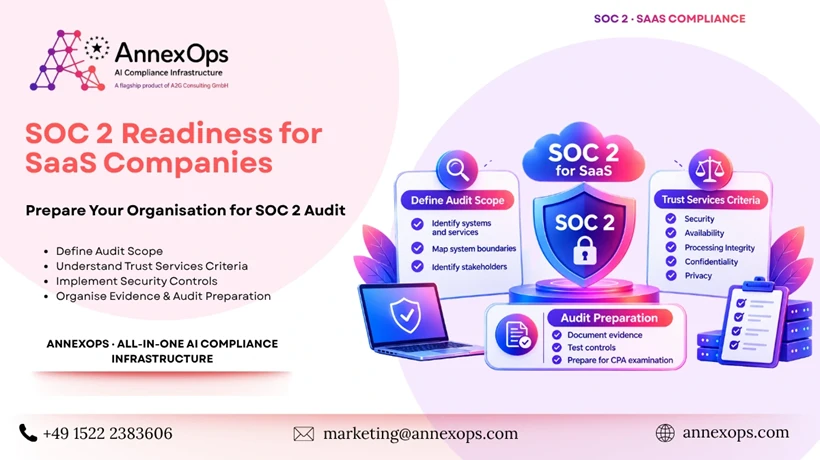
SOC 2 readiness helps SaaS companies strengthen security practices manage risks and build customer trust. Learn about Trust Services Criteria, audit preparation
Beyond Software Features: Why SaaS Companies Need a Strong Security and Compliance Strategy
A SaaS product may offer excellent features, a smooth user experience and reliable performance. But when businesses evaluate software for enterprise use, they also want to know how their information will be protected.
Questions about data security, access permissions, incident response and vendor management often become part of the purchasing process. For SaaS providers, these questions can influence customer confidence and business opportunities.
As software companies grow, managing security practices becomes more complex. Teams introduce new applications, onboard employees, connect external services and process increasing amounts of customer information. Without structured processes, important security activities can become difficult to monitor.
This is where a well-planned compliance strategy becomes valuable. Frameworks such as SOC 2 help service organisations assess and demonstrate controls relevant to their operations.
Why Security Is a Business Priority for SaaS Companies
Security is not only an IT responsibility. It affects customer relationships, procurement decisions and the ability to operate reliably.
Enterprise customers may ask SaaS providers to explain how they manage sensitive information, restrict system access and respond to security incidents. They may also request independent assurance reports before approving a new supplier.
A company that cannot clearly explain its security practices may face delays during procurement or additional customer assessments.
A structured security programme helps businesses establish consistent procedures and assign responsibility for important activities.
Understanding SOC 2
SOC 2 is an attestation framework developed by the American Institute of Certified Public Accountants (AICPA). It uses five Trust Services Criteria to assess controls relevant to a service organisation.
These criteria cover:
-
Security: Protecting systems and information from unauthorised access.
-
Availability: Maintaining systems and services according to agreed operational commitments.
-
Processing Integrity: Ensuring that system processing is complete, valid, accurate, timely and authorised.
-
Confidentiality: Protecting information identified as confidential.
-
Privacy: Managing personal information throughout its lifecycle.
Security is the common criterion. The remaining criteria are considered when relevant to the organisation's services and commitments.
SOC 2 is not a certification. An independent CPA firm performs the examination and issues the report based on the applicable scope and criteria.
SOC 2 Type 1 and Type 2: What Is the Difference?
SaaS companies preparing for SOC 2 should understand the two main examination types.
SOC 2 Type 1
A Type 1 examination evaluates whether an organisation's controls are suitably designed at a specific point in time.
It provides information about the control environment on the examination date.
SOC 2 Type 2
A Type 2 examination evaluates control design and operating effectiveness over a defined period.
It provides insight into whether the organisation followed its documented control procedures consistently during that period.
The appropriate examination depends on customer requirements, business objectives and the organisation's readiness.
Important Areas to Address During SOC 2 Preparation
Preparing for SOC 2 involves reviewing the systems, people and processes that support the services included in the examination.
1. Define the Audit Scope
The organisation should identify the services, systems, infrastructure and business processes included in the examination.
A clearly defined scope helps teams understand which controls need to be implemented, reviewed and documented.
2. Establish Access Management Procedures
Employees should receive access according to their job responsibilities. Access should also be reviewed when responsibilities change or an employee leaves.
Useful practices include:
-
Maintaining records of access approvals.
-
Reviewing privileged accounts.
-
Removing unnecessary permissions.
-
Applying appropriate authentication measures.
-
Documenting periodic access reviews.
3. Improve Incident Response
A documented incident response process helps employees understand how to report and escalate security events.
The process should identify responsible teams, communication procedures, investigation steps and documentation requirements.
4. Maintain Change Management Records
Software companies regularly update applications, infrastructure and system configurations.
Change management procedures should document relevant approvals, testing, deployment activities and reviews. This creates a clearer record of how changes are controlled.
5. Assess Third-Party Providers
Cloud hosting providers, payment processors, analytics services and external software vendors can affect a SaaS company's security environment.
Organisations should identify important suppliers, understand their access to company or customer information and assess relevant risks.
Why Evidence Collection Should Start Early
One of the common challenges during SOC 2 preparation is collecting evidence from different departments.
Security policies, access review records, incident reports, change approvals and vendor assessments may be stored across multiple systems. When teams begin collecting these records only before an examination, the process can become time-consuming.
A better approach is to maintain evidence as part of everyday operations.
For example, an access management policy explains how access should be reviewed. A dated access review record provides evidence that the review was actually completed.
Evidence should be relevant to the control, accurate and traceable. Organisations should also establish clear ownership so that teams know who is responsible for maintaining each record.
For a detailed explanation of audit scope, control ownership, Trust Services Criteria and evidence preparation, read this guide to SOC 2 readiness for SaaS companies.
Common Mistakes That Can Delay SOC 2 Readiness
Even companies with established security practices can encounter problems during preparation.
Starting too late: Waiting until a customer requests a report can leave insufficient time to address control gaps and organise evidence.
Treating policies as proof of implementation: Written procedures are important, but organisations must also demonstrate that relevant activities are performed.
Unclear ownership: When control responsibilities are not assigned, reviews and follow-up activities may be missed.
Overlooking suppliers: External providers can introduce security and operational risks that should be considered in the organisation's risk management process.
Ignoring ongoing reviews: Security controls need regular attention. A process that works today may become ineffective when systems, employees or business operations change.
How Compliance Software Can Help
As compliance activities increase, spreadsheets and separate document folders may become difficult to manage.
Compliance software can support organisations by bringing relevant information into a more structured environment. Depending on the solution, useful capabilities may include:
-
Tracking applicable Trust Services Criteria.
-
Mapping requirements to internal controls.
-
Assigning control owners.
-
Organising supporting evidence.
-
Recording review activities.
-
Monitoring outstanding preparation tasks.
AnnexOps provides compliance software that supports SOC 2 control tracking, evidence management and audit preparation. It helps teams organise compliance activities alongside other governance requirements.
Software can support readiness work, but it does not replace an independent SOC 2 examination. The final report must be issued by an independent CPA firm.
Conclusion
For SaaS companies, customer trust depends on more than product performance. Businesses must also demonstrate that they take information security, access management and operational risks seriously.
SOC 2 readiness provides a structured way to review relevant controls and prepare for independent assurance. By defining the audit scope, assigning responsibilities and maintaining evidence throughout normal operations, SaaS companies can make preparation more manageable.
A consistent security and compliance strategy also gives teams a stronger foundation as the business grows and customer expectations evolve.



Comments
Login to Comment