Seed Industry in India Trends, Size, Growth Potential and Industry Outlook 2026–2034
24 Sep, 2026
176 Views 0 Like(s)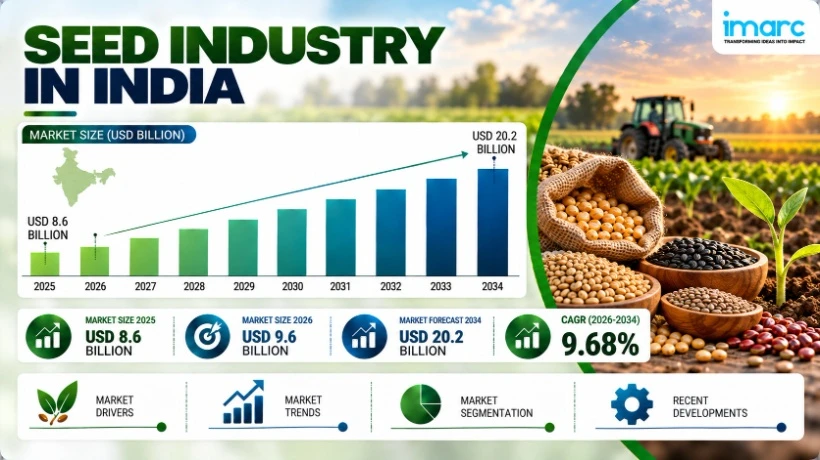
The seed industry in India size increased from USD 8.6 Billion in 2025 to USD 9.6 Billion in 2026 and is projected to reach USD 20.2 Billion by 2034, exhibiting a compound annual growth rate of 9.68% during the forecast period 2026-2034.
Seed Industry In India: Industry Report 2026–2034
The seed industry in India size increased from USD 8.6 Billion in 2025 to USD 9.6 Billion in 2026 and is projected to reach USD 20.2 Billion by 2034, exhibiting a compound annual growth rate (CAGR of 9.68%) during the 2026–2034 forecast period. The industry is expanding as farmers increasingly adopt high-yielding, hybrid, and climate-resilient seed varieties. Driven by food security priorities, government support programmes, rising hybrid penetration in paddy, wheat, cotton, and vegetables, and continuous R&D by domestic and multinational companies, quality seeds remain fundamental to India’s agricultural productivity and farm income growth.
What Is the Size and Growth Forecast of the Seed Industry In India?
The market is exhibiting resilient, continuous expansion, fundamentally anchored by the essential role of quality seeds in improving crop yields, farm resilience, and national food security across diverse agro-climatic zones.
- Market Size in 2025: USD 8.6 Billion.
- Market Size in 2026: USD 9.6 Billion.
- Market Forecast in 2034: USD 20.2 Billion.
- Compound Annual Growth Rate (CAGR): 9.68% during the 2026–2034 forecast period.
- Underpinning Momentum: Strong demand for paddy and wheat seeds, expanding hybrid adoption, government subsidies and food security missions, and growing vegetable and maize seed requirements support sustained long-term industry growth.
What Are the Latest Emerging Trends in the Seed Industry In India?
- Continued Leadership of Paddy Seed Demand: Paddy remains the largest crop segment because rice is India’s staple food and receives extensive policy support. Hybrid varieties offering shorter maturity and better mechanisation compatibility are further strengthening demand among farmers across major rice-growing states.
- Rising Adoption of Hybrid and Climate-Resilient Varieties: Farmers are increasingly choosing hybrids and improved varieties that deliver higher yields and better tolerance to heat, pests, and disease. This shift is visible across paddy, wheat, cotton, maize, and vegetable crops in progressive farming regions.
- Growth of Vegetable and Specialty Seed Segments: Hybrid vegetable seeds are gaining momentum due to rising urban food demand and protected cultivation. Higher-value vegetable seeds offer attractive opportunities for companies with strong breeding programmes and targeted farmer outreach.
- Strengthening of Domestic R&D and Regional Breeding: Indian seed companies continue investing in crop-specific and zone-specific breeding to match local agro-ecological conditions. Deep local knowledge combined with expanding dealer networks supports competitive positioning against global players.
- Integration of Digital Tools and Farmer Engagement: Companies are using digital platforms and advisory services to improve seed awareness, agronomic guidance, and brand loyalty. Better last-mile communication helps accelerate adoption of improved varieties among small and medium farmers.
Request Sample Report – TOC & Key Insights: https://www.imarcgroup.com/seed-industry-in-india/requestsample
What Growth Factors Are Driving the Seed Industry In India?
- Critical Role of Paddy and Wheat in Food Security: Rice and wheat form the backbone of India’s food system and receive sustained government support through minimum support prices and seed-related schemes. This structural demand keeps paddy and wheat seeds as the largest volume drivers in the industry.
- Expanding Hybrid Seed Penetration Across Crops: Hybrid technology is delivering higher productivity and better trait performance in cotton, maize, paddy, and vegetables. Rising awareness and demonstrated yield benefits encourage more farmers to shift from traditional saved seed to purchased hybrids.
- Government Subsidies and Agricultural Missions: Programmes under the National Food Security Mission and state-level seed support improve affordability and availability of quality seeds. Policy backing reduces adoption barriers and stimulates demand in both major and emerging crop segments.
- Rising Demand from Feed, Ethanol, and Horticulture: Maize demand is supported by poultry feed and ethanol blending needs, while vegetable seeds benefit from urban consumption and protected farming growth. These downstream drivers expand the overall addressable seed market.
- Continuous Product Innovation by Domestic and Global Players: Strong R&D pipelines focused on yield, pest resistance, and climate adaptation keep improving the value proposition of commercial seeds. Regular introduction of better varieties sustains farmer interest and replacement demand.
What Are the Key Challenges Facing the Seed Industry In India?
- Fragmented Market and Strong Regional Competition: The industry remains fragmented with numerous regional breeders and local suppliers. Intense competition on price and local adaptation makes it challenging for larger players to achieve uniform national dominance across all crops and zones.
- Farmer Price Sensitivity and Saved-Seed Practices: Many smallholders remain cost-conscious and continue using farm-saved seed for certain crops. Convincing them of the long-term benefits of certified and hybrid seeds requires sustained demonstration and extension efforts.
- Complex Regulatory and Quality Assurance Requirements: Seed certification, trait approvals, and quality standards involve multiple regulatory layers. Compliance adds time and cost, particularly for companies introducing new hybrids or biotech traits into the market.
- Climate Variability and Trait Performance Risks: Changing weather patterns can affect the field performance of even improved varieties. Breeding programmes must continuously adapt to heat, drought, and disease pressures to maintain farmer trust and product relevance.
Deep-Dive Segment Insights:
The market is meticulously segmented to address diverse crop requirements and regional agricultural patterns.
By Crop Type
- Paddy (26.50% share in 2025): Commands the majority share as India’s staple food crop, supported by extensive cultivation, government programmes, and rising hybrid adoption.
- Wheat (20.0%): Driven by large-scale cultivation across the Indo-Gangetic plains and demand for heat- and disease-tolerant varieties.
- Vegetables (15.0%): Emerging as a fast-growing segment through hybrid seeds and protected cultivation.
- Cotton (12.5%), Maize (10.0%), Groundnut (7.5%), Soybean (5.0%), and Others (4.5%): Contribute through commercial crop demand and specialised breeding progress.
By Region
- Uttar Pradesh (18.00% share in 2025): Leads due to vast paddy and wheat cultivation, large farming population, and strong government seed support.
- Madhya Pradesh (15.5%), West Bengal (12.5%), Rajasthan (11.5%), Punjab (10.0%), Maharashtra (9.5%), Andhra Pradesh (8.0%), Bihar (6.5%), Karnataka (5.0%), and Others (3.5%): Reflect diverse crop strengths and varying stages of hybrid and certified seed adoption.
Competitive Landscape & Key Player Positioning
The seed industry in India competitive landscape is characterized by a fragmented market structure where the top five companies hold approximately 29% of revenue, creating space for regional breeders that specialize in niche agro-climatic zones. Multinational corporations leverage deep R&D pipelines and proprietary trait technologies, while domestic leaders like Kaveri Seeds and Nuziveedu Seeds capitalize on intimate agro-ecological knowledge and extensive dealer networks across rural India.
Key players include:
- Advanta Seeds (UPL Limited) – Leader in hybrid seeds across corn, rice, sorghum, and vegetables
- Kaveri Seeds – Leader with strong cotton, rice, and maize hybrids and an active R&D pipeline
- Syngenta India – Leader in hybrid corn, rice, and vegetables with crop protection integration
- Bayer CropScience – Leader in Bt cotton and corn hybrids with digital farming solutions
- Nuziveedu Seeds LTD – Challenger with cotton, rice, and maize focus and extensive dealer reach
- Rallis India Limited (Tata Group) – Challenger combining crop care and seeds with rural distribution strength
- J K Seeds (J K Agri Genetics) – Emerging player focused on cotton, maize, and vegetables
- Pioneer (Corteva Agriscience) – Emerging player with advanced corn and soybean hybrids and biotech traits
Recent Developments
- Ongoing 2025–2026: Leading seed companies continued advancing hybrid and climate-resilient varieties for paddy, wheat, cotton, maize, and vegetables to meet evolving farmer and climate needs.
- Policy Support: Government seed subsidies and food security missions sustained demand for quality and certified seeds across major producing states.
- Hybrid Momentum: Adoption of hybrids remained strong in cotton and expanded in paddy, maize, and high-value vegetables, supporting value growth.
- Regional Dynamics: Uttar Pradesh and Madhya Pradesh retained leadership through large cereal and oilseed cultivation bases and supportive agricultural programmes.
- Market Outlook: Food security priorities combined with hybrid technology and continuous breeding innovation remain the primary drivers of long-term growth in India’s seed industry.
Customization Note: If you require any specific information not covered within this report’s scope, we will provide it as part of the customization.
Request Report Customization: https://www.imarcgroup.com/request?type=report&id=743&flag=E
Frequently Asked Questions (FAQs)
Q1. What is the current size of the seed industry in India?
The seed industry in India size increased from USD 8.6 Billion in 2025 to USD 9.6 Billion in 2026.
Q2. What is the projected market size by 2034 and the growth rate?
The market is projected to reach USD 20.2 Billion by 2034, exhibiting a compound annual growth rate (CAGR of 9.68%) during the 2026–2034 forecast period.
Q3. Which crop type holds the largest share?
Paddy commands the majority share at 26.50% in 2025, reflecting its role as India’s staple food crop.
Q4. Which region accounts for the highest market share?
Uttar Pradesh leads with an 18.00% share in 2025, supported by large-scale paddy and wheat cultivation and strong seed support programmes.
Q5. Who are the key players in the industry?
Key players include Advanta Seeds, Kaveri Seeds, Syngenta India, Bayer CropScience, Nuziveedu Seeds LTD, Rallis India Limited, J K Seeds, and Pioneer, among others.


Comments
Login to Comment