Salesforce Einstein AI Integration Services and Data Privacy Compliance
15 Jul, 2026
992 Views 0 Like(s)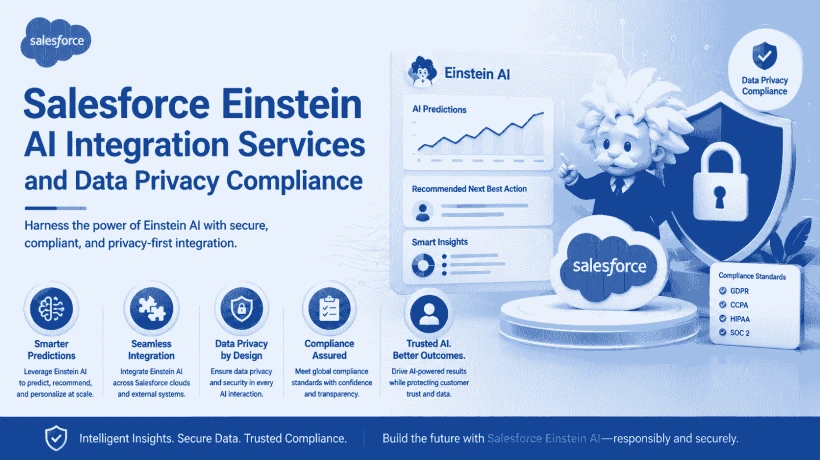
Salesforce Einstein AI Integration gives businesses a path to predictive insights without giving up control over customer data. This looks at how that integration works from a technical standpoint, and what compliance teams need to watch closely.
Businesses want AI-driven insights. Customers want their data protected. These two goals often pull in different directions. Companies that get this balance wrong face fines, lost trust, and real revenue loss.
Salesforce Einstein AI Integration gives businesses a path to predictive insights without giving up control over customer data. This looks at how that integration works from a technical standpoint, and what compliance teams need to watch closely.
Why Privacy and AI Cannot Be Separated
Consumers no longer see data privacy as a background issue. Research shows that 57% of consumers now view artificial intelligence as a significant privacy threat, and 63% report direct concerns about how their data feeds AI systems.
Trust is shifting fast. Recent survey data shows 52% of consumers now trust AI less than humans with their personal data, up from 48% just a year earlier. Nearly half of consumers have taken direct action against a brand over AI data concerns, including canceling subscriptions or switching to a competitor.
This shift changes how businesses need to approach AI projects. Salesforce Einstein AI Integration Services now treat privacy controls as a core requirement, not an added feature.
The Regulatory Pressure Behind This Shift
Regulation has grown alongside AI adoption. As of 2025, roughly 172 countries have enacted some form of data protection or privacy law, covering close to 79% of all UN member states.
Enforcement has real financial weight. Cumulative GDPR fines have passed €7.1 billion since the regulation took effect in 2018, with over 2,600 individual fines issued. Regulators now file more than 440 breach notifications daily across Europe, a sharp year-over-year increase.
Many organizations face overlapping compliance demands at once. Industry survey data shows 92% of organizations must comply with GDPR, alongside PCI DSS, HIPAA, or CCPA requirements depending on their sector. Companies now spend 30% to 40% more on privacy compliance than they did just a few years ago.
This regulatory weight makes technical compliance planning essential for any Salesforce Einstein AI Integration project, not just a legal afterthought.
What Salesforce Einstein AI Integration Actually Involves
Einstein is Salesforce's built-in AI layer, covering predictive scoring, recommendations, natural language processing, and generative features across Sales Cloud, Service Cloud, and Marketing Cloud.
Integration work typically covers:
-
Data preparation: cleaning and structuring CRM data for accurate model training.
-
Model configuration: setting up prediction models like lead scoring or opportunity insights.
-
Third-party data connections: pulling in external data sources to improve model accuracy.
-
Governance setup: defining who can access AI-generated insights and how data flows through the system.
-
Testing and validation: confirming model outputs match real business patterns before rollout.
Each of these steps touches customer data directly, which is why privacy compliance needs to run alongside technical build work, not follow after it.
How Einstein Handles Data Privacy by Design
Salesforce built several privacy protections directly into the Einstein platform. Development teams working on Salesforce Einstein AI Integration Services rely on these features as a starting foundation.
Key built-in protections include:
-
Einstein Trust Layer: filters sensitive data before it reaches external language models.
-
Zero data retention: some model providers process requests without storing the underlying data afterward.
-
Field-level security: restricts which data fields Einstein can access based on user permissions.
-
Data masking: hides sensitive fields like payment or health information from AI processing when not required.
-
Audit logging: tracks every AI-generated insight and the data used to produce it.
These controls give development teams a real advantage over building AI features from scratch on ungoverned infrastructure.
Core Privacy Risks in AI Integration Projects
Even with strong platform protections, integration projects carry specific privacy risks worth planning for early.
1. Training Data Exposure
AI models often need historical data to generate accurate predictions. If that training data includes sensitive fields without proper masking, the model can expose information indirectly through its outputs.
2. Third-Party Data Sharing
Many Einstein AI Integration Services projects connect external data sources for richer insights. Each new connection creates a new point where data could leave the company's control without proper agreements in place.
3. Over-Broad Data Access
Giving an AI model broader access than its task requires increases risk without adding real value. A customer service prediction model rarely needs full financial history, for example.
4. Cross-Border Data Transfer
Companies operating across regions need to track where customer data physically moves during AI processing. Some jurisdictions place strict limits on data leaving their borders, and enforcement has tightened significantly in recent years.
Technical Steps for a Privacy-Compliant Einstein Integration
Step 1: Map Data Flows Before Building
Before any model configuration begins, document exactly which data fields the AI feature will use, where that data lives, and where it will move during processing.
Step 2: Apply Data Minimization
Only feed the AI model the data it actually needs. This reduces both privacy risk and processing overhead at the same time.
Step 3: Configure the Trust Layer
Set masking rules for personally identifiable information before it reaches any external model. This step should happen before testing begins, not after.
Step 4: Set Role-Based Access to AI Insights
Not every employee needs access to every AI-generated prediction. Configure permission sets so insights reach only the roles that need them.
Step 5: Document Compliance Mapping
Map each AI feature against relevant regulations like GDPR, HIPAA, or CCPA. This documentation matters heavily during audits or regulatory review.
Step 6: Test for Data Leakage
Run structured tests to confirm the model does not surface sensitive data it should not expose, especially in generative or conversational features.
Key Statistics Shaping Compliance Priorities
These numbers help explain where compliance effort should focus during an Einstein integration project:
-
96% of organizations report that privacy investment returns exceed the cost, with a median return of 1.6 times spent.
-
Only 42% of organizations believe they have adequate solutions to protect data privacy inside AI environments, despite high awareness of where sensitive data lives.
-
Roughly 40% of organizations report experiencing at least one AI-related privacy incident.
-
87% of respondents agree that strong privacy laws make customers more comfortable engaging with AI-powered tools.
-
79% of organizations cite building trust with customers and regulators as a top benefit of strong AI governance.
-
Average data breach costs reached close to $4.88 million in recent industry reporting.
These figures show privacy compliance is not just a legal requirement. It directly affects customer trust and long-term AI adoption success.
Industry-Specific Compliance Considerations
1. Financial Services
Banks and financial firms using Einstein for fraud detection or credit scoring need strict audit trails and explainability for every AI-driven decision, given regulatory scrutiny in this sector.
2. Healthcare
Healthcare organizations must limit Einstein's access to protected health information, applying HIPAA-compliant masking rules before any predictive model processes patient data.
3. Retail and E-Commerce
Retailers using Einstein for personalized recommendations need clear customer consent mechanisms, especially when using purchase history or browsing behavior to train models.
Real-World Example
A mid-sized insurance company wanted to use Einstein for claims risk scoring. Early testing showed the model had access to more customer fields than its task required, including full medical history for auto claims that never needed that data.
The development team reworked the data model, limiting the AI feature to relevant claim history and policy data only. They configured Trust Layer masking for any remaining sensitive fields and built a full audit log for every risk score generated.
Before launch, the company ran a compliance review against state insurance regulations and internal privacy policy. The project passed review after two rounds of permission adjustments. The company now reports faster claims processing with no reported privacy incidents since launch.
Best Practices for Long-Term Compliance
Companies that maintain strong privacy compliance after launch follow a few consistent habits:
-
Review data access permissions for AI features every quarter.
-
Keep compliance documentation updated as regulations change.
-
Test for data leakage with every new model update, not just at initial launch.
-
Assign clear ownership for AI privacy governance within the organization.
-
Monitor consumer trust signals alongside technical performance metrics.
Conclusion
AI-driven insights carry real business value, but only when built on a foundation of strong data privacy practices. Regulatory pressure continues to grow, and consumer trust in AI systems remains fragile.
Salesforce Einstein AI Integration gives businesses strong built-in privacy tools, but responsible deployment still depends on the development team's approach. Companies that invest in proper Salesforce Einstein AI Integration Services, with careful attention to data minimization, access control, and compliance mapping, build AI features that customers can actually trust.


Comments
Login to Comment