Nutritionist SEO Services: How to Get Found on Google Maps in 2026
10 Sep, 2026
5 Views 0 Like(s)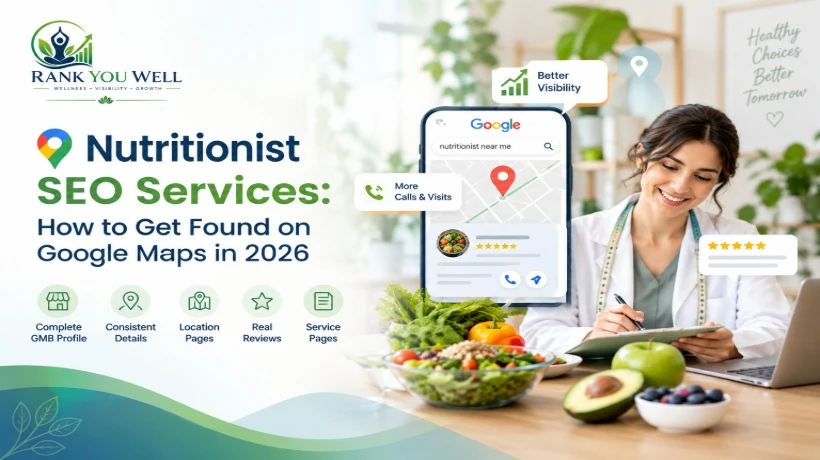
When someone searches for a nutritionist nearby, they're not browsing a general wellness article. They're comparing real providers, reading reviews, and deciding who to actually contact.
When someone searches for a nutritionist nearby, they're not browsing a general wellness article. They're comparing real providers, reading reviews, and deciding who to actually contact.
Getting chosen from that search comes down to five things working together — an accurate Google Business Profile, consistent business details, location-specific pages, real reviews, and website content built around the specific services you offer.
That matters more than most practices realize. Local intent now shows up in nearly half of all Google searches, "near me" searches have grown roughly 400% since 2020, and most people who run a local search visit a business within 24 hours. For a nutrition practice, this is exactly why working with a service built around nutritionist SEO services — rather than generic SEO — tends to outperform a one-size-fits-all approach: the searches, the client decision process, and even the compliance considerations are specific to healthcare and wellness.
Why Does Google Maps Matter So Much for Nutritionists?
Because it's where most local searches actually get decided, not just discovered.
A potential client typically searches, compares a few nearby options, checks reviews, and only then visits a website or picks up the phone. Data backs this pattern clearly: businesses with a complete Google Business Profile are reported to be roughly 2.7 times more likely to be seen as reputable, 70% more likely to get an in-person visit, and about 50% more likely to be considered for purchase, compared to incomplete listings. The goal isn't more traffic — it's being the option a real prospective client can confidently choose.
The Five Things That Actually Move the Needle
1. A genuinely complete Google Business Profile. Correct category, accurate hours, real services, and a description that reflects what the practice actually does — not a list of keywords stuffed into a field.
2. Consistent business information everywhere. Your name, address, phone number, and hours should match exactly across your website, your profile, and any directory you're listed in. Inconsistency is one of the more common — and easiest to fix — trust signals practices get wrong.
3. Location-specific website pages, done honestly. If you serve a specific city or neighborhood, say so clearly on a dedicated page. If you serve several genuine locations, separate pages can help — but duplicating one page with the city name swapped out tends to do more harm than good.
4. Pages built around actual services, not just "nutritionist." Searches are often far more specific than the general term — "sports nutritionist near me," "PCOS nutritionist in [city]," or "weight management nutrition consultation." Each deserves its own page so Google (and increasingly, AI search tools) has something specific to match to the search.
5. Real reviews, genuinely earned. Review trust remains remarkably high — a large majority of consumers say they trust online reviews as much as a personal recommendation from someone they know. Encourage honest feedback from real clients, monitor what comes in, and respond appropriately — never manufacture it.

What About Online-Only Nutrition Practices?
The strategy shifts, but the principle doesn't — accuracy matters more than volume.
If you serve clients virtually across a broader region, don't try to manufacture local signals for places you don't actually operate in. Instead, build content around your specific services, specialties, and the client needs you genuinely address — that's what both search engines and AI-driven answers reward, regardless of physical location.
How Long Does This Actually Take?
There's no universal timeline. It depends on your existing website authority, local competition, your Google Business Profile history, and how much needs fixing technically. Some improvements — like completing your profile or fixing inconsistent business details — can show results relatively quickly. Stronger, more durable visibility generally builds over months of consistent, accurate signals.
How Should You Actually Measure It?
Rankings alone don't tell you whether this is working. Track what actually matters: Google Business Profile interactions, calls, direction requests, contact enquiries, booked consultations, and new reviews. The real question isn't "am I ranking" — it's are relevant local searches turning into real consultations?
Common Mistakes Worth Avoiding
Incomplete or inconsistent profile information. Duplicate location pages built by swapping a city name. Keyword-stuffed descriptions. Ignoring reviews entirely. Targeting locations you don't genuinely serve. Treating Google Maps and website SEO as two separate efforts instead of one connected strategy. And tracking rankings without ever checking whether they're producing actual enquiries.
Frequently Asked Questions
How can a nutritionist rank higher on Google Maps?
Start with a complete, accurate Google Business Profile, consistent business information everywhere you're listed, dedicated service pages, and genuine reviews — together, not in isolation.
What's the best keyword for a nutritionist to target?
There isn't one universal keyword. Specific searches like "sports nutritionist in [city]" tend to convert better than a broad term like "nutritionist," because they match real client intent more closely.
Can an online-only nutrition practice rank locally?
It depends on eligibility and business model. Practices serving clients virtually should represent that accurately rather than creating artificial local signals for areas they don't serve.
How important are reviews for local nutrition SEO?
Very. Review trust remains close to personal-recommendation levels, and profiles with more genuine, recent reviews consistently perform better in local search.
Final Thoughts
Local SEO for nutritionists isn't about chasing a Maps ranking for its own sake — it's about connecting a real practice with the people already searching for exactly what it offers. Get the fundamentals right — profile, consistency, service pages, reviews — and the visibility follows. Rank You Well provides nutritionist SEO services built around exactly this: Google Business Profile optimization, local website structure, service and specialty pages, and a genuine review strategy — so the goal isn't just appearing on the map, but becoming the practice people actually choose to contact.



Comments
Login to Comment