Modern Ceiling Fans | Trusted Manufacturers in India
11 May, 2026
1752 Views 0 Like(s)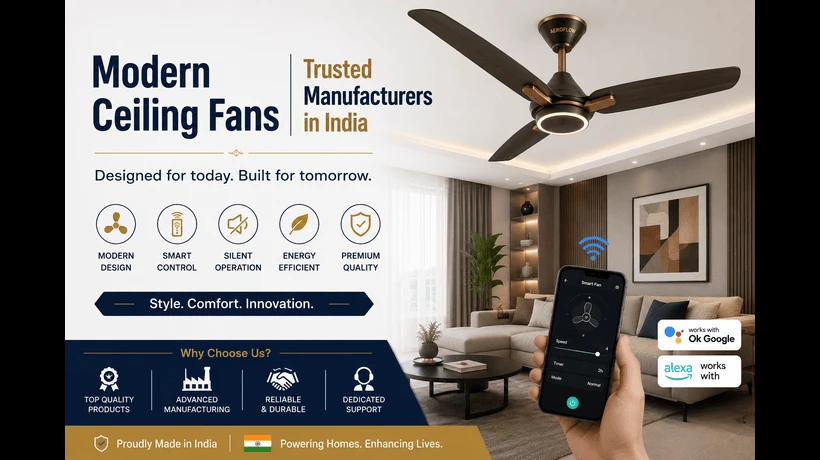
Source Modern Ceiling Fans from ISO-certified Indian manufacturers exporting to 31 countries. Compare specs, MOQ, and supplier reliability today.
Modern Ceiling Fans: Trusted Ceiling Fan Manufacturers & Suppliers
A procurement manager notices fan returns long before the finance team does. Bearings fail after eight months. Remote pairing stops working. Motor noise creeps in during peak summer sales. That’s usually where the conversation around Modern Ceiling Fans becomes less about styling and more about supplier discipline.
Most buyers already know the Indian ceiling fan market crossed ₹11,000 crore in value recently, driven by smart home adoption and energy-efficiency demand. But volume growth has also created a problem: too many factories now market the same catalog with different stickers.
And yet, very few buyers audit what actually matters — copper winding consistency, PCB sourcing stability, airflow testing, or whether the supplier can maintain spare-part availability after two production cycles.
That mistake gets expensive fast.
What Separates Commercial-Grade Modern Ceiling Fans From Commodity Stock
Motor Technology Is No Longer a Cosmetic Feature
The shift toward BLDC motors changed buyer expectations completely. Traditional induction motor fans typically consume 70–80 watts. Many BLDC-based Smart Ceiling Fans now operate between 28–35 watts while delivering comparable airflow.
Which means electricity savings became a procurement discussion, not just a retail marketing angle.
A surprising number of suppliers still quote airflow figures tested without standard installation height conditions. Ask for test parameters. If they hesitate, assume the numbers were built for brochures, not field performance.
Blade Material Changes More Than Appearance
ABS blades gained popularity because they resist warping better in humid regions compared to lower-grade aluminum setups. That matters in coastal distribution zones across India, Southeast Asia, and East Africa.
Here’s the detail buyers usually overlook: blade balancing tolerance.
Even a 2–3 mm imbalance can create vibration complaints after installation. Retail customers rarely blame installation crews first. They blame the brand printed on the motor housing.
Smart Features Need Stable Component Supply
Remote controls, Wi-Fi modules, and IoT integrations pushed demand for Smart Ceiling Fans sharply upward after 2021. But electronic dependency introduced a new risk — inconsistent PCB sourcing.
Nobody tells you how often factories quietly substitute electronic components during raw material shortages.
That’s where shipments become unpredictable.
Packaging Failure Is Still a Massive Export Problem
Carton compression strength matters more than most importers expect. A fan can leave the factory perfectly assembled and still arrive with bent blades because packaging was optimized for cost instead of container stacking pressure.
We’ve seen buyers negotiate aggressively on unit pricing while ignoring drop-test certification entirely.
That is backwards procurement.
The Supplier Evaluation Questions That Actually Matter
1. Ask About Defect Handling Before You Discuss Pricing
A serious supplier can explain replacement ratios, complaint timelines, and root-cause reporting clearly.
A bad answer sounds like this:
"We rarely get complaints."
Every factory gets complaints. The difference is whether they track them.
2. Verify Export Documentation History
India exported electrical appliances worth billions last year, yet many smaller factories still struggle with destination-specific compliance paperwork.
Ask for recent shipment references by region.
If a supplier avoids naming export markets, there is usually a reason.
3. Check Production Consistency Across Batches
Most buyers inspect samples carefully and then assume mass production matches them automatically.
It doesn’t.
The hard part in fan manufacturing is maintaining finish consistency across 3,000 or 5,000-unit runs, especially with matte coatings and decorative trims.
What a Weak Answer Sounds Like
"Minor color variation is normal."
Small variations happen. Uncontrolled variation destroys retailer confidence.
4. Evaluate Lead-Time Honesty
Some Ceiling Fan Manufacturers quote unrealistic timelines simply to secure purchase orders.
Then the delays begin.
A supplier promising 12-day dispatch during peak summer demand without explaining production allocation probably isn’t being truthful.
5. Audit Spare-Part Availability
This matters more for Smart Ceiling Fans Manufacturers than standard fan suppliers.
Receivers, remotes, and drivers fail occasionally. Buyers need assurance that replacement inventory exists six months later — not just during the initial shipment.
One missing spare part can freeze an entire after-sales channel.
How Modern Ceiling Fans Protect Margins for Distributors and Brands
Lower Power Consumption Helps Retail Conversion
Electricity pricing pressure changed consumer behavior significantly. Energy-efficient Modern Ceiling Fans sell faster because the savings argument is easy for retailers to explain on the shop floor.
That shortens sales cycles.
Reduced Warranty Claims Preserve Dealer Relationships
A dealer who handles repeated replacement complaints eventually stops recommending the product altogether.
Reliable motor winding and balancing reduce those friction points dramatically.
Smart Features Increase Average Selling Price
Retailers across India increasingly position Smart Ceiling Fans as lifestyle products rather than basic electrical hardware.
Which means wholesalers can operate with healthier margins compared to standard economy models.
Better Packaging Reduces Transit Damage
Export buyers already know this problem. Domestic buyers are starting to experience it too due to multi-layer logistics handling.
Improved packaging specifications directly reduce landed replacement costs.
Stable Supply Chains Prevent Seasonal Stockouts
Summer procurement cycles punish unreliable factories.
A supplier who misses dispatch windows in April or May can cost distributors an entire season’s turnover opportunity.
Certification Compliance Builds Long-Term Retail Trust
BIS certification, ISO systems, and documented testing processes still influence institutional and retail procurement heavily across India and export markets.
And frankly, buyers should be skeptical of factories unwilling to share audit documentation.
Where India’s Ceiling Fan Supply Chain Still Has an Edge
India remains one of the strongest sourcing hubs for Ceiling Fan Manufacturers because component ecosystems already exist across Gujarat, Delhi NCR, Maharashtra, and parts of South India.
That geographical clustering matters.
Motor vendors, powder coating units, electronics suppliers, packaging converters, and logistics operators sit within workable industrial distances. Buyers sourcing from Indian Modern Ceiling Fans Manufacturers often gain faster customization capability compared to fragmented overseas supply chains.
Export activity from India’s fan industry has also expanded steadily into Africa, the Middle East, and Southeast Asia. Many established Modern Ceiling Fans Suppliers now ship to 31 countries or more, balancing OEM manufacturing with private-label production.
For importers, location is not just about freight cost anymore. It affects spare-part continuity, transit predictability, and communication speed during production problems.
About RotexFans
At RotexFans, we manufacture and export ceiling fans with a clear understanding of what buyers actually deal with after the shipment leaves the factory.
We’ve worked with wholesalers, procurement teams, and private-label brands that needed consistency more than marketing promises. Our production systems follow ISO-certified processes, and our fans are exported to 31 countries across multiple climate conditions and voltage standards.
We learned an uncomfortable lesson in 2021 after repeated feedback from high-humidity markets. One decorative coating supplier kept causing finish inconsistency during monsoon storage cycles. We replaced the coating process completely instead of negotiating around complaints. That decision increased production cost slightly, but return rates dropped noticeably within two quarters.
That’s how long-term export manufacturing actually works.
Send the Right RFQ First — It Saves Weeks Later
If you’re sourcing Modern Ceiling Fans, send us the specifications that affect production accuracy early:
-
Blade size and finish
-
Motor type preference
-
Voltage requirements
-
Packaging standards
-
Branding requirements
-
Target market certifications
-
Estimated order quantity
We typically respond within 24 business hours.
Our MOQ depends on model configuration and branding complexity, but most export and wholesale orders begin from 300–500 units per SKU.
Conclusion
The market for Modern Ceiling Fans is growing quickly, but supplier reliability still separates profitable partnerships from expensive inventory problems. Buyers who evaluate documentation, component sourcing, and after-sales readiness usually avoid the failures that damage distributor relationships later. India’s manufacturing ecosystem continues to give serious importers and wholesalers strong sourcing advantages, especially for energy-efficient and smart-enabled products. The next five years will reward suppliers who can maintain consistency while adapting faster to smarter consumer demand.
Here is the another blog you might be intersted in:
Best Modern Ceiling Fans Manufacturers & Smart Ceiling Fan Suppliers
FAQs
Are Indian Modern Ceiling Fans Manufacturers competitive for export orders?
Yes. OEM providers working in the Middle East, Southeast Asia, and Africa utilize Indian suppliers as OEM service and private-label factories. The main issue factories face is planning buffer time in light of shifting freight schedules.
What do buyers prioritize when selecting Smart Ceiling Fans?
Assure PCB sourcing, remote compatibility, and downtime to minimum spare parts fixture provided. Many buyers pay less attention to the internal electrics of the design, i.e. to their reliability, until complaints are lodged.
What is the most effective way for Ceiling Fan Manufacturers to process complaints?
Serious factories log complaints and keep records of their replacement ratios and batch traceability. Defects are usually handled “informally” by the supplier and settle claims. Unaddressed complaints become disputes after shipment.
Why is the demand for Smart Ceiling Fans with BLDC increasing?
They're more efficient. The best BLDC fans are almost 50% less power consuming than the most efficient induction fans and offer almost the same airflow.
Do suppliers of all Modern Ceiling Fans offer products with BIS certification?
No, several suppliers offer products manufactured on outsourcing bases and prefer to use third-party certifications of products and their applicability to some extent. It is the buyer's responsibility to verify the certificates.
What MOQ do Modern Ceiling Fans Suppliers in India usually set?
Most factories set the lower limit between 300 and 500 units for standard models. Customized degree of branding, decorative finish, and Smart function integrations increase the minimum order quantity.
How do Ceiling Fans Suppliers manage seasonal production pressure?
The suppliers reserve the available production capacity before the peak summer demand. When the buyers are placing orders but waiting for the summer season, they face difficulties in fast production lines, delivery delays, and quality issues.


Comments
Login to Comment