Introduction
Running a retail business today is more complex than ever. Customers expect a seamless shopping experience whether they buy from your physical store, your online store, or multiple sales channels. While this creates more opportunities to grow, it also increases the challenge of managing inventory, orders, products, and customer information across different platforms.
Many retailers using Lightspeed POS also sell through Shopify to expand their online presence. However, handling both systems manually often results in inventory mismatches, delayed order processing, duplicate data entry, and unnecessary operational costs.
This is where Lightspeed Shopify Integration becomes an essential part of modern retail management. By connecting your Lightspeed POS with Shopify, businesses can automate data synchronization, reduce manual work, and maintain accurate inventory across every sales channel.
In this guide, we'll explore how the integration works, its key benefits, common business challenges it solves, and why it has become a valuable investment for multi-channel retailers.
What is Lightspeed Shopify Integration?
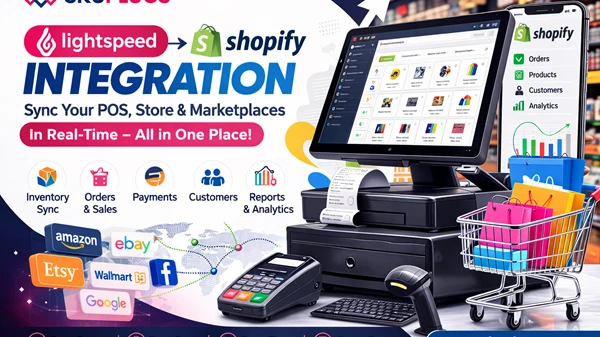
Lightspeed Shopify Integration is a solution that connects your Lightspeed POS system with your Shopify online store. Instead of manually updating products, inventory, and orders on two separate platforms, the integration automatically synchronizes important business data.
The connection helps retailers maintain consistency between their physical store and online storefront while minimizing human errors.
Typical synchronized data includes:
Product information
Inventory quantities
Orders
Pricing
Customer details
Product variants
The result is a single, connected retail ecosystem where every sale automatically updates your inventory across channels.
Why Multi-Channel Retailers Need Integration
Today's customers don't limit themselves to one shopping channel. A customer may:
Discover a product online
Visit the physical store
Purchase through Shopify
Return the product in-store
Without proper Shopify Integration, businesses often struggle to keep every system updated.
Manual updates become increasingly difficult as:
Product catalogs grow
Orders increase
Multiple employees manage inventory
New sales channels are added
Integration eliminates these repetitive tasks and keeps your business running smoothly.
Common Problems Retailers Face Without Integration
Many retailers underestimate how much time is spent managing disconnected systems.
Some common issues include:
Inventory Inconsistencies
Products sold online may still appear available in-store, leading to overselling.
Manual Data Entry
Employees repeatedly update products in multiple systems, increasing workload and mistakes.
Delayed Order Processing
Online orders may require manual transfer into the POS system before fulfillment begins.
Pricing Errors
Changing prices across platforms manually often creates inconsistencies.
Duplicate Product Records
Maintaining separate product databases increases confusion and reporting inaccuracies.
How Lightspeed Shopify Integration Works
The integration acts as a bridge between Lightspeed POS and Shopify.
Whenever business activity occurs, the systems communicate automatically.
For example:
Product Updates
New products created in Lightspeed can automatically appear on Shopify.
Inventory Synchronization
Inventory adjusts automatically after every online or in-store sale.
Order Synchronization
Orders placed through Shopify can be transferred into Lightspeed without manual entry.
Customer Information
Customer details remain updated across connected platforms.
This continuous synchronization helps retailers operate with accurate and reliable business data.
Major Benefits of Lightspeed Shopify Integration
Real-Time Inventory Accuracy
Inventory accuracy is one of the biggest challenges in retail.
Real-time synchronization ensures stock quantities remain updated after every transaction, reducing overselling and stock shortages.
Retailers gain greater confidence in inventory availability while customers enjoy a better shopping experience.
Faster Order Processing
Manual order entry slows fulfillment.
With automated synchronization, Shopify orders can appear in Lightspeed immediately, allowing staff to process orders much faster.
This improves customer satisfaction while reducing administrative work.
Reduced Manual Work
Automation removes repetitive tasks such as:
Updating inventory
Uploading products
Matching stock quantities
Entering orders
Maintaining product information
Employees can focus more on serving customers instead of handling spreadsheets.
Improved Business Accuracy
Human errors become expensive when selling across multiple channels.
Automation significantly reduces mistakes caused by:
Incorrect inventory updates
Missing orders
Wrong pricing
Duplicate product listings
Accurate business data leads to better decision-making.
Better Customer Experience
Customers expect products shown online to actually be available.
Accurate inventory information prevents cancelled orders, delayed shipping, and disappointing shopping experiences.
Satisfied customers are more likely to return and recommend your business.
Key Features Businesses Should Look For
Not every integration solution offers the same capabilities.
When choosing a Lightspeed Integration, businesses should look for features such as:
Automatic Product Sync
Keep product details consistent between platforms.
Inventory Synchronization
Update stock levels instantly after every sale.
Order Synchronization
Transfer online orders into Lightspeed automatically.
Variant Support
Manage different sizes, colors, and styles accurately.
Multi-Location Inventory
Support inventory across multiple retail stores and warehouses.
Scheduled Synchronization
Allow automatic syncing at regular intervals.
Easy Configuration
Simple setup reduces implementation time.
Industries That Benefit Most
Many industries rely on Lightspeed Shopify Sync for efficient operations.
Examples include:
Fashion Retail
Manage seasonal inventory while selling online and in-store.
Electronics Stores
Prevent overselling expensive products.
Home & Living
Keep product availability updated across every channel.
Sports Equipment
Manage large product catalogs with multiple variants.
Beauty & Cosmetics
Maintain accurate stock for fast-moving products.
Specialty Retail
Connect physical retail stores with online sales without manual updates.
Best Practices for a Successful Integration
Simply connecting two systems is not enough.
Businesses should also follow best practices.
Maintain Clean Product Data
Ensure product names, SKUs, and categories are accurate before synchronization.
Standardize Inventory Management
Use consistent inventory rules across all locations.
Monitor Synchronization Logs
Regularly review sync activity to identify potential issues early.
Train Your Team
Employees should understand how automated synchronization works.
Review Product Variants
Verify that all variants sync correctly between systems.
How Integration Supports Business Growth
Retail businesses often begin with one physical store before expanding online.
As sales increase, manual processes become difficult to manage.
Connect Lightspeed to Shopify allows businesses to grow without proportionally increasing administrative work.
Instead of hiring additional staff for inventory updates, retailers can rely on automation to handle routine operations.
This makes expansion more sustainable while maintaining operational efficiency.
Choosing the Right Integration Partner
Technology alone does not guarantee success.
Businesses should select an integration provider that offers:
Reliable synchronization
Easy implementation
Regular software updates
Responsive technical support
Scalable solutions
Secure data transfer
A dependable integration partner ensures long-term business continuity as your operations expand.
Future of Multi-Channel Retail
Retail continues to evolve as customers move between physical and digital shopping experiences.
Businesses that rely on disconnected systems often struggle to keep up with customer expectations.
Automation, centralized inventory management, and real-time synchronization are becoming standard requirements rather than optional features.
As retailers adopt more sales channels, integrations will play an even greater role in simplifying operations and improving customer satisfaction.
Businesses that invest in connected retail technology today position themselves for sustainable growth tomorrow.
Final Thoughts
Managing separate systems for in-store and online sales no longer makes sense for growing retailers. Manual inventory updates, delayed order processing, and inconsistent product information can quickly affect customer satisfaction and business performance.
A reliable Lightspeed Shopify Integration helps eliminate these challenges by automating inventory synchronization, order management, and product updates across both platforms. The result is greater accuracy, improved operational efficiency, and a smoother shopping experience for customers.
For retailers looking to simplify multi-channel operations and scale with confidence, choosing the right integration solution is an important step. SKUPlugs provides a dependable solution that helps businesses connect Lightspeed to Shopify, automate daily workflows, and keep their retail operations synchronized in real time. With the right integration in place, businesses can spend less time managing data and more time focusing on growth, customer relationships, and long-term success.



Comments
Login to Comment