Key Questions to Ask Before Importing Medicines from India
11 Aug, 2026
546 Views 0 Like(s)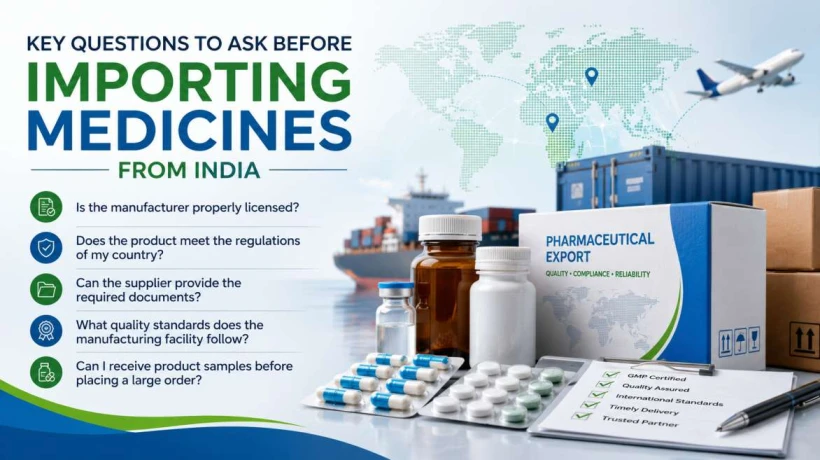
Importing medicines from India can offer competitive sourcing opportunities, but choosing the right pharmaceutical supplier requires careful checks. Learn the key questions to ask about quality, documentation, regulations, pricing, packaging and delivery before placing an order.
Importing medicines from India can be a practical choice for distributors, hospitals, pharmacies and healthcare businesses looking for quality pharmaceutical products at competitive prices. However, importing medicines from India involves more than finding a manufacturer and placing an order. Product quality, regulatory requirements, documentation, packaging, pricing and supply reliability all need careful attention before you make a business commitment.
India has a large pharmaceutical manufacturing sector, with companies producing finished formulations, generic medicines, APIs and other healthcare products for markets across the world. But every importing country has its own rules, and a product that is suitable for one market may require additional approvals or documentation in another.
Before choosing an Indian pharmaceutical supplier, ask the right questions.
Why Do Businesses Import Medicines from India?
India is well known for its pharmaceutical manufacturing capabilities and wide range of generic medicines. Buyers can source products across several therapeutic categories, including antibiotics, cardiovascular medicines, diabetes medicines, pain management products, vitamins and other healthcare products.
Cost is another important consideration. Indian manufacturers can often offer competitive pricing because of established manufacturing facilities, a large pharmaceutical workforce and a strong domestic supply chain.
For example, a distributor looking for a regular supply of tablets may compare several Indian manufacturers based on price, batch size, product quality, packaging and delivery timelines rather than choosing a supplier only because the quotation is low.
This is why proper supplier evaluation matters.
Key Questions to Ask Before Importing Medicines from India
1. Is the manufacturer properly licensed?
Start with the basics. Ask the pharmaceutical manufacturer for details about its manufacturing licence, manufacturing site and relevant regulatory approvals.
You should know exactly which company will manufacture the medicine and where the production will take place.
Do not rely only on a company profile or sales presentation. Ask for supporting documents and check whether the details match the actual manufacturing facility.
India's Central Drugs Standard Control Organization (CDSCO) has regulatory responsibility for the import of drugs into India and handles several central drug regulatory functions.
2. Does the product meet the regulations of my country?
This is one of the most important questions when importing medicines from India.
Your country's medicine regulator may have specific requirements for product registration, manufacturing standards, labelling, packaging, stability data, testing and marketing approval.
Do not assume that an Indian manufacturing approval automatically gives you permission to sell the product in your market.
Before placing an order, check:
- Product registration requirements
- Import licence requirements
- Marketing authorisation requirements
- Labelling rules
- Packaging requirements
- Product testing requirements
- Required certificates
- Local pharmacovigilance obligations
The exact requirements depend on the destination country and the type of medicine.
3. Can the supplier provide the required documents?
Good documentation is an important part of pharmaceutical sourcing.
Ask the supplier which documents they can provide for your product and destination market. Depending on the country and product, documents may include a Certificate of Analysis, manufacturing licence, product specifications, batch documents, Certificate of Pharmaceutical Product and other regulatory papers.
You may also need commercial documents such as:
- Commercial invoice
- Packing list
- Certificate of Origin
- Shipping documents
- Batch details
- Product test reports
- Product registration documents
Ask for a document checklist before finalising the order. This can help prevent delays later.
4. What quality standards does the manufacturing facility follow?
Price should never be the only factor when choosing a pharmaceutical supplier.
Ask about the manufacturing facility, quality control procedures, testing systems and applicable Good Manufacturing Practice standards.
You can also ask whether the facility has undergone inspections or audits by recognised regulatory authorities.
If possible, request recent certificates and quality documents rather than relying on old records.
A distributor importing medicines for a long-term market should have confidence in the supplier's production and quality systems before signing a major agreement.
5. Can I receive product samples before placing a large order?
Samples can tell you a lot before you commit to a commercial shipment.
Ask for samples and review factors such as:
- Product appearance
- Packaging quality
- Labelling
- Batch information
- Expiry details
- Dosage and strength
- Product specifications
If local regulations permit, you may also arrange independent testing of samples through an appropriate laboratory.
A small sample order can be far less risky than discovering quality or packaging problems after receiving a large shipment.
6. What is the minimum order quantity?
Every manufacturer has its own minimum order quantity, commonly known as MOQ.
This matters particularly for new distributors entering a market.
For example, if your expected monthly sales are only 5,000 units but the supplier requires an order of 100,000 units, you could end up holding excessive inventory.
Ask about:
- Minimum order quantity
- Batch size
- Production capacity
- Repeat order quantity
- Lead time
- Storage requirements
A supplier that understands your market size may be able to suggest a more practical purchasing plan.
7. What is the total landed cost?
A low factory price does not always mean a low final cost.
When importing medicines from India, calculate the complete landed cost. This may include manufacturing cost, packaging, documentation, freight, insurance, customs duties, taxes, testing and local distribution expenses.
For example:
Product price + freight + insurance + duties + taxes + testing + local charges = approximate landed cost
Compare suppliers using this figure rather than comparing only the price per tablet, bottle or box.
8. What packaging and labelling options are available?
Packaging requirements can vary significantly between countries.
Ask whether the manufacturer can provide your required:
- Language
- Product information
- Batch number
- Manufacturing date
- Expiry date
- Storage instructions
- Registration details
- Manufacturer information
- Barcode or other market-specific information
Some buyers may also require private-label or contract manufacturing arrangements. If this applies to your business, discuss artwork approval, packaging material, ownership of artwork and production timelines before the first commercial order.
9. How long will production and delivery take?
Pharmaceutical supply chains require planning.
Ask the supplier for a realistic production timeline and shipping schedule. Do not base your inventory planning on an ideal delivery date alone.
Important questions include:
- How many days are needed for production?
- How long does packaging take?
- When will quality testing be completed?
- When will the shipment be ready?
- Which shipping methods are available?
- What happens if production is delayed?
A supplier with clear communication can make international purchasing much easier.
10. What happens if there is a quality issue?
This question is often forgotten until something goes wrong.
Before signing an agreement, ask how complaints, rejected batches, damaged goods and product recalls are handled.
Your agreement should clearly cover responsibilities related to product quality, documentation, replacement shipments and communication.
It is also useful to know who will be your main contact for quality and regulatory matters.
How to Compare Indian Pharmaceutical Suppliers
Instead of choosing a supplier based only on price, create a simple comparison sheet.
You can compare suppliers based on:
|
Factor |
What to Check |
|
Manufacturing |
Licence, facility and production capacity |
|
Quality |
GMP systems, testing and certificates |
|
Product |
Composition, strength and specifications |
|
Documents |
Regulatory and commercial paperwork |
|
Price |
Product cost and total landed cost |
|
MOQ |
Minimum quantity per order |
|
Delivery |
Production and shipping timelines |
|
Packaging |
Market-specific labelling and artwork |
|
Support |
Communication and after-sales assistance |
|
Experience |
Export markets and relevant product experience |
This makes supplier selection more objective and can help you avoid choosing a manufacturer simply because it offers the cheapest quotation.
Common Mistakes to Avoid
One common mistake is starting with price instead of product requirements.
Another is assuming that all Indian pharmaceutical manufacturers offer the same level of quality or regulatory support.
Buyers should also avoid placing large orders before checking samples, documentation and market requirements.
Ignoring shelf life can create another problem. Medicines have specific storage and expiry considerations, so your purchase and shipping plans should take the remaining shelf life into account.
CDSCO maintains official information relating to drug import procedures, documentation and regulatory processes, so buyers should refer to current official requirements where applicable.
Final Checklist Before Placing an Order
Before confirming your first pharmaceutical order from India, ask yourself:
- Have I checked the manufacturer's credentials?
- Is the product suitable for my country's regulations?
- Have I reviewed the required documents?
- Have I checked samples?
- Is the packaging suitable for my market?
- Do I understand the MOQ?
- Have I calculated the total landed cost?
- Is the delivery timeline realistic?
- Have quality responsibilities been discussed?
- Do I have a clear agreement with the supplier?
If the answer to these questions is yes, you are in a much stronger position to move forward.
Conclusion
Importing medicines from India can offer good opportunities for pharmaceutical distributors and healthcare businesses, but successful sourcing depends on careful planning. The right supplier should offer more than a competitive price. Product quality, documentation, regulatory support, communication, packaging and reliable supply all matter.
The best approach is to ask detailed questions before placing an order. Take time to review the manufacturer, check the product requirements in your destination country and understand the full cost of importing.
A well-planned supplier relationship can make pharmaceutical sourcing more predictable and support long-term business growth.
Note: Pharmaceutical import rules differ by destination country and product category. Always check the latest requirements with the relevant medicine regulator and qualified regulatory professionals before importing or selling medicines.



Comments
Login to Comment