How New Therapies Are Creating Fresh Opportunities in the Pharmaceutical Market
30 Sep, 2026
5 Views 0 Like(s)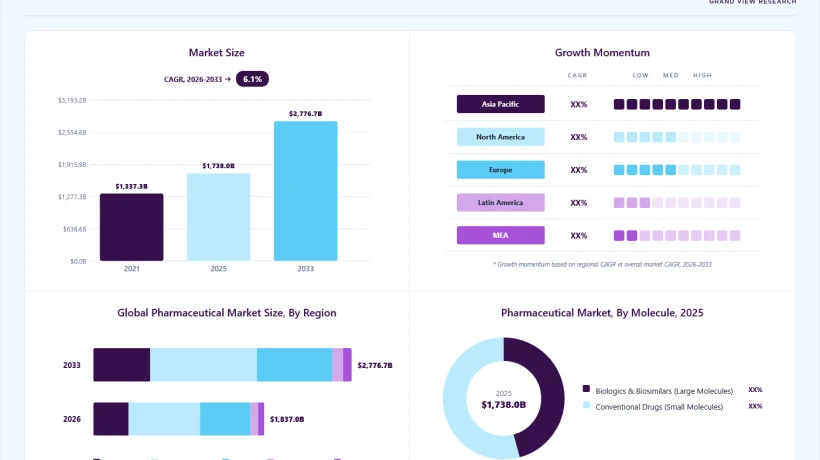
The global pharmaceutical market size was valued at USD 1,738.0 billion in 2025 and is projected to grow from USD 1,837.0 billion in 2026 to USD 2,776.7 billion by 2033, at a CAGR of 6.1% from 2026 to 2033
The pharmaceutical market is expanding as rising disease prevalence, aging populations, healthcare access, and advances in drug development reshape treatment demand. The market was valued at USD 1,738.0 billion in 2025 and is estimated to reach USD 1,837.0 billion in 2026, before rising to USD 2,776.7 billion by 2033, representing a 6.1% CAGR from 2026 to 2033. The continued need for chronic disease management, specialty medicines, biologics, and innovative therapies is creating sustained opportunities across the industry.
Disease Burden Continues to Expand the Need for Medicines
The increasing prevalence of cancer, cardiovascular disorders, diabetes, respiratory conditions, and infectious diseases remains a central factor supporting pharmaceutical demand. Longer life expectancy is also increasing the number of people requiring long-term treatment for multiple conditions. Urbanization, sedentary lifestyles, changing dietary patterns, and rising obesity rates are adding further pressure to healthcare systems.
The growing focus on early diagnosis, preventive healthcare, and structured treatment protocols is encouraging earlier intervention and more consistent medication use. This creates demand across branded medicines, specialty therapies, maintenance treatments, and affordable alternatives.
Small Molecules Maintain a Strong Market Foundation
Conventional drugs, or small molecules, accounted for the largest molecule-type share at 54.24% in 2025. Their established manufacturing processes, extensive clinical experience, broad therapeutic applications, and availability of generic alternatives continue to support their position.
At the same time, biologics and biosimilars are gaining momentum. This segment is projected to expand at a 7.17% CAGR during the forecast period as targeted therapies, monoclonal antibodies, recombinant proteins, and other advanced modalities become increasingly important in the treatment of cancer and autoimmune conditions.
Branded Products Lead While Generics Broaden Access
Branded pharmaceuticals represented the largest product share at 66.49% in 2025. Innovative therapies, patent protection, clinical development investment, and new product launches continue to support branded drug revenue.
Generics are also becoming increasingly important as patents expire and healthcare systems seek cost-efficient treatment options. The generic segment is projected to grow at a 7.20% CAGR through the forecast period. Expanding domestic manufacturing, supportive healthcare policies, and greater adoption in emerging markets are contributing to this growth.
Prescription Medicines Remain the Main Treatment Channel
Prescription drugs accounted for 86.53% of revenue in 2025, reflecting the substantial demand for physician-supervised treatments for chronic and complex diseases. Oncology, cardiovascular disorders, diabetes, autoimmune conditions, specialty medicines, and biologics contribute strongly to prescription demand.
Meanwhile, the OTC segment is projected to grow at a 7.80% CAGR. Greater awareness of preventive healthcare, self-medication, convenient dosage formats, and expanding access through retail and online pharmacies are supporting its development.
Cancer Leads Therapeutic Demand as Obesity Becomes a Fast-Growing Area
Cancer represented the largest disease segment with an 18.61% share in 2025. Investment in targeted therapies, immunotherapies, monoclonal antibodies, personalized medicine, and oncology research continues to expand treatment possibilities.
Obesity is emerging as another significant growth area, with the segment projected to record a 12.73% CAGR. The increasing prevalence of obesity-related conditions and adoption of novel pharmacological treatments are encouraging greater pharmaceutical activity in weight management.
Oral Treatments Dominate as Injectable Therapies Advance
Oral medicines remained the leading route of administration, accounting for 57.35% of revenue in 2025. Tablets, capsules, and syrups benefit from convenience, ease of administration, and established manufacturing capabilities.
Parenteral treatments, however, are projected to grow at a 7.63% CAGR. Biologics, biosimilars, specialty drugs, and therapies requiring rapid or high-bioavailability delivery are supporting demand for injectable formulations. Prefilled syringes, autoinjectors, and long-acting injectables are also improving convenience and expanding applications beyond traditional hospital settings.
Digital Innovation Is Changing Pharmaceutical Development
Technology is increasingly influencing how medicines are researched, developed, tested, and commercialized. Artificial intelligence-driven drug discovery tools are helping accelerate compound identification, while digital integration in clinical trials is improving patient recruitment, monitoring, and data analysis.
Precision medicine, biotechnology, cell-based therapies, monoclonal antibodies, and advanced drug delivery platforms are also creating new pathways for pharmaceutical innovation. At the manufacturing level, modernization and supply chain digitization are supporting production scalability, inventory management, and operational efficiency.
Regional Healthcare Investment Shapes Future Expansion
North America held the largest regional share at 41.80% in 2025, supported by high research intensity, advanced healthcare infrastructure, significant drug spending, and strong adoption of specialty and innovative therapies.
Asia Pacific is expected to register the fastest CAGR of 7.06% from 2026 to 2033. Expanding healthcare access, rising income levels, urbanization, local manufacturing, biotechnology investment, and large patient populations are creating substantial opportunities.
Europe continues to benefit from established pharmaceutical manufacturing capabilities, biosimilars, specialty generics, research networks, and advanced healthcare systems, while Latin America and the Middle East & Africa are supported by expanding access to medicines, healthcare infrastructure, and local manufacturing initiatives.
High Development Costs Remain a Key Industry Constraint
Pharmaceutical innovation requires extensive research, clinical trials, regulatory submissions, manufacturing preparation, and post-market monitoring. Bringing a new drug to market can take more than ten years and require billions of dollars of investment.
High clinical failure rates and differences between regulatory frameworks can further increase development costs and timelines. These challenges can particularly affect smaller pharmaceutical and biotechnology companies, encouraging partnerships, licensing agreements, and acquisitions as pathways to commercialization.
Key Pharmaceutical Companies:
· F. Hoffmann-La Roche Ltd
· Novartis AG
· AbbVie Inc.
· Johnson & Johnson Services, Inc.
About us:
Grand View Research, a market research and consulting company, provides syndicated research reports, customized research reports, and consulting services. Grand View Research database is used by the world's renowned academic institutions and Fortune 500 companies to understand the global and regional business environment. Our database features thousands of statistics and in-depth analysis on 46 industries in 25 major countries worldwide.

Comments
Login to Comment