Key Management in Cryptography: How Secure Key Provisioning Supports Enterprise Security
02 Nov, 2026
13 Views 0 Like(s)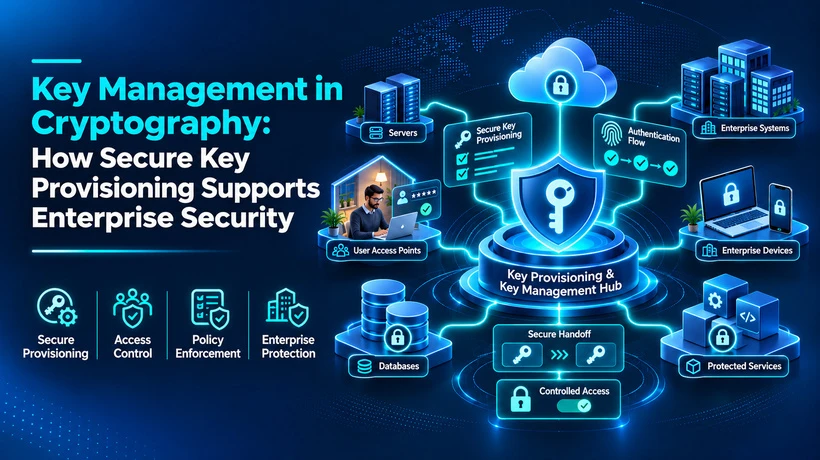
Secure key provisioning determines how applications, systems, and authorized users receive access to the cryptographic keys required for approved operations. Key management in cryptography helps organizations provision keys securely while controlling identity, authorization, storage, rotation, and lifecycle activities
Introduction
Cryptographic keys protect some of the most important digital assets within an enterprise.
Organizations use keys for encryption, authentication, digital signatures, certificates, API security, and secure communications.
However, generating a key is only the beginning.
Applications and authorized systems must receive access to the appropriate cryptographic resources.
This process is known as key provisioning.
Poor provisioning practices can expose sensitive keys or provide excessive access.
A well-designed provisioning process ensures that only authorized identities receive access to the cryptographic resources they require.
This makes secure provisioning an important component of Key management.
A structured approach to key management in cryptography helps organizations control how keys are generated, provisioned, accessed, rotated, recovered, and retired.
What Is Key Provisioning?
Key provisioning refers to the secure process of making cryptographic keys or approved cryptographic operations available to authorized systems, applications, or users.
Provisioning should answer several questions:
-
Who or what needs access?
-
Which key or cryptographic operation is required?
-
Why is access required?
-
What permissions should apply?
-
How long should access remain active?
-
How should access be revoked?
These questions help organizations avoid unnecessary key exposure.
Why Secure Provisioning Matters
If organizations provision keys without sufficient controls, they may create security weaknesses.
For example, an application may receive access to a key that protects information outside its business function.
If attackers compromise that application, they may gain access to unnecessary cryptographic capabilities.
Least privilege therefore plays an important role in provisioning.
Key Management in Cryptography
Key management in cryptography covers the entire lifecycle of cryptographic keys.
This lifecycle includes:
-
Generation
-
Provisioning
-
Storage
-
Access
-
Usage
-
Rotation
-
Backup
-
Recovery
-
Retirement
-
Destruction
Provisioning connects key creation with authorized operational use.
Identity-Based Provisioning
Organizations should associate cryptographic access with verified identities.
These identities may represent:
-
Employees
-
Applications
-
Services
-
Devices
-
Automated workloads
An application should prove its identity before receiving approved cryptographic access.
Application Provisioning
Applications frequently require cryptographic services.
For example, an application may need to encrypt customer records.
Instead of embedding a raw encryption key in application code, the application can use an approved cryptographic service.
The application receives only the access necessary to perform its authorized operation.
Service Account Provisioning
Automated systems often use service accounts.
These accounts may require cryptographic access without human interaction.
Organizations should define:
-
Account ownership
-
Purpose
-
Permissions
-
Key access
-
Rotation
-
Expiration
-
Revocation
Service account access should receive the same security attention as human identities.
Least Privilege
Least privilege should form the foundation of secure key provisioning.
Organizations should provide only the permissions required for a specific function.
For example, an application that needs to encrypt information should not automatically receive unrestricted access to decrypt unrelated information.
Granular permissions can reduce unnecessary exposure.
Provisioning in Cloud Environments
Cloud applications may be created and removed rapidly.
This creates additional provisioning requirements.
When an application launches, it may require cryptographic access.
When the application is retired, that access should be removed.
Automated provisioning and deprovisioning can help maintain consistency.
Provisioning Across Hybrid Infrastructure
Enterprises may operate applications across cloud and on-premises infrastructure.
A consistent Key management strategy should cover both environments.
Security teams should understand:
-
Which systems require access
-
Where keys reside
-
Which permissions apply
-
How access is revoked
Protecting Raw Key Material
Organizations should minimize unnecessary exposure of raw cryptographic keys.
Where appropriate, applications should request cryptographic operations without receiving direct access to sensitive key material.
This approach can reduce the number of systems where keys exist.
Key Rotation and Provisioning
When organizations rotate a key, applications may need access to the replacement key.
The provisioning process should account for this transition.
Security teams should test:
-
New key availability
-
Application compatibility
-
Permission changes
-
Old key handling
-
Rollback procedures
This can reduce the risk of service interruptions.
Provisioning and Digital Certificates
Digital certificates require cryptographic keys, particularly private keys.
Organizations should provision certificate-related credentials carefully.
Security teams should control who can:
-
Request certificates
-
Access private keys
-
Renew certificates
-
Replace certificates
-
Revoke credentials
Provisioning and APIs
APIs may use cryptographic keys for authentication and secure communication.
Organizations should establish controlled provisioning procedures for API credentials.
These procedures should include:
-
Ownership
-
Permissions
-
Expiration
-
Rotation
-
Revocation
Automated Provisioning
Automation can improve provisioning consistency.
Organizations can create workflows that automatically provide approved applications with appropriate cryptographic access.
However, automation requires strong controls.
Automation identities should receive only the permissions necessary to perform their tasks.
Provisioning and DevOps
Modern DevOps environments create applications rapidly.
Development and deployment pipelines may require access to cryptographic services.
Organizations should ensure that production keys do not become unnecessarily available within development environments.
Security teams should establish separate controls for:
-
Development
-
Testing
-
Staging
-
Production
Monitoring Provisioning Events
Organizations should monitor provisioning activity.
Important events include:
-
New access requests
-
Key assignments
-
Permission changes
-
Failed requests
-
Revocations
-
Administrative actions
Monitoring provides visibility into changes involving cryptographic access.
Deprovisioning
Secure provisioning must include secure deprovisioning.
When a user, application, service, or device no longer requires access, organizations should revoke its cryptographic permissions.
For example, when an application is retired, its access to encryption keys should also be reviewed.
Common Provisioning Challenges
Excessive Permissions
Applications may receive more access than necessary.
Manual Processes
Manual provisioning can create inconsistencies.
Poor Identity Validation
Unauthorized identities may receive access.
Key Exposure
Raw keys may appear in application environments.
Incomplete Deprovisioning
Retired systems may retain unnecessary permissions.
Best Practices
Organizations should:
-
Verify identities before provisioning
-
Apply least privilege
-
Avoid unnecessary exposure of raw keys
-
Assign clear ownership
-
Separate development and production access
-
Automate approved provisioning workflows
-
Monitor provisioning activity
-
Establish expiration policies
-
Review permissions regularly
-
Revoke access when no longer required
-
Test key rotation
-
Document provisioning procedures
Building a Secure Provisioning Lifecycle
A practical lifecycle can follow:
Request → Verify → Authorize → Provision → Monitor → Review → Rotate → Revoke
This ensures that cryptographic access remains controlled throughout its lifecycle.
Conclusion
Secure key provisioning plays an important role in enterprise cryptographic security.
Applications, users, services, and automated workloads need controlled access to cryptographic resources, but organizations should avoid providing unnecessary permissions or exposing sensitive key material.
Key management in cryptography provides the lifecycle framework needed to manage cryptographic keys from generation through destruction.
Effective Key management supports secure provisioning, least privilege, rotation, monitoring, recovery, and deprovisioning.
By integrating secure provisioning with identity management, application security, cloud security, and automated workflows, enterprises can strengthen control over cryptographic resources while reducing unnecessary key exposure.


Comments
Login to Comment