How Poor Operational Visibility Impacts Enterprise Decision-Making
03 Jul, 2026
1124 Views 0 Like(s)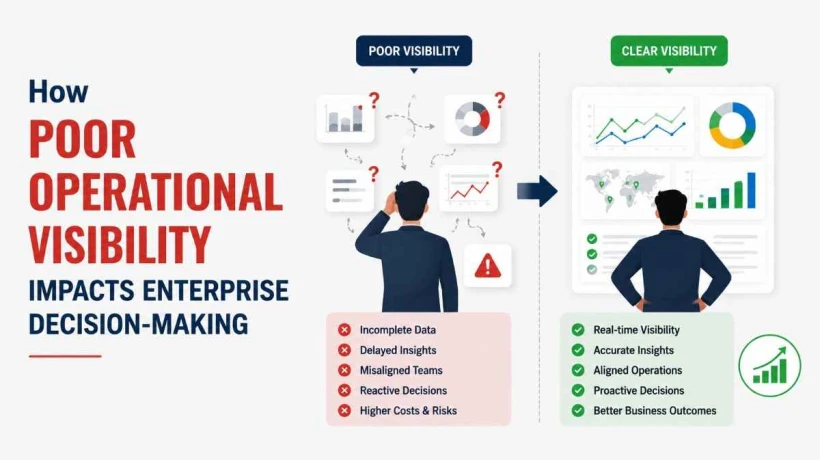
Discover how poor Operational Visibility affects enterprise decision-making and learn how real-time insights improve efficiency, forecasting, and business performance.
Modern enterprises generate massive amounts of operational data every second. Manufacturing plants, logistics networks, warehouses, energy facilities, healthcare systems, and retail operations all rely on continuous information from machines, sensors, software platforms, and connected devices. Despite this abundance of data, many organizations still struggle with operational visibility.
Operational visibility refers to the ability to monitor, analyze, and understand business processes in real time. When leaders lack accurate and timely operational insights, decision-making becomes reactive instead of strategic. Small operational issues remain unnoticed until they become expensive disruptions.
The financial impact is substantial. According to the IBM Cost of a Data Breach Report 2024, the global average cost of a data breach reached $4.88 million, highlighting the growing importance of real-time operational monitoring and system awareness. Likewise, McKinsey & Company reports that organizations using advanced analytics and real-time operational intelligence consistently achieve better productivity and faster decision cycles than their peers. Additionally, Gartner predicts that by 2027, the majority of enterprise operational decisions will be supported by AI-driven analytics, making data visibility a core business capability rather than a competitive advantage.
These findings demonstrate a common reality: organizations cannot make informed decisions without complete operational visibility.
What Is Operational Visibility?
Operational visibility is the continuous monitoring of processes, assets, equipment, personnel, and workflows across an organization. It combines information from multiple systems into a single view that helps decision-makers understand current performance and identify potential risks.
Instead of relying on disconnected reports generated at the end of the day or week, organizations with strong visibility access live operational information that supports immediate action.
Operational visibility commonly includes:
-
Equipment performance monitoring
-
Supply chain tracking
-
Inventory management
-
Production efficiency
-
Workforce productivity
-
Energy consumption
-
Quality control metrics
-
Asset utilization
The objective is not simply to collect more data. The goal is to transform operational data into information that supports timely and accurate business decisions.
Why Poor Operational Visibility Creates Decision-Making Problems
Poor visibility creates information gaps throughout an organization. Executives, operations managers, and frontline supervisors often work with incomplete or outdated information.
As a result, important decisions rely on assumptions instead of facts.
Several challenges commonly emerge.
Delayed Identification of Operational Issues
Many operational failures develop gradually. Equipment may begin operating below optimal efficiency weeks before a complete breakdown occurs. Production defects may increase slowly before quality teams recognize the trend.
Without continuous monitoring, organizations only discover problems after customers experience delays or production targets are missed.
Late detection often results in:
-
Emergency maintenance
-
Production downtime
-
Increased labor costs
-
Delayed deliveries
-
Customer dissatisfaction
The longer an issue remains hidden, the greater its financial impact.
Inaccurate Forecasting
Business forecasts depend on reliable operational data.
If inventory records are inaccurate, production data contains errors, or machine utilization remains unknown, forecasting models become unreliable.
Poor forecasting affects:
-
Capacity planning
-
Procurement decisions
-
Budget allocation
-
Workforce scheduling
-
Demand planning
Executives may invest in unnecessary capacity while overlooking actual operational bottlenecks.
Slow Executive Decision-Making
Decision-makers often spend more time collecting information than analyzing it.
Different departments maintain separate reporting systems, creating inconsistent versions of operational performance. Finance, operations, maintenance, procurement, and logistics may all report different numbers for the same business process.
When leadership teams cannot trust operational data, decision-making slows considerably.
Critical initiatives may remain pending until multiple reports are manually verified.
Higher Operational Costs
Poor visibility increases costs in ways that are not always immediately obvious.
Examples include:
-
Unplanned equipment failures
-
Excess inventory
-
Idle production capacity
-
Higher maintenance expenses
-
Increased energy consumption
-
Inefficient workforce allocation
Many organizations discover these hidden costs only during quarterly financial reviews, when corrective action becomes more expensive.
Reduced Supply Chain Responsiveness
Modern supply chains involve suppliers, transportation providers, warehouses, manufacturing facilities, and distribution centers.
A disruption at one stage can affect the entire network.
Without operational visibility, organizations struggle to answer important questions:
-
Where is the inventory currently located?
-
Which supplier is experiencing delays?
-
Which production line faces shortages?
-
Which customer orders are at risk?
Delayed responses often lead to missed delivery commitments and increased logistics expenses.
Data Silos Create Inconsistent Business Decisions
Many enterprises still operate with disconnected software systems.
ERP platforms, maintenance applications, manufacturing execution systems, warehouse management software, and customer platforms often function independently.
As a result:
-
Operations teams view one dataset.
-
Finance analyzes another.
-
Executives receive summarized reports.
-
Maintenance teams rely on separate dashboards.
These isolated systems prevent leaders from understanding the complete operational picture.
Integrated IoT Dashboard Solutions help consolidate information from multiple operational systems into a centralized interface, improving consistency across departments and reducing conflicting reports.
Real-World Example: Siemens and Digital Manufacturing
A practical example comes from Siemens, which has invested heavily in digital manufacturing and industrial analytics across several production facilities.
The company uses connected sensors, industrial IoT platforms, and centralized monitoring systems to observe machine performance, production quality, and energy usage in real time.
Instead of waiting for periodic production reports, plant managers receive continuous operational insights. Maintenance teams can identify equipment abnormalities before failures occur, while production managers adjust scheduling based on live factory conditions.
This approach has contributed to improved production efficiency, reduced downtime, and faster operational decision-making across multiple manufacturing environments.
The example illustrates how operational visibility directly supports informed management decisions rather than simply generating additional reports.
The Role of Real-Time Operational Intelligence
Real-time operational intelligence combines sensor data, software analytics, cloud infrastructure, and visualization tools to present current business conditions as they happen.
Decision-makers gain immediate awareness of:
-
Production output
-
Machine health
-
Environmental conditions
-
Equipment utilization
-
Inventory movement
-
Transportation status
-
Energy performance
Instead of reviewing yesterday's operational reports, managers can respond immediately to developing issues.
This shift significantly improves organizational agility while reducing operational uncertainty.
How IoT Dashboard Solutions Improve Enterprise Visibility
Modern enterprises increasingly depend on connected devices that continuously generate operational information.
However, raw data alone provides little value without proper visualization and analysis.
IoT Dashboard Solutions collect data from sensors, industrial equipment, enterprise software, and connected assets and present it in centralized dashboards that display meaningful operational metrics.
Typical capabilities include:
1. Centralized Monitoring
Organizations gain a single interface for monitoring multiple facilities, production lines, warehouses, or field assets.
2. Real-Time Alerts
Automated notifications identify abnormal operating conditions before they become critical failures.
3. Historical Trend Analysis
Managers can compare historical performance with current operations to identify recurring issues and improve planning.
4. Cross-Department Visibility
Engineering, maintenance, operations, finance, and executive teams access consistent operational information, improving collaboration and reducing reporting conflicts.
Business Impact and ROI
Improved operational visibility produces measurable business benefits when implemented effectively.
Organizations commonly report improvements such as:
-
Lower equipment downtime through predictive maintenance
-
Faster incident response
-
Reduced maintenance costs
-
Better inventory accuracy
-
Improved production planning
-
Lower energy consumption
-
Faster executive reporting cycles
According to McKinsey & Company, predictive maintenance programs supported by operational analytics can reduce maintenance costs by 10%–40%, decrease equipment downtime by 30%–50%, and extend machine life by 20%–40%.
Similarly, Deloitte has reported that organizations implementing industrial IoT technologies often achieve productivity improvements ranging from 10% to 25%, depending on operational maturity and industry.
Although implementation costs vary, improved visibility often delivers measurable returns through better asset utilization, lower operational risk, and faster decision-making.
Building Better Operational Visibility
Improving visibility requires more than purchasing new technology.
Organizations should focus on several practical initiatives:
1. Standardize Data Collection
Ensure operational data follows consistent standards across departments and facilities.
2. Integrate Existing Systems
Connect ERP platforms, manufacturing systems, maintenance software, and sensor networks to eliminate isolated information sources.
4. Focus on Actionable Metrics
Avoid overwhelming users with excessive dashboards. Monitor key performance indicators that directly support business decisions.
5. Improve Data Quality
Reliable decisions require accurate data. Regular validation, sensor maintenance, and governance processes improve confidence in operational reporting.
6. Train Decision-Makers
Operational dashboards only create value when managers understand how to interpret trends and respond appropriately.
Final Thoughts
Operational visibility has become a fundamental requirement for enterprise decision-making. As organizations expand their digital infrastructure and connected operations, fragmented information creates delays, higher costs, and unnecessary business risks.
Leaders who rely on incomplete operational data often react to problems after they have already affected productivity, customer satisfaction, or financial performance. In contrast, organizations with comprehensive visibility can identify emerging issues early, evaluate performance objectively, and make informed decisions based on current operational conditions.
Technologies such as IoT Dashboard Solutions play an important role by bringing together data from multiple systems into a unified view, enabling faster analysis and more consistent decision-making across departments. However, technology alone is not enough. Success also depends on reliable data, integrated systems, clear governance, and a culture that values evidence-based decision-making.
As enterprises continue investing in digital transformation, operational visibility will remain one of the most important factors influencing efficiency, resilience, and long-term business performance.



Comments
Login to Comment