How Lumber Takeoff Creates More Reliable Material Quantities For Construction
05 Aug, 2026
712 Views 0 Like(s)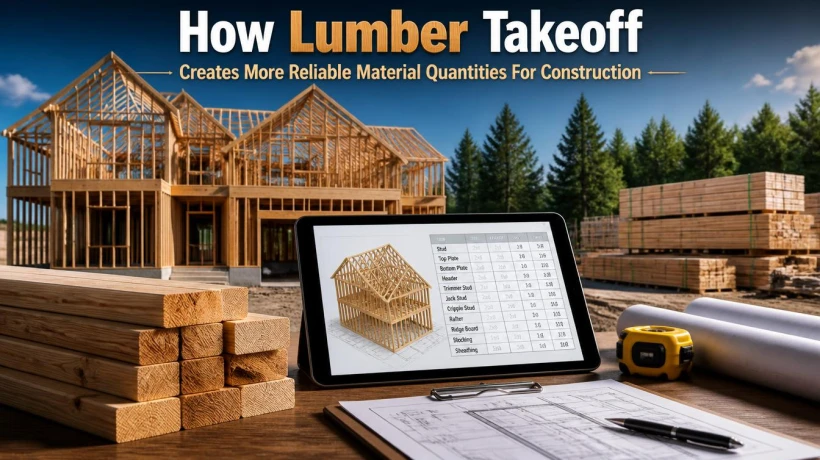
A lumber takeoff ensures that the estimator can present an accurate bid to the client. A precise takeoff prevents budget overruns by avoiding reordering and ordering extra material.
A lumber takeoff creates a list of the materials needed for a project, such as joists, studs, headers, and plywood sheets. It helps prevent reordering and over-ordering of the material during the project. Failure of this process leads to project delays and budget overruns.
What Is A Lumber Takeoff?
This is a list of materials consisting of the types, sizes, and quantities of wood materials needed to complete a project. It is one specialty of a larger construction material takeoff. It categorizes each trade’s requirements for the worksite.
An estimator studies the plans and calculates the amount of lumber. These are calculated in square or linear feet or in board feet. This is an important step when a contractor has to prepare a bid for a project. It will represent the largest expenditure on the worksite’s spending.
Why Does Takeoff Accuracy Matter for Cost Planning??
According to NAHB, the framing lumber alone comprises approximately 16–17% of all single-family home construction. This makes up 94% of all takeoffs of this scope.
Framing lumber inaccuracies have a direct effect on the overall project budget. McKinsey’s research found that budget overruns were common in 80% of major capital projects. The main cause of this budget overrun is poorly planned, inaccurate initial estimates. This is why an accurate takeoff ensures accurate construction cost planning.
How Does Lumber Measurement Procedure Work?
The lumber measurement process begins with the set of plans from the general contractor or the owner. The estimator identifies all framing members, noting their sizes, lengths, and weighing the lumber required to complete the project.
The work process typically involves the following:
-
Reviewing structural drawings and framing schedules
-
Calculating linear and board footage by species
-
Factoring in a waste allowance
-
Checking calculated results against current market prices
For example, according to Home Innovation Research Labs’ findings, a new home will typically require the following components:
-
Around 15,000 board feet of framing lumber
-
Over 2,200 square feet of softwood plywood
-
6,800 square feet of oriented strand board (OSB)
Inaccuracies in any of these calculations can generate issues. This error can add up to the final cost of the project.
How Much Waste Can Accurate Takeoff Services Prevent?
According to EPA figures, wood accounts for 20-30% of all building-related C&D debris by weight. A lot of it results from unnecessary over-ordering due to rough estimating practices.
The EPA’s research found that in 2018, the combined C&D debris generated in the U.S. amounted to 600 million tons. This is compared to only roughly 250 million tons of total household waste. Better lumber estimating helps reduce this number by preventing the ordering of excess material. Thus, it reduces material waste.
Lumber Material Takeoff Vs. Rough Estimating: What’s The Real Difference?
A rough estimate is based on typical square footage multipliers. On the other hand, a lumber material takeoff involves determining all members by their grade and size in accordance with the project’s plans and specifications.
This is another important aspect that is not taken into account by most lumber takeoff services.
According to the Producer Price Index data, Lumber estimates have become important in a post-pandemic economic environment. Because the price of residential building materials has experienced increases. The input costs have risen by over 3% since mid-2025. SMA Estimating LLC offers top-notch lumber material takeoff services. It offers field-specific knowledge and expertise.
Conclusion
A lumber takeoff ensures that the estimator can present an accurate bid to the client. A precise takeoff prevents budget overruns by avoiding reordering and ordering extra material. This practice prevents material waste and secures profit margin.



Comments
Login to Comment