Frontend Development Company: What Businesses Should Consider
07 Sep, 2026
4 Views 0 Like(s)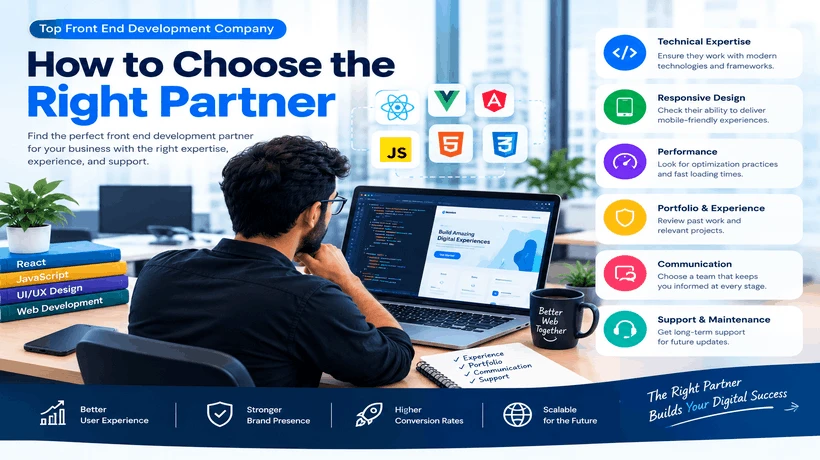
A reliable frontend development company should combine technical expertise with responsive design, performance optimization, accessibility, testing, communication, and long-term support. Businesses should review relevant portfolios, understand development processes, compare proposals, and consider scalability. Choosing a partner based on project requirements and overall value can lead to a stronger and more maintainable digital product.
A website's frontend determines much of the experience visitors have when interacting with a business online. From navigation and page layouts to forms, product displays, dashboards, and interactive elements, frontend development connects users with the functionality behind a digital product.
For this reason, choosing the right frontend development company is an important decision for businesses building a new website, redesigning an existing platform, or developing a custom web application.
The right partner should provide more than coding skills. It should understand responsive design, performance, accessibility, usability, testing, and the business objectives behind the project.
Understand What You Need to Build
Before contacting a development company, identify your project's basic requirements.
Are you creating a corporate website, ecommerce store, landing page, SaaS product, customer portal, or web application?
Each type of project has different technical requirements.
For example, an ecommerce website may require product filtering, shopping cart functionality, checkout interfaces, and payment integrations. A SaaS product may require dashboards, account management, notifications, and complex interactive components.
Understanding these requirements helps you choose a provider with relevant experience.
Evaluate Technical Skills
A professional frontend team should be comfortable with modern web technologies.
Depending on the project, this could include HTML, CSS, JavaScript, React, Vue.js, Angular, Next.js, and TypeScript.
However, the technology list should not be the only consideration.
Ask how the company handles:
-
Responsive development
-
Performance optimization
-
API integration
-
Browser compatibility
-
Accessibility
-
Testing
-
Code organization
-
Maintenance
The best technology is the one that fits the project's actual requirements.
Review the Portfolio Carefully
A portfolio is one of the easiest ways to assess practical experience.
Visit completed websites rather than relying exclusively on screenshots.
Test them using different screen sizes and browsers. Explore navigation, forms, menus, interactive components, and pages with larger amounts of content.
A development company with experience building projects similar to yours may be better prepared to handle the specific challenges of your project.
Responsive Development Should Be Essential
Mobile users represent a significant portion of website visitors.
A responsive interface ensures that pages adapt to smartphones, tablets, laptops, and desktop screens.
Responsive development involves more than shrinking a desktop layout. Navigation, spacing, typography, buttons, images, forms, and interactive components may all need to behave differently depending on screen size.
Ask potential providers how they test responsive layouts before choosing one.
Website Speed and Performance
Performance can directly affect the user experience.
Visitors generally expect pages to respond quickly, and slow interfaces can make navigation frustrating.
Frontend developers can improve performance by optimizing images, reducing unnecessary JavaScript, loading resources efficiently, implementing lazy loading, and using suitable development architectures.
Core Web Vitals can also provide useful measurements for evaluating loading performance, visual stability, and responsiveness.
Accessibility and Usability
A website should be designed so that as many users as reasonably possible can interact with it.
Accessibility practices can include semantic HTML, keyboard navigation, appropriate form labels, sufficient contrast, logical heading structures, and descriptive alternative text.
Usability and accessibility should be considered during development instead of being treated as final-stage additions.
Communication and Collaboration
A development project usually involves several stages of feedback.
Clear communication helps ensure that the final product matches expectations.
Before selecting a provider, determine:
-
Who manages the project?
-
How are updates provided?
-
How are revisions handled?
-
How are scope changes managed?
-
What happens when technical issues arise?
A clear communication structure can make development more efficient and predictable.
Ask About Testing
Testing is an essential part of professional frontend development.
A website should be tested across different browsers, devices, screen sizes, and interaction scenarios.
Depending on the project, testing may cover:
-
Navigation
-
Forms
-
Responsive layouts
-
Interactive components
-
API responses
-
Performance
-
Accessibility
-
Browser compatibility
Thorough testing helps identify issues before customers encounter them.
Think About Scalability
A website that works today may need considerably more functionality in the future.
Your business may add new services, products, users, integrations, or digital features.
The frontend architecture should therefore be designed with future requirements in mind.
A good development partner should be able to explain how the project can evolve without requiring a complete rebuild every time a new feature is introduced.
Compare Development Proposals
When comparing proposals, look beyond the total price.
Review what each provider includes.
Important factors may include:
-
Project scope
-
Number of pages
-
Development technology
-
Design implementation
-
Integrations
-
Testing
-
Deployment
-
Documentation
-
Warranty
-
Maintenance
A detailed proposal makes it easier to compare providers fairly.
Consider Post-Launch Support
A website may require ongoing technical attention after launch.
Browsers and frameworks change, businesses introduce new features, and performance requirements can evolve.
Ask whether the provider offers maintenance and support after the initial project is completed.
Long-term support can be especially valuable for businesses whose websites are important to daily operations.
Protect Your Project Ownership
Before signing an agreement, clarify ownership of the website and related project assets.
Depending on the agreement, this may include source code, design files, documentation, hosting accounts, repositories, and third-party service credentials.
Clear ownership terms can make future maintenance or migration easier.
Choosing the Right Partner
The best frontend development company is not necessarily the largest or most expensive provider.
Instead, look for a team with relevant experience, clear communication, strong technical practices, and an understanding of your business goals.
Businesses seeking a broader digital development partner can explore Inforisen.
For more detailed information about front-end development technologies, services, costs, and selection criteria, you can also review Inforisen's front-end development guide.
Final Thoughts
Selecting a frontend development company requires a balanced evaluation of technical expertise, portfolio quality, responsive development, performance, accessibility, testing, communication, scalability, pricing, and support.
By understanding your requirements first and carefully comparing potential providers, you can choose a development partner capable of creating a reliable digital experience that can grow alongside your business.

Comments
Login to Comment