From Seizure to Report: Keeping Digital Evidence Identifiable at Every Stage
10 Sep, 2026
5 Views 0 Like(s)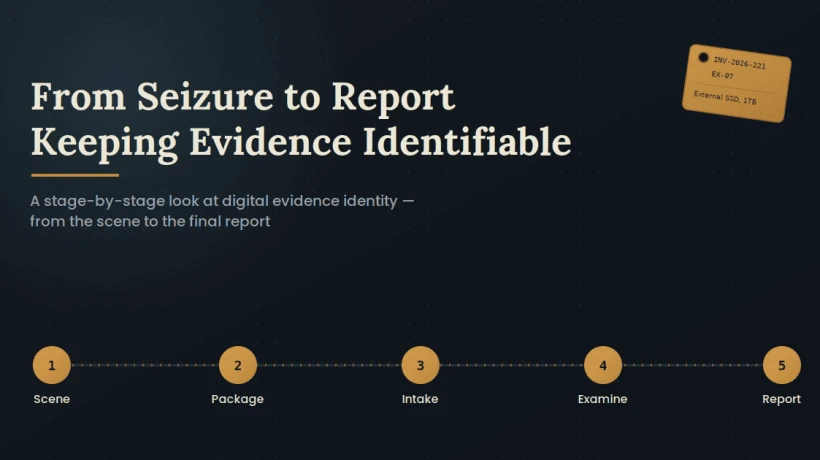
Evidence doesn't sit still. From seizure to report, a single device can branch into thousands of digital artifacts , and each one needs to trace back to where it started, at every stage.
Evidence doesn't sit still. Between the moment a device is seized and the moment a report lands on a prosecutor's desk, that item passes through several hands, several systems, and several forms — a physical drive becomes a forensic image, which becomes a folder of extracted files, which becomes a set of exhibits. If identity isn't carried forward carefully at each handoff, the thread connecting the final exhibit back to the original seizure starts to fray.
Following an item through its full lifecycle — rather than treating identification as a single intake step — is the most reliable way to keep that thread intact.
Stage One: At the Scene
Identification starts before an item is ever bagged. The moment a device is located, it needs a case number and a distinct item number that will follow it for the rest of the investigation — for example, INV-2026-221 / Ex-07. At this stage, the goal is simple: capture enough detail that nobody has to rely on memory later.
That means noting:
-
Exactly where the item was found (room, desk, drawer, device port)
-
Its physical condition and any visible markings
-
The date and time it was collected
-
Who collected it
A rushed or generic note here — "laptop, black" — creates work for every person downstream who has to reconstruct context that should have taken thirty seconds to record properly.
Stage Two: Packaging and Transport
Once identified, an item needs packaging that protects both its physical integrity and its identity. A sealed evidence bag or container should carry the same case and item reference used at collection, along with a sealing signature and date. This is also the stage where a common mistake creeps in: covering a manufacturer's serial number or model plate with a new sticker. Existing identifiers should stay visible — label the container instead if direct marking isn't appropriate.
A transport log recording who moved the item, when, and to where extends the custody trail one link further, keeping it continuous rather than leaving a gap between the scene and the lab.
Stage Three: Intake and Logging
At the receiving lab or evidence unit, the item gets logged into the case system. This is the point where the original scene notes either hold up or start showing their gaps. A consistent naming convention — INV-2026-221-Ex07 — should now appear across the physical evidence log, any digital case management system, and eventually the forensic image itself.
Intake is also where condition should be re-checked and reconciled against the scene notes. Any discrepancy — a seal that looks disturbed, a missing accessory — needs to be documented immediately rather than discovered weeks later during examination.
Stage Four: Examination and Artifact Tagging
This is where a single physical item multiplies into many digital ones. A forensic image of one hard drive can produce thousands of recovered files, emails, chat logs, and metadata records, all of which still need to trace back to Ex-07.
Tagging is what makes that volume manageable. Category tags — Relevant, Financial, Communications, Timeline — let an examiner sort artifacts efficiently, but the more valuable tags go a step further and explain relevance directly: "Financial — matches transfer date referenced in witness statement" tells the next reviewer exactly why the file matters, not just where it sits. This is the stage where careful Proper Tagging and Labeling of Evidence practice pays off the most, since it's the point where the evidence set grows fastest and gets hardest to track by hand.
Stage Five: Reporting and Disclosure
By the time findings reach a report, every referenced artifact should be traceable back through examination notes, the forensic image, and the original item number — without any renaming or relabeling along the way. A report that references "the recovered email" without a tag or item reference forces opposing counsel, or a second examiner, to take the analyst's word for it. A report that references "Ex-07, Tag: Financial, File 0142" doesn't have that problem.
The Vocabulary That Keeps Everyone Aligned
Across all five stages, four terms are doing distinct jobs, and mixing them up causes real confusion on a team:
-
Marking places an identifier on the item itself, when appropriate.
-
Labeling records identity on packaging or documentation.
-
Tagging categorizes evidence so it can be found again quickly.
-
Chain of custody tracks who held the item and when.
A well-labeled item with no custody log is still a liability. A documented custody trail attached to a vaguely described item is barely more useful. Both threads need to run in parallel from start to finish.
Where Technology Helps at Scale
Stage Four is usually where manual methods start to strain. Spreadsheets can track a few dozen tagged files without much trouble, but a case producing several thousand emails needs something built for the volume. Dedicated Email Forensics Software lets an examiner apply a tag name and description to individual messages directly within the platform, then retrieve every item under a given tag in seconds — turning what would otherwise be an unmanageable manual sort into something searchable and reviewable, without asking examiners to abandon the identification habits they've already built.
Common Breakdowns Across Stages
-
Scene notes too vague to reconstruct later — "laptop" instead of a real description
-
Identifiers that shift between the scene log, intake system, and final report
-
Covered serial numbers from careless relabeling
-
Custody gaps where a transfer wasn't documented
-
Tags with no explanation, leaving reviewers to guess at relevance
-
Treating any one stage's documentation as sufficient on its own, rather than as one link in a continuous chain
Final Takeaway
No single stage carries the full weight of evidence identification — it's the consistency across all of them that makes an investigation defensible. A clear identifier assigned at the scene should still be recognizable in the final report, months later, after the item has passed through packaging, intake, and examination. That continuity is what lets anyone authorized to review the case, at any point, understand exactly what they're looking at.
Frequently Asked Questions
At what point should an item receive its case and item number? At the scene, the moment it's identified — not retroactively during intake or examination.
Does chain of custody replace the need for tagging? No. Chain of custody documents possession; tagging and labeling establish identity and searchability. An investigation needs both.
Why does digital evidence need tracking at the artifact level, not just the device level? One physical device can produce thousands of derivative files during examination, and each still needs to trace back to a single, consistently identified source item.



Comments
Login to Comment