Descriptive Statistics Explained in Plain Language
15 Apr, 2026
2029 Views 0 Like(s)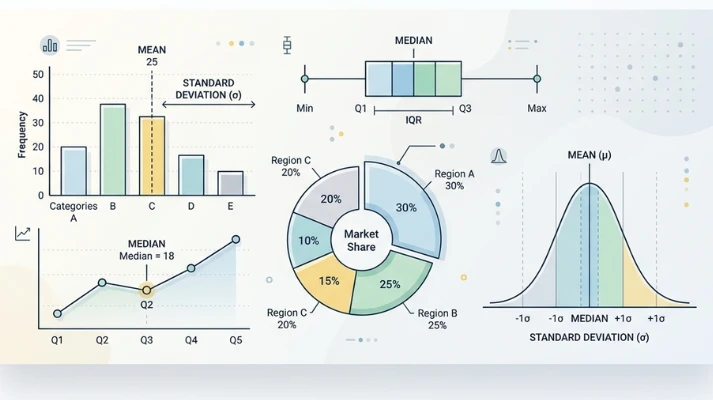
Learn descriptive statistics in simple terms and understand how to summarize, analyze, and interpret data with ease.
Descriptive statistics is one of the simplest ways to understand data. It helps you summarize large amounts of information into clear and meaningful insights. Instead of getting lost in rows of numbers, you can quickly see patterns, trends, and key values that matter.
If you are new to data, descriptive statistics acts as your starting point. It builds the foundation for deeper analysis and helps you make sense of what the data is saying. If you are interested in learning these basics in a structured way, you can consider enrolling in Data Analytics Courses in Bangalore at FITA Academy to strengthen your understanding and apply these concepts with confidence.
What is Descriptive Statistics
Descriptive statistics refers to methods used to organize, summarize, and present data in a useful way. It does not try to predict the future or explain why something happened. Instead, it focuses on describing what is already there in a dataset.
For example, if you have exam scores of students, descriptive statistics can help you find the average score, the highest and lowest marks, and how the scores are spread. These simple summaries make it easier to understand the overall performance without checking every single value.
Measures of Central Tendency
One of the key parts of descriptive statistics is understanding the center of the data. This is where measures like mean, median, and mode come into play.
The mean is the average value of the dataset. You calculate it by adding all values and dividing by the number of values. The median is the middle value when the data is arranged in order. The mode is the value that appears most frequently.
These measures help you quickly identify what is typical in your data. They are especially useful when comparing different datasets or tracking changes over time.
Measures of Spread
While the center gives a general idea, it is also important to understand how the data is spread. This is where range, variance, and standard deviation are useful.
The range shows the difference between the highest and lowest values. Variance tells you how far the data points are from the average. Standard deviation gives a clearer picture of how much variation exists in the dataset.
Understanding spread helps you see whether the data points are close together or widely scattered. If you want to gain hands-on experience with these concepts, you can consider taking a Data Analytics Course in Hyderabad to practice with real datasets and improve your skills.
Why Descriptive Statistics Matters
Descriptive statistics is important because it makes data easier to understand. It allows you to summarize complex information in a way that is simple and clear. This is especially helpful in business, research, and everyday decision making.
For instance, companies use descriptive statistics to understand customer behavior. Schools use it to analyze student performance. Even in daily life, you might use it to track expenses or monitor fitness progress.
By learning descriptive statistics, you develop the ability to interpret data quickly and accurately. This skill is valuable in almost every field today.
Common Visualization Methods
Descriptive statistics often works hand in hand with data visualization. Charts and graphs help present data in a visual format that is easy to understand.
Bar charts are useful for comparing categories. Line graphs help show trends over time. Pie charts display proportions within a dataset. Histograms are used to understand the distribution of data.
These graphical tools facilitate the communication of insights to others. They also help you spot patterns that might not be obvious in raw numbers.
Descriptive statistics is a powerful yet simple way to understand data. It helps you summarize, organize, and present information clearly. By learning concepts like central tendency and spread, you can turn complex datasets into meaningful insights.
As you continue your learning journey, practicing these concepts will make you more confident in working with data. If you are ready to take the next step, you can join a Data Analytics Course in Ahmedabad to build practical skills and apply descriptive statistics in real-world scenarios.
Also check: Data Collection Methods Used by Analysts
Comments
Login to Comment