Clustering Techniques and How They Find Patterns
16 Apr, 2026
1835 Views 0 Like(s)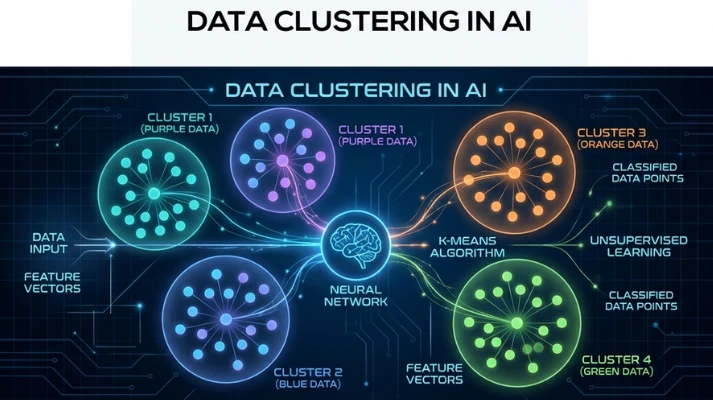
Learn how clustering techniques uncover hidden patterns in data with simple explanations and real world examples for beginners.
Clustering is one of the most useful techniques in Artificial Intelligence and machine learning. It helps in discovering hidden patterns in data without needing labeled examples. This makes it a powerful tool for exploring large datasets where the structure is not immediately visible.
In simple terms, clustering groups similar data points together based on their characteristics. Businesses, researchers, and developers use it to understand customer behavior, detect anomalies, and organize information more effectively. If you are interested in building a strong foundation in such concepts, consider enrolling in the Artificial Intelligence Course in Trivandrum at FITA Academy to deepen your understanding in a structured way.
What is Clustering in AI
Clustering is a technique in unsupervised learning where the algorithm detects inherent groupings within the data. Unlike supervised learning, there are no predefined labels or outputs. The system learns patterns by analyzing similarities and differences among data points.
For example, imagine a dataset of customers with different purchasing habits. A clustering algorithm can group customers with similar buying patterns together. This helps businesses create targeted strategies without manually analyzing each record.
How Clustering Finds Patterns
Clustering works by measuring how similar or different data points are from each other. These similarities are often calculated using distance metrics such as Euclidean distance. Points that are nearer to each other are more likely to be part of the same cluster.
The algorithm repeatedly evaluates the dataset and adjusts groupings until it finds the best possible clusters. This process helps reveal patterns that are not obvious at first glance. If you want to gain practical experience with such techniques, you can explore programs like the Artificial Intelligence Course in Kochi to apply these ideas in real scenarios.
Popular Clustering Techniques
There are several clustering techniques, each suited for different types of data and problems.
K means clustering is one of the most widely used methods. It divides data into a fixed number of clusters and assigns each point to the nearest cluster center. It is simple and efficient for large datasets.
Hierarchical clustering builds a tree of clusters. It starts by treating each data point as its own cluster and then merges them step by step. This approach is useful for understanding relationships between groups.
DBSCAN is another powerful technique that focuses on density. It groups points that are closely packed together and identifies outliers as noise. This makes it effective for detecting unusual patterns in data.
Real World Applications of Clustering
Clustering is widely used across industries. In marketing, it helps segment customers based on behavior and preferences. In healthcare, it assists in identifying patterns in patient data for better diagnosis.
It is also used in recommendation systems to suggest products or content based on user similarity. In cybersecurity, clustering helps detect unusual activities that may indicate threats. These applications show how clustering plays a key role in making data-driven decisions.
Challenges in Clustering
Despite its usefulness, clustering comes with challenges. Choosing the right number of clusters can be difficult and often requires experimentation. Different algorithms may produce different results on the same dataset.
Data quality also affects clustering performance. Disruptive or partial data can result in imprecise classifications. Understanding these challenges is important for applying clustering effectively in real projects.
Clustering techniques are essential for uncovering hidden patterns in data. They help transform raw information into meaningful insights that can guide decisions and strategies. By learning how these techniques work, beginners can take an important step into the world of Artificial Intelligence.
If you want to build hands-on skills and explore advanced concepts, you can consider signing up for an Artificial Intelligence Course in Pune to continue your learning journey with practical exposure.
Also check: Role of Convolutional Neural Networks

Comments
Login to Comment