Chalazion vs Stye: Are They the Same Thing?
14 Jul, 2026
1002 Views 0 Like(s)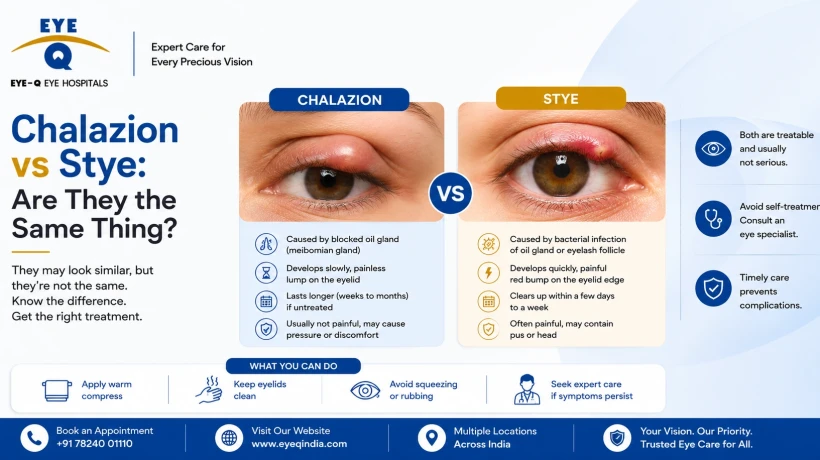
Chalazion vs Stye what's the difference? Learn how to tell them apart, what causes each, and when to see a doctor for the lump on your eyelid.
You wake up one morning, glance in the mirror, and notice a lump on your eyelid. It's not particularly painful maybe a little tender and it wasn't there yesterday. Your first instinct might be to call it a Stye, squeeze it, or just wait and see if it goes away.
Before you do any of those things, it's worth understanding what you're actually looking at. Chalazion vs Stye is one of the most common points of confusion in eyelid conditions and the two are not the same thing, even though they can look remarkably similar at first glance.
Getting the distinction right matters because the treatment is different, the causes are different, and the urgency of seeing a doctor varies significantly between them. Let's break this down clearly.
Chalazion vs Stye — What's the Core Difference?
The simplest way to think about it: a chalazion is a specific type of Stye that forms in the eyelid due to a blocked oil gland. An eyelid Stye is a broader term that can refer to several different types of fluid-filled or solid lumps that appear on or around the eyelid.
So technically, a chalazion is a kind of Stye but not all eyelid Styes are chalazia.
Here's a quick comparison before we go deeper:
| Feature | Chalazion | Eyelid Stye (General) |
|---|---|---|
| Cause | Blocked meibomian (oil) gland | Varies — blocked duct, keratin buildup, retained secretion |
| Location | Inside the eyelid, mid-portion | On the eyelid margin, skin surface, or inside lid |
| Pain | Usually painless (unless infected) | Varies — mostly painless |
| Appearance | Firm, round, non-tender lump | Can be clear, white, or skin-coloured |
| Treatment | Warm compresses, steroid injection, or surgery | Depends on type — observation, excision, or drainage |
| Goes away on its own? | Often yes, in 2–6 weeks | Sometimes — depends on type |
What Is a Chalazion?
A chalazion (pronounced kuh-LAY-zee-on) forms when one of the meibomian glands inside the eyelid becomes blocked. These glands normally produce the oily layer of your tear film the part that prevents your tears from evaporating too quickly.
When the gland's opening gets clogged, the oil has nowhere to go. It builds up inside the gland, and the surrounding tissue reacts by forming a granuloma a small nodule of inflammatory tissue. This is what you feel as that firm, round lump in the eyelid.
Key Features of a Chalazion
- Located within the eyelid tissue, not on the skin surface
- Usually feels like a firm pea-sized lump
- Typically painless, though it may cause some tenderness when it first develops
- Can cause the eyelid to appear swollen or droopy if large
- More common in the upper eyelid than the lower
- May cause blurred vision if it presses on the cornea
- Not contagious
Chalazia are more common in people who have meibomian gland dysfunction, rosacea, blepharitis (chronic eyelid inflammation), or seborrhoeic dermatitis. They can also recur some people get them repeatedly on the same eyelid.
What Are the Different Types of Eyelid Styes?
The word "Stye" on the eyelid can refer to several distinct conditions. Here are the most common ones your doctor might differentiate between:
1. Sebaceous Stye
A sebaceous Stye forms when a sebaceous (skin oil) gland duct becomes blocked. Unlike a chalazion, which involves the meibomian glands deeper in the eyelid, a sebaceous Stye typically develops closer to the skin surface.
It usually looks like a smooth, rounded bump filled with a white, waxy material called keratin. It may have a small central punctum (tiny dark dot) on the surface.
2. Inclusion Stye (Epithelial Stye)
These are small, clear, fluid-filled Styes that form when skin cells get trapped under the surface often following minor trauma, surgery, or a previous stye. They're typically very small (1–3mm), appear pearly or translucent, and are more common on the eyelid margin.
3. Milia
Milia are tiny white or yellowish keratin-filled Styes, usually no bigger than 1–2mm. They often appear in clusters on the eyelid skin or near the lash line. They're harmless, extremely common, and often mistaken for whiteheads.
4. Sweat Gland Stye (HidroStyeoma)
These translucent, dome-shaped Styes develop from sweat glands and are more common in hot, humid climates making them particularly relevant in India's summer months. They often appear near the inner corner of the eye or along the eyelid margin.
5. Dermoid Stye
These are congenital Styes present from birth or early childhood. They form when skin tissue becomes trapped beneath the surface during development. They're firm, deep, and typically found near the outer corner of the eye or along the eyebrow. Dermoid Styes don't go away on their own and usually require surgical removal.
How to Tell the Difference at Home
You can't always make a reliable distinction without a clinical examination, but here are some clues:
It's more likely a chalazion if:
- The lump is inside the eyelid (you can feel it with your finger but it's beneath the lid skin)
- It appeared gradually over several days
- It's painless and firm
- You have a history of blepharitis, rosacea, or previous chalazia
- Eversion (flipping) of the eyelid reveals a red or yellowish bump on the inner surface
It's more likely a surface eyelid Stye if:
- The lump is clearly on the skin of the eyelid
- It looks white, yellowish, or translucent
- It has a tiny central pore or punctum
- It's very small (under 3mm) and doesn't change in size
- It's been there for months without any inflammation
See a doctor promptly if:
- The lump is growing rapidly
- There's significant pain, warmth, or spreading redness
- Your vision is affected
- The lump bleeds or ulcerates
- You're over 50 and the lump keeps recurring in the same spot this can rarely be a sign of sebaceous gland carcinoma, a malignant condition that mimics chalazion
Chalazion vs Stye — Another Common Mix-Up
While we're distinguishing similar-looking eyelid lumps, it's worth addressing the chalazion vs stye confusion too, since patients often use these terms interchangeably.
A stye (hordeolum) is an infection of a gland at the eyelid margin, usually caused by Staphylococcus bacteria. Unlike a chalazion, a stye:
- Is usually painful and tender to touch
- Appears at the eyelid edge, often near a lash follicle
- Looks red and inflamed, sometimes with a visible pus-filled tip
- Develops quickly (within 1–2 days)
- Is essentially a pimple on the eyelid
A chalazion can form after an unresolved stye the infection clears but the blocked gland remains, eventually forming a granuloma.
Treatment Options: What Works for Each
For a Chalazion
The first line of treatment is warm compresses a clean cloth soaked in warm water (not hot) pressed gently against the closed eyelid for 10–15 minutes, 3–4 times a day. This softens the blocked material and helps the gland drain naturally.
Most chalazia resolve within 2–6 weeks with consistent warm compress therapy. If they don't:
- Steroid injection: A small injection of corticosteroid into the chalazion can reduce inflammation and speed resolution. Often done in a clinic setting without general anaesthesia.
- Incision and curettage (I&C): A minor surgical procedure where the chalazion is drained through a small incision in the inner eyelid surface. Performed under local anaesthesia, usually takes under 15 minutes.
For Eyelid Styes
- Observation: Small, stable, asymptomatic Styes can often be left alone if they're not affecting vision or comfort.
- Warm compresses: Helpful for milia and early inclusion Styes.
- Excision: Sebaceous Styes, dermoid Styes, and large inclusion Styes usually require surgical removal.
- Drainage: Small hidroStyeomas or surface Styes may be drained in a clinic.
Never try to squeeze or pop an eyelid Stye at home. The eyelid skin is extremely thin, and infection introduced through improper drainage can spread to surrounding structures rapidly.
Expert Tips for Managing Eyelid Lumps
- Clean your eyelids daily using a diluted baby shampoo solution or purpose-made lid wipes, particularly if you're prone to blepharitis or recurrent chalazia.
- Remove eye makeup thoroughly every night. Incomplete makeup removal is a significant and underappreciated contributor to meibomian gland blockage.
- Don't rub your eyes. Rubbing introduces bacteria and can aggravate existing gland blockages.
- Warm compresses work best with gentle massage. After warming the eyelid, gently massage the lid toward the lash margin with a clean finger — this helps express the blocked gland contents.
- If you wear contact lenses, switch to glasses until any active eyelid inflammation has resolved, as lenses can trap bacteria against the eye.
- Treat blepharitis proactively if you've had recurrent chalazia addressing the underlying gland dysfunction is the most effective way to prevent them coming back.
Common Mistakes to Avoid
- Squeezing or trying to pop the lump. This is probably the most common mistake and one of the more harmful ones. Introducing bacteria into the eyelid can cause a serious infection called orbital cellulitis.
- Assuming all eyelid lumps are harmless. Most are but a persistent, painless nodule that recurs repeatedly in the same spot in an older adult needs to be examined by an ophthalmologist to rule out sebaceous gland carcinoma.
- Using hot water instead of warm for compresses. Hot water can burn the delicate eyelid skin. Warm comfortable to the back of your hand is what you're aiming for.
- Giving up on warm compresses after two days. This treatment takes patience. Two to three weeks of consistent twice-daily compresses gives the best results.
- Confusing a chalazion with a stye and treating it with antibiotic eye drops. Antibiotics have no role in treating a non-infected chalazion it's not a bacterial infection.
Wrapping Up
Understanding chalazion vs Stye comes down to recognising that these terms aren't interchangeable a chalazion is a specific type of inflammatory eyelid Stye with its own cause, appearance, and treatment pathway, while the broader category of eyelid Styes includes several distinct conditions each handled differently.
Most eyelid lumps are benign and respond well to conservative care. But that doesn't mean every lump should be ignored or managed at home indefinitely.
If you've had a lump on your eyelid for more than four weeks, it's not improving with warm compresses, it's affecting your vision, or you simply want a clear diagnosis, the right move is to see an ophthalmologist not a general practitioner.
Book an eye consultation at Eye Q Eye Hospitals for a comprehensive eyelid examination by a specialist who can give you a clear diagnosis and the right treatment plan from a single warm visit.



Comments
Login to Comment