Brain Training for Toddlers: Fun Ways to Build Early Learning Skills
18 Sep, 2026
9 Views 0 Like(s)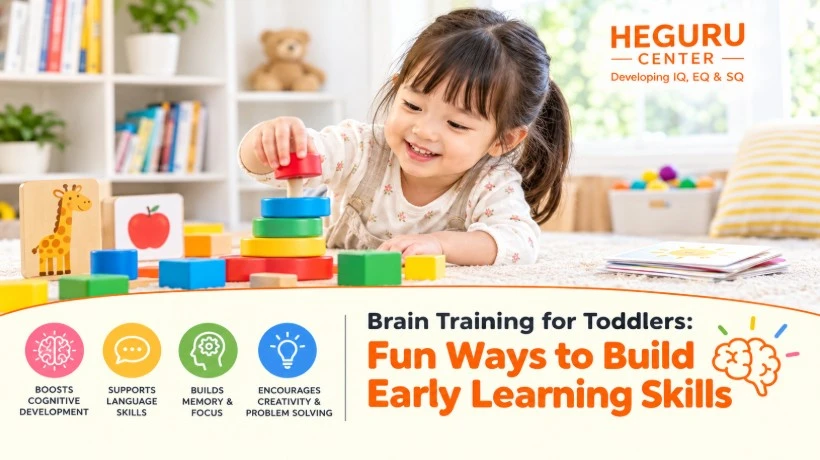
Brain training for toddlers with fun songs, counting, flash cards, movement and stories to support early cognitive development.
Brain training for kids in the toddler years means using play-based activities — like songs, movement, images, and simple number games — to stimulate cognitive development. Between ages 0 and 3, the brain forms over one million neural connections per second. Activities that engage multiple senses at once accelerate language, memory, and problem-solving skills during this critical window.
Most parents know toddlers learn through play. But not all play is equal. The right activities — ones that combine rhythm, repetition, visual input, and physical movement — actively support brain training for kids during the years when it matters most. The good news? You do not need expensive equipment or a structured classroom to make it happen.
Why the Toddler Years Are the Brain's Golden Window
Brain development does not happen evenly across a lifetime. The first three years are when the brain is most plastic — most responsive to new input and experience. During this period, every song sung, every object named, and every texture touched builds new neural pathways.
Research from early childhood development experts consistently shows that toddlers who receive rich sensory and cognitive stimulation during these years demonstrate stronger language skills, better emotional regulation, and improved school readiness by age five. Toddler cognitive development is not a passive process — it is shaped, moment by moment, by what a child experiences at home and in learning environments.
How to Use Everyday Moments for Brain Training

You do not need a formal programme to begin. Many of the most effective brain training activities for toddlers are already part of daily life — they just need intentional framing.
1. Sing Songs With a Purpose
Music is one of the most powerful tools for early brain development. Songs combine rhythm, melody, language, and memory — activating multiple brain regions simultaneously. Nursery rhymes, action songs, and call-and-response tunes help toddlers develop phonological awareness, which is a core foundation for reading.
Try singing the same song in different tempos — fast, slow, whispered. This keeps a toddler's brain engaged and teaches them to notice change, a key cognitive skill.
2. Use Flash Cards and Visual Stimulation
Toddlers process images faster than words. High-contrast images and picture cards stimulate the visual cortex and build early vocabulary. When you show a card and name what is on it, you are connecting visual input with language — a process that supports memory retention and word recognition.
Point, name, and repeat. The repetition is not boring to a toddler — it is essential. Their brains are wired to strengthen connections through repeated exposure.
3. Introduce Numbers Through Play
Early numeracy does not start with worksheets. It starts with counting steps as you walk up stairs, sorting blocks by colour, or pointing out how many apples are in a bowl. These toddler learning activities build number sense — an intuitive understanding of quantity that forms the basis of mathematical thinking.
Keep it light and celebratory. When a toddler correctly identifies "two" objects, their brain releases dopamine. That positive feedback loop makes them want to try again.
4. Movement and Gross Motor Play
Physical movement is directly tied to cognitive development. When toddlers crawl, jump, balance, or reach, they are not just building muscles — they are developing spatial awareness, coordination, and focus. Activities like obstacle courses, dancing, and clapping games strengthen the connection between the brain's motor cortex and cognitive centres.
Even something as simple as playing "Simon Says" or following a rhythm with hand claps trains attention span and working memory — two skills that predict academic success later in life.
5. Storytelling and Read-Aloud Sessions
Reading aloud to toddlers — even before they understand every word — activates brain regions linked to language, imagination, and emotional understanding. The back-and-forth of asking "What do you see?" or "What happens next?" turns a passive activity into an interactive brain workout.
Use books with bold illustrations. Let your toddler turn pages, point to pictures, and make sounds. Engagement is what drives learning, not perfect comprehension.
Realted Post: A Parent's Guide to Heguru's Preschool Enrichment Programme in Singapore
Brain Training Activities at a Glance
|
Activity |
Skill Developed |
Best Age Range |
|---|---|---|
|
Singing nursery rhymes |
Language, memory, phonics |
6 months – 3 years |
|
Flash card sessions |
Visual processing, vocabulary |
6 months – 2.5 years |
|
Counting games |
Number sense, logic |
1 – 3 years |
|
Dancing and movement |
Coordination, focus, spatial awareness |
9 months – 3 years |
|
Interactive read-alouds |
Language, imagination, comprehension |
6 months – 3 years |
What Makes Structured Brain Training Different
Home activities are valuable, but structured early learning programmes take brain training for toddlers further. They use research-backed methods — like right-brain activation, photographic memory training, and speed learning techniques — in ways that are difficult to replicate consistently at home.
Programmes designed for infants and toddlers typically incorporate multisensory stimulation in a structured sequence. This means a child is not just exposed to sounds or images randomly — they receive input in a specific pattern that builds one cognitive skill on top of another. This scaffolding approach mirrors how the brain actually learns.
Signs Your Toddler's Brain Training Is Working
Parents sometimes wonder whether these activities are making a real difference. Here are signs that your toddler's cognitive development is progressing well:
-
They remember and anticipate the words or actions in familiar songs
-
They point to and name objects they have seen in picture cards
-
They show curiosity — picking things up, turning them over, experimenting
-
They respond to their name and simple instructions before age one
-
They attempt to copy sounds, gestures, or expressions
These are not just cute milestones. They are measurable signals that neural pathways are forming and strengthening in exactly the right areas.
How to Build a Simple Daily Brain Training Routine
Consistency matters more than duration. A focused 15-minute session of intentional play is more effective than an hour of passive screen time. Here is a simple daily structure you can adapt:
-
Morning: Start with a song or rhyme — something familiar to ease them into the day
-
Mid-morning: Flash cards or naming objects around the house
-
After lunch: Movement activity — dancing, clapping, or simple balancing
-
Evening: Read-aloud before bed with interactive questions
You do not need to stick to a rigid timetable. The goal is to weave these moments into what you already do. Bath time becomes a counting game. A walk to the park becomes a colour-naming exercise. Every moment is an opportunity.
For parents in Singapore looking to complement these home activities with a structured programme, Heguru Centre offers specialist infant and toddler classes designed around right-brain development, multisensory stimulation, and early cognitive training — built specifically for children from six months to three years of age.
Frequently Asked Questions
Q: What is brain training for toddlers and when should it start?
Toddlers’ brain training means exercises that help the development of their mental abilities, senses, and movements. The process can start at the age of six months since the brain becomes most sensitive to all kinds of stimuli at this age. Some simple exercises such as singing, seeing, and moving are good to start with.
Q: What are the best toddler learning activities for cognitive development?
The most effective exercises are those that incorporate different senses into one activity – singing songs, playing with picture cards, counting objects, reading stories. This approach involves using language, memory and physical movements at once. Programs involving right-brain activation exercises may be also very helpful for toddlers’ brain development.
Q: How long should brain training sessions be for toddlers?
Ten to twenty minutes at a time is recommended because the toddler can maintain a short span of concentration, but the mind is quick to absorb information. What is most important is the daily repetition, and not necessarily the length of time spent, during any one period.
Q: Can brain training improve my toddler's language skills?
Yes. Activities such as nursery rhymes, reading aloud and repeating naming activities actually trigger the areas of the brain that handle language processing. Toddlers who receive plenty of verbal and musical stimulation in their first three years have been found to have better vocabularies and communication abilities at preschool age.


Comments
Login to Comment