Arvind Kejriwal Announces National Town Hall Against E20 Fuel Policy on August 1
27 Jul, 2026
649 Views 0 Like(s)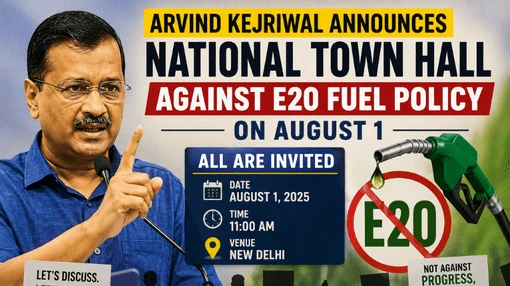
The debate surrounding India's E20 fuel policy has gained fresh momentum after Aam Aadmi Party (AAP) national convenor Arvind Kejriwal announced a National Town Hall on August 1
The debate surrounding India's E20 fuel policy has gained fresh momentum after Aam Aadmi Party (AAP) national convenor Arvind Kejriwal announced a National Town Hall on August 1 to discuss the potential impact of the ethanol-blended fuel initiative. Inviting citizens, experts, farmers, environmentalists, and industry representatives to participate, Kejriwal described the event as an open platform where everyone can express their views on the government's decision to promote E20 petrol across the country.
The announcement comes at a time when the central government is actively pushing ethanol blending as part of its strategy to reduce dependence on imported crude oil, improve energy security, and lower carbon emissions. While the policy has received support from several stakeholders, it has also raised concerns about vehicle compatibility, fuel efficiency, food security, and the impact on consumers.
Why Is the E20 Fuel Policy Important?
E20 refers to petrol blended with 20% ethanol and 80% petrol. Ethanol is primarily produced from sugarcane, maize, and other agricultural products. The Indian government has set ambitious targets to increase ethanol blending in fuel to reduce oil imports and encourage domestic biofuel production.
Supporters of the policy argue that higher ethanol blending can help India save billions in foreign exchange, reduce greenhouse gas emissions, and create new income opportunities for farmers by increasing demand for agricultural produce.
However, critics believe the transition requires careful planning, especially considering the readiness of vehicles currently running on Indian roads.
Kejriwal's Concerns Over E20
While announcing the National Town Hall, Arvind Kejriwal emphasized that the discussion is not intended to oppose progress but to ensure that public concerns are heard before large-scale implementation. According to him, policies affecting millions of vehicle owners should involve transparent consultation and evidence-based discussions.
Kejriwal questioned whether all existing vehicles are fully compatible with E20 fuel and whether consumers have been adequately informed about possible maintenance costs. He also raised concerns regarding mileage, engine performance, and the long-term financial impact on middle-class families.
The AAP leader invited experts from various sectors to present facts and research so that citizens can make informed decisions about the policy.
Public Participation at the Town Hall
One of the highlights of the event is its open invitation. Kejriwal announced that everyone is welcome to participate, regardless of political affiliation. The Town Hall aims to bring together economists, automobile experts, environmental specialists, farmers, scientists, and ordinary citizens.
The objective is to create a balanced discussion where both the advantages and challenges of E20 fuel are examined in detail. Such public forums are increasingly becoming important as major policy decisions directly impact daily life.
Government's Stand on Ethanol Blending
The central government has consistently maintained that ethanol blending is an essential part of India's clean energy transition. According to official estimates, increased ethanol use has already helped reduce crude oil imports while supporting domestic agriculture.
Automobile manufacturers have also been preparing for the transition by developing vehicles compatible with E20 fuel. Several companies have announced that their latest models are designed to operate efficiently using higher ethanol blends.
The government believes the initiative aligns with India's long-term climate goals while strengthening energy independence.
Concerns Raised by Experts
Despite its environmental benefits, some experts believe challenges remain before nationwide implementation.
Among the frequently discussed concerns are:
- Compatibility of older vehicles with E20 fuel.
- Potential reduction in fuel efficiency due to ethanol's lower energy content.
- Increased maintenance costs for certain engines.
- Pressure on agricultural resources if ethanol production expands rapidly.
- Possible effects on food prices if more crops are diverted toward fuel production.
Experts suggest that consumer awareness and gradual implementation are essential to ensure a smooth transition.
Impact on Vehicle Owners
For millions of Indian motorists, one of the biggest questions is whether existing vehicles can safely use E20 petrol. While many newer models are expected to support higher ethanol blends, some older vehicles may require modifications or additional maintenance.
Vehicle manufacturers have advised owners to check their owner's manual or consult authorized service centers before regularly using E20 fuel where applicable.
Consumers are also interested in understanding whether fuel economy will change and whether maintenance expenses could increase over time.
Why the August 1 Town Hall Matters
The National Town Hall announced by Arvind Kejriwal is likely to become an important platform for discussing one of India's most significant fuel policy changes. By inviting experts and citizens to participate, the event seeks to encourage transparency and public engagement in policymaking.
Regardless of political opinions, the discussion is expected to provide valuable insights into the benefits, risks, and practical challenges associated with E20 fuel adoption.
Conclusion
As India moves toward cleaner and more sustainable transportation, the E20 fuel policy remains a topic of national importance. While the government views ethanol blending as a key step toward energy security and environmental sustainability, concerns regarding vehicle compatibility, consumer costs, and implementation continue to generate debate.
Arvind Kejriwal's announcement of a National Town Hall on August 1 adds another dimension to the discussion by encouraging public participation and expert dialogue. The event is expected to provide a platform where different viewpoints can be shared, helping citizens better understand the implications of E20 fuel and its role in India's future energy strategy.



Comments
Login to Comment