In today’s software-driven world, applications rarely work in isolation. They rely on APIs (Application Programming Interfaces) to communicate between services, mobile apps, databases, and third-party platforms. That’s why API testing has become one of the most critical parts of modern software testing.
This guide explains what API testing is, why it matters, types of API testing, best practices, and how to implement it effectively.
What Is API Testing?
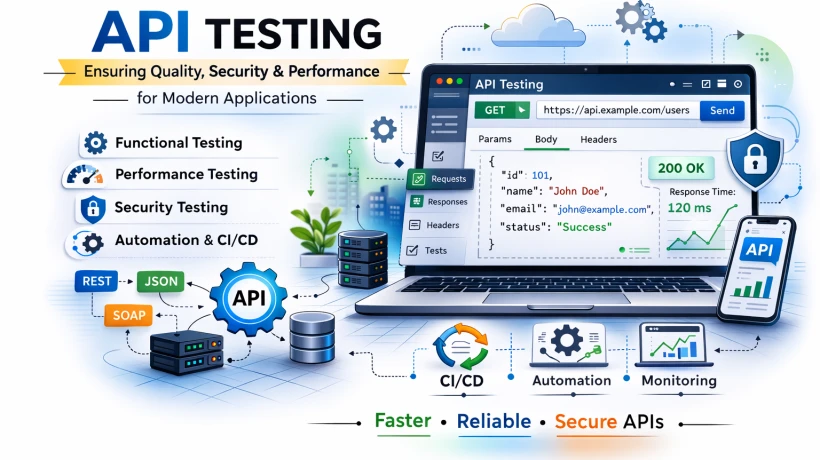
API testing is a type of software testing that focuses on verifying the functionality, reliability, performance, and security of APIs. Instead of testing the user interface, API testing validates the business logic layer directly.
For example:
-
Does the API return correct status codes?
-
Is the response time acceptable?
-
Is the response structure accurate?
-
Are authentication and authorization working properly?
Since APIs are the backbone of microservices architecture, testing them ensures system stability and reliability.
Why API Testing Is Important
1. Detects Bugs Early
Testing APIs before UI development helps detect issues early in the development lifecycle.
2. Faster Than UI Testing
API tests execute faster than UI tests because they don’t depend on rendering or browser interactions.
3. Better Coverage
You can test edge cases, invalid inputs, and backend logic more thoroughly.
4. Supports CI/CD
API testing integrates easily into CI/CD pipelines, ensuring every build is validated automatically.
5. Critical for Microservices
In microservices architectures, services communicate via APIs. If one API fails, the entire system may break.
Types of API Testing
1. Functional Testing
Ensures the API performs as expected and returns correct outputs.
Example:
2. Load Testing
Checks how the API performs under heavy traffic.
3. Performance Testing
Measures response time, latency, and throughput.
4. Security Testing
Validates authentication, authorization, encryption, and protection against attacks.
5. Integration Testing
Ensures multiple APIs and services work together correctly.
6. Validation Testing
Confirms API behavior aligns with documentation and business requirements.
What to Test in an API?
When performing API testing, focus on:
-
HTTP status codes (200, 400, 401, 500, etc.)
-
Response body structure (JSON/XML format)
-
Data accuracy
-
Headers
-
Authentication tokens
-
Error handling
-
Response time
-
Rate limiting
API Testing in CI/CD
API testing plays a major role in DevOps pipelines:
-
Developer pushes code.
-
CI tool triggers automated tests.
-
API tests run automatically.
-
Build fails if any test fails.
-
Deployment proceeds only if tests pass.
This ensures stable releases and reduces production bugs.
Best Practices for API Testing
1. Start Early
Begin API testing during development, not after UI completion.
2. Automate Repetitive Tests
Use automation tools to run regression tests efficiently.
3. Validate Response Schemas
Always validate JSON schema structure.
4. Use Realistic Test Data
Avoid hardcoded or unrealistic values.
5. Include Negative Testing
Test invalid inputs and edge cases.
6. Secure Your APIs
Test authentication, token expiration, and authorization rules.
7. Integrate with Monitoring
Combine API testing with monitoring tools for production validation.
API Testing vs UI Testing
| Feature |
API Testing |
UI Testing |
| Speed |
Fast |
Slower |
| Stability |
More stable |
Prone to UI changes |
| Cost |
Lower |
Higher |
| Coverage |
Backend logic |
User workflows |
API testing is generally more reliable and cost-effective compared to UI testing.
Challenges in API Testing
Using automation tools and structured frameworks can reduce these challenges significantly.
The Future of API Testing
With the rise of microservices, cloud-native applications, AI-driven development, and continuous deployment, API testing is becoming more automated and intelligent. Modern tools are now capable of auto-generating test cases, detecting schema changes, running parallel tests, and integrating with observability tools.
AI-powered API testing is expected to reduce manual effort and improve reliability.
Conclusion
API testing is no longer optional—it is essential. As software architectures become more distributed and service-based, APIs become the backbone of applications.
By implementing strong API testing strategies and integrating them into CI/CD pipelines, teams can ensure faster releases, fewer bugs, and higher application reliability. If you're building modern applications, investing in API testing is one of the smartest decisions you can make.


Comments
Login to Comment