What is AEO vs SEO?
21 Apr, 2026
2022 Views 0 Like(s)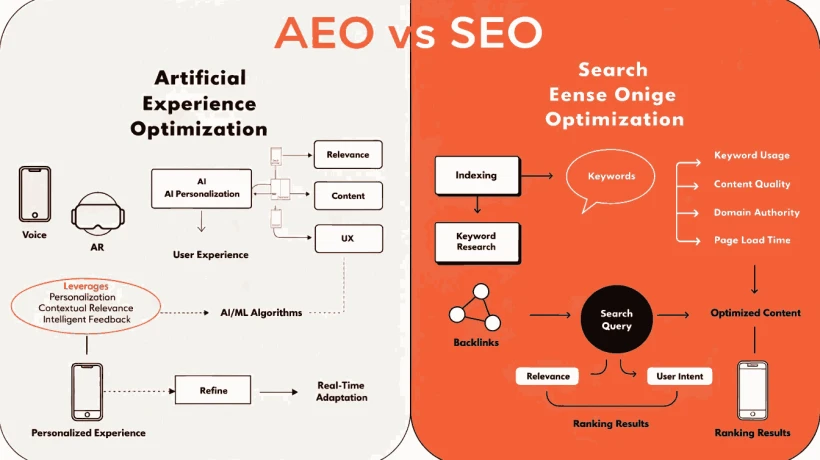
Search is no longer just about typing keywords into a search engine and browsing through a list of blue links. Today, users expect direct answers—fast, accurate, and personalized.
Search is no longer just about typing keywords into a search engine and browsing through a list of blue links. Today, users expect direct answers—fast, accurate, and personalized. With the rise of AI-powered assistants, voice search, and conversational interfaces, a new optimization approach has emerged: Answer Engine Optimization (AEO).
While Search Engine Optimization (SEO) remains essential, AEO is quickly becoming just as critical for businesses that want to stay visible in modern search experiences.
In this blog, we’ll break down AEO vs SEO, how they differ, why both matter, and how frameworks like The AEO Audit Framework can help you future-proof your content strategy.
What is SEO?
Search Engine Optimization (SEO) is the process of optimizing your website and content to rank higher in search engine results pages (SERPs). The goal is simple: drive organic traffic to your website.
Key Elements of SEO:
-
Keyword research and targeting
-
On-page optimization (titles, meta descriptions, headings)
-
Technical SEO (site speed, mobile-friendliness, indexing)
-
Backlinks and authority building
-
Content optimization for search intent
SEO focuses on improving your visibility in search results and encouraging users to click through to your website.
What is AEO?
Answer Engine Optimization (AEO) is the practice of optimizing content so that it can be directly used by AI systems, voice assistants, and answer engines to provide instant answers to user queries.
Instead of driving clicks, AEO focuses on:
-
Providing clear, concise answers
-
Structuring content for AI understanding
-
Appearing in featured snippets, voice results, and AI-generated responses
Where AEO Appears:
-
Voice assistants (Alexa, Google Assistant, Siri)
-
AI chat interfaces
-
Featured snippets (Position Zero)
-
Knowledge panels
-
AI-generated summaries
AEO is about being the answer, not just being a result.
AEO vs SEO: Key Differences
|
Factor |
SEO |
AEO |
|
Goal |
Drive website traffic |
Provide direct answers |
|
Focus |
Keywords & rankings |
User questions & intent |
|
Output |
Links in SERPs |
Instant answers/snippets |
|
Content Style |
Long-form, keyword-rich |
Structured, concise, clear |
|
Platforms |
Search engines |
AI tools, voice assistants, answer engines |
|
Success Metric |
Clicks, traffic |
Visibility, answer inclusion |
Why AEO is Gaining Importance
The way people search has changed dramatically:
1. Rise of Voice Search
Users now ask questions conversationally, like:
“What is the difference between AEO and SEO?”
2. Zero-Click Searches
Many queries are answered directly on the search results page, reducing the need to click.
3. AI-Powered Search
AI systems generate answers by pulling from structured, high-quality content.
4. Faster User Expectations
Users want instant, accurate responses—not multiple links to explore.
This shift means that traditional SEO alone is no longer enough.
How SEO and AEO Work Together
It’s important to understand that AEO is not a replacement for SEO—it’s an evolution.
SEO Brings Visibility
SEO helps your content get discovered and indexed.
AEO Converts Visibility into Answers
AEO ensures your content is selected as the best answer.
Think of it this way:
-
SEO gets you on the page
-
AEO gets you into the answer box
A strong digital strategy requires both.
Core Principles of AEO
To succeed in AEO, your content must be:
1. Question-Focused
Identify real user queries and answer them directly.
2. Structured
Use headings, bullet points, and clear formatting.
3. Concise
Provide short, accurate answers before expanding.
4. Contextual
Explain concepts clearly so AI systems can understand meaning.
5. Authoritative
Build trust with accurate, well-researched content.
Introducing the AEO Audit Framework
To effectively transition from traditional SEO to a hybrid SEO + AEO strategy, businesses need a structured approach. This is where The AEO Audit Framework becomes essential.
What is the AEO Audit Framework?
The AEO Audit Framework is a systematic method for evaluating and optimizing your content so it performs well in both search engines and answer engines.
It helps you identify:
-
Whether your content answers user questions clearly
-
If your structure supports AI readability
-
Gaps in intent coverage
-
Opportunities for featured snippets
Key Components of The AEO Audit Framework
1. Query Intent Mapping
Analyze what users are really asking—not just keywords, but full questions.
Example:
-
SEO keyword: “AEO vs SEO”
-
AEO query: “What is the difference between AEO and SEO?”
2. Answer Clarity Check
Ensure every section answers a specific question clearly and directly.
Best Practice:
-
Start with a direct answer in 2–3 lines
-
Follow with detailed explanation
3. Content Structuring
Use:
-
H2 and H3 headings
-
Bullet points
-
Numbered lists
This helps AI systems extract information easily.
4. Snippet Optimization
Optimize sections to appear in:
-
Featured snippets
-
Voice search results
Use formats like:
-
Definitions
-
Lists
-
Step-by-step guides
5. Semantic Depth
Include related concepts and context to improve understanding.
Example:
When discussing AEO, also include:
-
Voice search
-
AI assistants
-
Structured data
6. Technical Readiness
Ensure your website supports AEO:
-
Fast loading speed
-
Mobile-friendly design
-
Proper schema markup
Practical Example: SEO vs AEO Content
Traditional SEO Content:
-
Long paragraphs
-
Keyword repetition
-
Focus on ranking
AEO-Optimized Content:
-
Direct answers
-
Structured sections
-
Clear headings
-
Conversational tone
How to Optimize for Both SEO and AEO
1. Target Questions, Not Just Keywords
Use tools and research to find real user queries.
2. Add FAQ Sections
FAQs are highly effective for AEO.
3. Use Structured Data
Schema markup helps search engines understand your content better.
4. Write in a Conversational Tone
Match how people actually ask questions.
5. Prioritize Readability
Short sentences and clear language improve both SEO and AEO.
6. Update Existing Content
You don’t always need new content—optimize what you already have using The AEO Audit Framework.
Common Mistakes to Avoid
1. Ignoring User Intent
Focusing only on keywords without understanding the query.
2. Overloading Content with Keywords
This harms readability and AI interpretation.
3. Lack of Structure
Unstructured content is harder for AI to process.
4. No Direct Answers
If your content doesn’t clearly answer questions, it won’t be selected.
Future of Search: AEO + SEO
The future of search is hybrid.
-
SEO ensures discoverability
-
AEO ensures answerability
Businesses that adapt early will gain a competitive advantage by:
-
Capturing voice search traffic
-
Appearing in AI-generated responses
-
Dominating zero-click results
Conclusion
The debate of AEO vs SEO is not about choosing one over the other—it’s about understanding how they complement each other.
SEO remains the foundation of digital visibility, but AEO is the key to staying relevant in an AI-driven search landscape.
By adopting structured strategies like The AEO Audit Framework, you can:
-
Improve your chances of being selected as the best answer
-
Enhance content clarity and user experience
-
Stay ahead in the evolving world of search
The brands that win in 2026 and beyond will not just rank—they will answer.



Comments
Login to Comment