Understanding Public and Private Keys in Cryptocurrency
03 Feb, 2026
8731 Views 0 Like(s)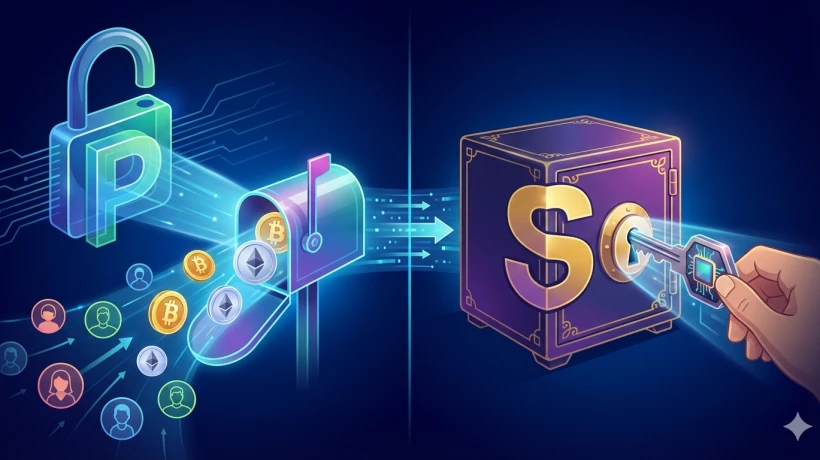
Learn how public and private keys secure cryptocurrency, enable transactions, and protect digital assets with essential insights into crypto key management.
Throughout my 12 years of working in blockchain security and educating cryptocurrency users, I've found that public and private keys are among the most misunderstood yet critical concepts in digital asset ownership. These cryptographic keys form the backbone of cryptocurrency security, yet many users interact with them daily without truly understanding their function or importance. Let me break down this essential technology in clear, practical terms.
What Are Public and Private Keys in Cryptocurrency?
Public and private keys are mathematically linked cryptographic codes that work together to secure cryptocurrency transactions the public key serves as your account address that others can see, while the private key is your secret password that authorizes transactions. These keys use asymmetric cryptography, meaning they're connected but one cannot be derived from the other.
This cryptographic relationship is what makes cryptocurrency secure and trustless. Your private key is typically a 256-bit number (often displayed as 64 hexadecimal characters or a 12-24 word seed phrase), while your public key is derived from it through complex mathematical functions. From my experience auditing blockchain security systems, this one-way mathematical relationship is virtually unbreakable with current technology you can easily generate a public key from a private key, but it's computationally impossible to reverse the process.
How Do Public Keys Function in Crypto Transactions?
Public keys act as your cryptocurrency address that others use to send you digital assets, similar to how an email address allows people to send you messages. You can freely share your public key without any security risk because it cannot be used to access or move your funds.
In my work consulting for various blockchain projects, I've observed that public keys actually go through additional processing before becoming the addresses you typically see. For Bitcoin, your public key is hashed through multiple cryptographic functions to create a shorter, more user-friendly address starting with "1," "3," or "bc1." Ethereum addresses are the last 20 bytes of the public key's hash, always starting with "0x." When someone sends you cryptocurrency, they're creating a transaction that locks funds to your public address. This transaction is broadcast to the network, verified by validators, and recorded on the blockchain. Your public key essentially serves as a transparent lockbox that anyone can deposit into but only you can open with your private key.
What Makes Private Keys So Important and Sensitive?
Private keys are the ultimate proof of cryptocurrency ownership and must remain absolutely secret because anyone possessing your private key can access and transfer your entire cryptocurrency holdings without any additional authentication. Unlike traditional banking where you can reset passwords or reverse fraudulent transactions, lost or stolen private keys mean permanent, irreversible loss of funds.
From my decade-plus experience in this field, I cannot overstate the critical nature of private key security. I've consulted with individuals who lost access to hundreds of thousands of dollars because they stored private keys on compromised devices or accidentally deleted them. The private key is your only credential there's no customer service department, no password reset option, no bank to call for help. When you sign a transaction with your private key, you're creating a unique digital signature that proves you authorized that specific transaction. This signature can be verified by anyone using your public key, but it can only be created by someone holding the private key. This is why platforms, including those offering white label dex solutions, implement extensive security measures to protect private key management and educate users about security best practices.
How Are Public and Private Keys Generated?
Public and private keys are generated using complex cryptographic algorithms that create mathematically linked pairs through processes involving random number generation and elliptic curve cryptography. The private key is generated first using secure randomness, and then the public key is mathematically derived from it using one-way cryptographic functions.
In my experience developing wallet systems and consulting on blockchain infrastructure, the key generation process is fascinating yet crucial to understand. Most cryptocurrencies use Elliptic Curve Digital Signature Algorithm (ECDSA), which creates keys based on the properties of elliptic curve mathematics. The private key starts as a randomly generated number between 1 and a very large number (approximately 2^256 for Bitcoin). This randomness is critical predictable key generation has led to numerous thefts in poorly implemented systems. Once the private key exists, it undergoes elliptic curve multiplication to produce the public key. This mathematical operation is designed to be computationally easy in one direction but practically impossible to reverse. Modern wallet software handles this automatically, but understanding the process helps you appreciate the security mechanisms protecting your assets.
Can You Recover Cryptocurrency Without Your Private Key?
You cannot recover cryptocurrency without access to your private key or recovery seed phrase it is mathematically and practically impossible for anyone to retrieve your funds without this information. This immutable aspect of cryptocurrency design means personal responsibility for key security is absolute and non-negotiable.
This harsh reality is both cryptocurrency's greatest strength and its biggest challenge for mainstream adoption. Throughout my career advising both individual investors and enterprises, I've encountered countless tragic stories of lost fortunes. Unlike traditional financial systems where institutions can verify your identity and restore access, blockchain networks have no central authority to appeal to. If you lose your private key and don't have a backup seed phrase, your cryptocurrency becomes permanently inaccessible frozen in the blockchain forever. However, this same property ensures that governments, corporations, or hackers cannot arbitrarily seize or freeze your assets. The tradeoff between absolute ownership and the requirement for perfect security responsibility is fundamental to how cryptocurrency operates. This consideration factors significantly into platform development decisions, including evaluating crypto exchange white label cost versus custom solutions, as security architecture directly impacts both user experience and fund safety.
What Is the Relationship Between Seed Phrases and Private Keys?
A seed phrase is a human-readable representation of your private key, consisting of 12 to 24 randomly selected words that can regenerate your private keys through a standardized process. Seed phrases and private keys contain the same information in different formats knowing one allows you to derive the other.
The seed phrase innovation, which I've seen evolve since its introduction, solved a major usability problem in cryptocurrency. Raw private keys are long strings of random characters impossible for humans to reliably transcribe or memorize. The BIP39 standard introduced seed phrases using a dictionary of 2,048 common words. Through mathematical processes, these words encode your private key information in a format humans can write down and store securely. From this single seed phrase, modern hierarchical deterministic (HD) wallets can generate unlimited private-public key pairs for different addresses while maintaining a single backup. In my security audits, I always verify that platforms properly implement seed phrase generation with sufficient entropy, as weak randomness in seed generation has historically led to catastrophic vulnerabilities.
How Can You Keep Your Private Keys Secure?
The most secure method for protecting private keys involves using hardware wallets that keep keys offline, creating multiple physical backups of seed phrases stored in separate secure locations, and never entering private keys on internet-connected devices. Security is achieved through multiple redundant protections rather than relying on any single measure.
Based on my extensive experience conducting security assessments and training users, I recommend a layered approach. For significant holdings, hardware wallets like Ledger or Trezor are essential these devices generate and store private keys in secure chips that never expose them to potentially compromised computers. Write your seed phrase on durable materials (metal plates designed for this purpose are available) and store copies in physically separate locations like home safes and bank safety deposit boxes. Never photograph your seed phrase, store it in cloud services, or enter it into any website or app. Use strong passwords and two-factor authentication for any software wallets, and maintain updated antivirus software. Be extremely vigilant against phishing legitimate services will never ask for your private key or complete seed phrase. These practices have protected my clients' assets through exchange hacks, malware outbreaks, and sophisticated social engineering attacks.
Conclusion
Public and private keys represent the cryptographic foundation that makes cryptocurrency possible a revolutionary system where mathematical certainty replaces institutional trust. Understanding these concepts transforms cryptocurrency from mysterious digital tokens into a comprehensible system of ownership and transfer. Your public key is your address, shareable and visible, while your private key is your absolute proof of ownership that must remain secret. This knowledge empowers you to take full responsibility for your digital assets, appreciating both the freedom and the accountability that cryptocurrency ownership entails. As you navigate the crypto ecosystem, remember that these keys aren't just technical details they're the essence of your financial sovereignty in the digital age.


Comments
Login to Comment