Top 5 Background Verification Trends Every Business Owner Should Know
20 Jan, 2026
9821 Views 0 Like(s)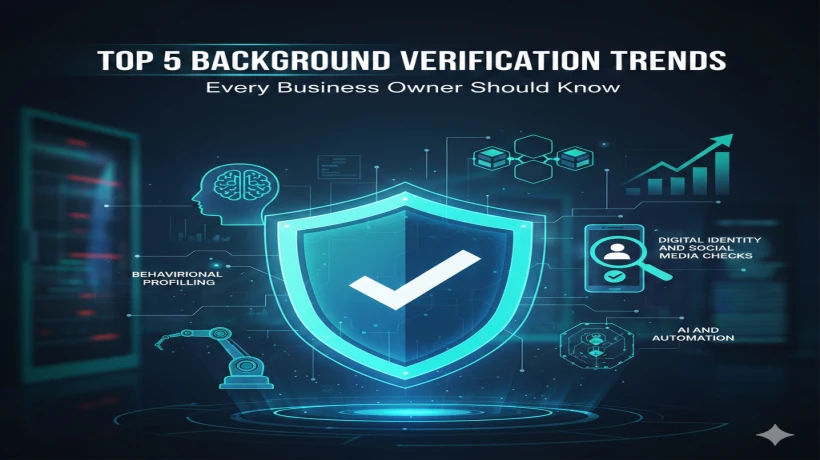
Discover the top 5 Employee Background Verification trends of 2026. From AI-driven screening to blockchain identity, learn how to secure your hiring process and ensure HR compliance.
In the high-stakes arena of the modern Indian corporate sector, a single "bad hire" is no longer just a recruitment error—it is a significant financial and reputational liability. With the rise of sophisticated resume fraud, deepfake interviews, and "moonlighting" (dual employment), business owners are finding that traditional gut-instinct hiring is a relic of the past.
In 2026, Employee Background Verification has transitioned from a mundane "check-the-box" HR task to a core strategic pillar. As a Senior HR Compliance Specialist, I’ve seen firsthand how companies that fail to modernize their screening processes face devastating consequences, from data breaches to legal penalties under the Digital Personal Data Protection (DPDP) Act.
Here are the top five background verification trends that every business owner, startup founder, and HR professional must integrate into their 2026 hiring strategy.
1. AI & Automation: Slashing Turnaround Time (TAT)
The days of waiting 15 days for a verification report are over. Today, Artificial Intelligence (AI) and machine learning are revolutionizing candidate screening.
-
Real-time Checks: Modern platforms now use AI to perform instant Aadhaar and UAN (EPFO) validation, reducing the initial verification phase from days to mere minutes.
-
Document Forensics: AI algorithms can now detect "photoshopped" experience letters or forged degree certificates that are often invisible to the human eye.
-
Smart Automation: By integrating these tools directly into your Applicant Tracking System (ATS), the Employee Background Verification process begins the second a candidate accepts an offer letter.
Why it matters: In a competitive talent market, speed is a differentiator. If your verification process is too slow, you risk losing top-tier talent to competitors who can onboard faster.
2. Digital Identity & Blockchain: The End of Paper Trails
The Indian recruitment landscape is moving toward a "Self-Sovereign Identity" (SSI) model powered by Blockchain technology.
Blockchain provides a decentralized, immutable ledger where educational institutions and previous employers can issue "Digital Credentials." Instead of your HR team calling a university registrar, they can verify a candidate’s degree instantly through a tamper-proof digital link.
This shift ensures HR compliance by providing a clear, unalterable audit trail. It eliminates the risk of "diploma mills" and fake experience certificates, which currently account for nearly 15% of discrepancies in the Indian IT and BFSI sectors.
3. Social Media & Behavioral Profiling: The Digital Footprint
A resume tells you what a candidate can do; their online presence often reveals who they are. Social media screening has become a vital component of behavioral profiling, but it comes with a catch: ethics.
-
Beyond the Surface: Recruiters are looking for "red flags" such as hate speech, extremist views, or instances of online harassment that could jeopardize workplace safety.
-
The Ethical Boundary: In 2026, it is critical to separate personal lifestyle choices from professional conduct.
-
Compliance Check: To avoid bias, many firms now use third-party Employee Background Verification companies to provide "sanitized" social media reports that flag only relevant behavioral risks without revealing protected data like religion or political affiliation.
4. Continuous Monitoring: Beyond the "One-Time" Check
Historically, background checks were a "one-and-done" event at the time of joining. However, the 2026 trend is shifting toward Continuous Monitoring (also known as Lifecycle Screening).
Why is this necessary? An employee who was "clear" three years ago may have developed a criminal record or financial conflicts of interest since then.
Key Insight: Continuous monitoring involves periodic, automated scans of criminal databases, global watchlists, and court records. This is especially critical for roles involving financial authority or access to sensitive intellectual property.
You can visit Force Track to learn more about how ongoing monitoring can protect your long-term business interests.
5. Remote/Hybrid Hiring: Verifying the "Invisible" Workforce
With the permanence of remote work, verifying a candidate you have never met in person presents unique challenges. This has led to a rise in "Identity Impersonation," where a candidate might have a proxy take their technical interview.
To counter this, businesses are adopting:
-
Liveness Detection: Using AI-powered video tools during the digital onboarding process to ensure the person on the screen matches their government ID.
-
Geofencing & Physical Address Verification: Even for remote roles, confirming a candidate’s physical location is essential for tax compliance and equipment security.
-
Dual Employment Detection: Utilizing EPFO data to ensure the remote hire isn't secretly working two full-time "remote" jobs simultaneously.
Pro-Tips for Business Owners
If you are scaling your startup or managing an SME, keep these three pointers in mind to stay ahead of the curve:
| Strategy | Action Point |
| Consent is King | Always obtain explicit, written consent before any check to stay compliant with the DPDP Act. |
| Role-Based Checks | Don't use a one-size-fits-all approach. A delivery partner needs a criminal record verification, while a CFO needs a deep-dive employment history check. |
| Partner Wisely | Choose a verification partner that offers an API-first approach for seamless integration with your existing HR tech stack. |
The Future of Hiring is Secure
As we navigate 2026, the definition of a "qualified candidate" has evolved. It’s no longer just about skills; it’s about verified integrity. By embracing AI, blockchain, and continuous monitoring, you aren't just "checking backgrounds"—you are building a culture of trust and security.
The cost of a robust Employee Background Verification process is a fraction of the cost of a single legal dispute or data breach. Don't let your next hire be your biggest mistake.
Investing in such security measures is the first step towards a successful corporate workplace transformation. When verified integrity becomes the bedrock of your team, a culture of long-term safety and high productivity follows naturally.



Comments
Login to Comment