Marketing Automation for Enterprises: Building Scalable Workflows for Lead Generation and Customer Retention
29 Sep, 2026
17 Views 0 Like(s)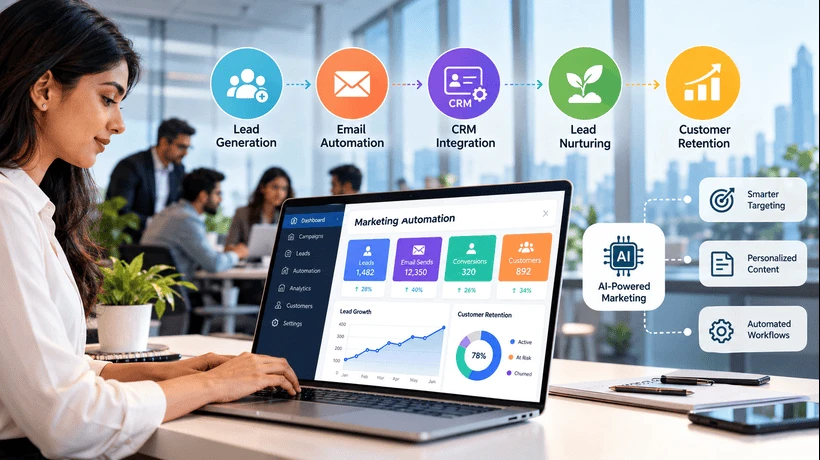
Marketing automation helps enterprises build scalable workflows that streamline lead generation, nurture prospects, connect CRM data, personalize campaigns, and improve customer retention through intelligent, AI-powered processes.
Enterprise marketing rarely struggles because there are too few ideas. The harder problem is execution. Large teams manage multiple channels, customer segments, campaigns, databases, and sales handoffs at the same time. Marketing Automation helps connect those moving parts through structured workflows that can capture leads, respond to customer behavior, and maintain engagement without requiring manual action at every stage.
For an enterprise, automation should not simply mean sending more emails. It should create a reliable system for moving prospects from their first interaction toward meaningful conversations and, eventually, long-term customer relationships. The strongest programs combine good data, useful content, clear triggers, and regular human oversight.
Why Enterprises Need Scalable Marketing Workflows
A small campaign can often be managed from a spreadsheet and a few scheduled messages. Enterprise marketing is different. Thousands of contacts may interact with a company through websites, social platforms, events, paid campaigns, product pages, and customer portals.
Without connected workflows, important signals can get lost. A sales team might receive a lead after several days, while another prospect receives irrelevant content because their recent activity was never recorded.
A scalable workflow creates rules around these interactions. For example:
-
A visitor downloads an industry report.
-
The system records the activity and identifies the relevant segment.
-
A follow-up message provides related educational content.
-
Additional engagement increases the lead's qualification score.
-
A sales representative receives an alert when the prospect reaches a defined threshold.
The objective is simple: make the next useful action easier and more consistent.
Building an Enterprise Automation Framework
Good automation starts before choosing software. Marketing and sales teams need to agree on what the workflow is supposed to accomplish.
Start by defining the customer journey. Identify major stages such as awareness, consideration, evaluation, purchase, onboarding, expansion, and retention. Then determine what customer behavior should move someone from one stage to another.
A practical framework usually includes four components:
1. Customer Data
Automation depends on accurate information. Duplicate records, outdated contact details, missing company information, and inconsistent segmentation can create poor customer experiences.
Enterprises should establish clear rules for data collection, validation, ownership, and synchronization across marketing and sales platforms.
2. Behavioral Triggers
A workflow should respond to meaningful actions rather than simply running on a fixed schedule.
Useful triggers can include:
-
Content downloads
-
Product-page visits
-
Webinar registrations
-
Demo requests
-
Email engagement
-
Form submissions
-
Trial activity
-
Changes in customer status
3. Content Logic
Every automated message should have a reason for being sent. A prospect researching implementation options needs different information from an existing customer considering an upgrade.
Relevant content makes automation feel helpful instead of mechanical.
4. Measurement
A workflow should have measurable outcomes. Enterprises can monitor conversion rates, engagement, lead velocity, pipeline contribution, retention, and revenue influence.
Connecting Marketing and Sales With CRM Workflows
CRM Marketing Automation becomes particularly useful when marketing and sales teams operate from connected customer information. Instead of treating campaign engagement and sales activity as separate records, teams can create workflows based on a broader customer profile.
For instance, a prospect who attends a webinar, downloads two resources, and visits a pricing page may demonstrate stronger purchase intent than someone who only opens an email.
The system can combine those signals and notify sales when predefined criteria are met. This reduces unnecessary manual checking and gives representatives better context before starting a conversation.
The important point is that automation should support sales judgment, not replace it. High-value enterprise deals often involve complex buying committees and requirements that cannot be understood from activity scores alone.
Improving Lead Nurturing at Scale
Lead Nurturing Automation allows enterprises to maintain useful communication with prospects who are not ready to buy immediately.
This matters because enterprise purchasing cycles can stretch across weeks or months. A prospect may have genuine interest but still need internal approval, budget confirmation, technical validation, or additional research.
A thoughtful nurture sequence can provide:
-
Educational material related to the prospect's challenge.
-
Practical examples and implementation guidance.
-
Product information when buying intent becomes clearer.
-
Relevant proof points and customer evidence.
-
A direct sales conversation when the timing is appropriate.
The sequence should also adapt. If someone repeatedly ignores a particular type of content, continuing to send similar messages can create fatigue. Good systems use engagement signals to adjust frequency, content, or channel.
Using Email Automation Without Losing Relevance
Email Marketing Automation remains valuable because it can deliver timely information at scale. The challenge is maintaining relevance.
Enterprises should avoid building enormous sequences where every recipient receives identical messages. Segmentation can make automated communication more useful.
Segments might be based on industry, role, customer lifecycle, geography, product interest, previous interactions, or account characteristics.
Testing also matters. Teams can compare subject lines, content formats, calls to action, timing, and frequency. The goal is not simply to increase open rates. A successful test should improve a business outcome further down the customer journey.
Where AI Fits Into Enterprise Marketing
AI Marketing Automation can add another layer of intelligence to existing workflows. AI systems can help analyze large volumes of behavioral information, identify patterns, generate content variations, summarize customer interactions, and support audience segmentation.
However, AI should operate within clear business rules. Enterprises need human review for sensitive communications, brand claims, customer data handling, and decisions that could significantly affect customers.
A useful model is to let AI handle repetitive analysis and production tasks while marketers retain responsibility for strategy, judgment, and quality control.
Retention Requires More Than Acquisition
Many automation programs focus heavily on generating new leads. That leaves a major opportunity unexplored: existing customers.
Retention workflows can identify customers who have reduced product usage, missed onboarding milestones, stopped engaging with educational resources, or reached a point where additional support may be useful.
Automated reminders can then guide customers toward training, documentation, support resources, or relevant account conversations.
This approach is particularly useful when customer bases are large. A retention system can help teams identify patterns early instead of waiting for a cancellation request to reveal a problem.
Making AI-Powered Marketing More Responsible
AI-Powered Marketing works best when technology and human expertise operate together. Enterprises should establish governance around customer data, content approval, access permissions, model outputs, and measurement.
Before launching an automated workflow, teams should ask:
-
What customer problem does this workflow solve?
-
What data does it require?
-
What happens if the data is incorrect?
-
When should a human intervene?
-
How will success be measured?
-
How can customers opt out of unwanted communication?
These questions help prevent automation from becoming a collection of disconnected processes.
Common Enterprise Automation Mistakes
Several problems appear repeatedly in large marketing operations.
Automating a broken process: Technology cannot fix unclear ownership or poor customer journeys.
Over-communicating: More messages do not automatically create more engagement.
Ignoring data quality: Incorrect records can send the right message to the wrong person.
Using vanity metrics: Opens and clicks can be useful signals, but pipeline, conversion, revenue, and retention often provide stronger business context.
Failing to review workflows: Customer behavior changes. A sequence that worked six months ago may become ineffective after a product, audience, or market change.
Creating a Sustainable Automation Strategy
Enterprise automation should develop gradually. Start with one high-value workflow, measure its performance, identify weaknesses, and expand from there.
Teams evaluating Marketing Automation Services should look beyond the number of features offered by a platform. Integration capabilities, data governance, reporting, workflow flexibility, security, and ongoing optimization are equally important.
A mature system eventually connects acquisition, nurturing, sales enablement, onboarding, engagement, and retention into one coordinated customer journey.
Final Thoughts
Enterprise automation is most effective when it improves the timing and relevance of customer interactions. The technology itself is only one part of the equation. Strong data, useful content, thoughtful segmentation, measurable objectives, and human oversight determine whether automated workflows actually create value.
For enterprises exploring connected digital systems, HyprForge can be considered as a technology partner for designing and implementing scalable digital and automation solutions. The focus should remain on building workflows that support measurable business goals rather than automating tasks simply because they can be automated.
Frequently Asked Questions
1. What is enterprise marketing automation?
Enterprise marketing automation uses software and connected workflows to manage repetitive marketing activities across large customer and prospect databases. It can support lead capture, segmentation, nurturing, campaign execution, sales handoffs, and retention.
2. How does automation improve lead generation?
Automation captures customer interactions and responds with relevant actions based on predefined rules. This can help businesses follow up faster, identify higher-intent prospects, and maintain consistent communication throughout longer buying journeys.
3. Can marketing automation improve customer retention?
Yes. Automated workflows can monitor engagement signals and trigger useful communications such as onboarding reminders, educational resources, product guidance, or customer-success follow-ups. Early engagement can help teams address potential problems before they become churn risks.
4. What data is needed for effective automation?
Common data includes contact information, company details, customer lifecycle stage, content engagement, website activity, purchase history, product usage, and sales interactions. Data quality and appropriate permissions are essential for reliable workflows.
5. How should enterprises measure automation success?
Enterprises should connect automation metrics to business outcomes. Useful measurements include qualified leads, conversion rates, sales-cycle movement, pipeline contribution, customer engagement, retention, expansion, and revenue impact. The most relevant metrics depend on the workflow's objective.


Comments
Login to Comment