India Book Market 2026: Size, Share, Growth Insights, Trends and Forecast Report by 2034
13 Oct, 2026
9 Views 0 Like(s)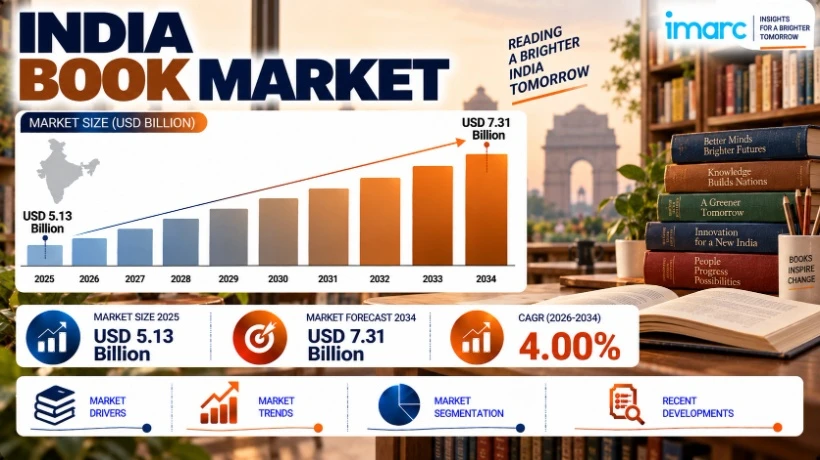
The India book market reached USD 5.13 Billion in 2025 and is projected to reach USD 7.31 Billion by 2034, growing at a CAGR of 4.00% during 2026-2034.
India Book Market: Industry Report 2026–2034
The India book market size is expanding steadily, supported by rising literacy, a vast student population, and the growing adoption of digital reading formats. India stands as the world's second-largest publisher of English-language books, with hard copy formats retaining dominance while audiobooks and e-books gain momentum. Educational books anchor the type segment, online channels lead distribution, and North India remains the largest regional market, anchored by Delhi NCR's publishing ecosystem.
What Is the Size and Growth Forecast of the India Book Market?
The market is demonstrating consistent, broad-based expansion, fundamentally anchored by education sector growth, digital format adoption, and the democratisation of reading through subscription and regional language platforms.
-
Market Size in 2025: USD 5.13 Billion
-
Market Forecast in 2034: USD 7.31 Billion
-
Compound Annual Growth Rate (CAGR): 4.00% during the 2026–2034 forecast period
-
Underpinning Momentum: Rising literacy, NEP 2020 curriculum reform, and digital reading platform expansion support sustained demand
What Are the Latest Emerging Trends in the India Book Market?
Government Publishing Investment and World Book Fair Participation:
In January 2026, the Publications Division announced its participation in the New Delhi World Book Fair 2026, showcasing books on art, culture, history, and Gandhian literature, alongside journals including Yojana, Kurukshetra, Aajkal, and Bal Bharati. The New Delhi World Book Fair, hosted at Pragati Maidan with over 1,000 publishers from more than 35 countries, serves as India's most significant annual book discovery and rights trading event, bringing Indian literature to global publishers and reinforcing Delhi's position as the country's publishing capital.
Audiobook Platform Scaling Through Regional Language Content:
Kuku FM has emerged as a major audiobook distribution channel by pioneering regional language audiobooks and original audio series in Hindi, Tamil, Telugu, Marathi, and Bengali. The platform's strategy of commissioning original audio content from regional language authors is creating new reading behaviours among non-English smartphone users who represent India's largest underpenetrated book market. This approach is expanding the audiobook audience beyond metro English listeners into mass-market vernacular consumers, significantly broadening the addressable base for audio content across the country.
Government Initiatives for Library Development and Book Accessibility:
The National Education Policy (NEP) 2020 emphasises the development of high-quality, engaging learning materials in Indian and local languages to improve educational outcomes. It also promotes wider availability and accessibility of books through schools and public libraries, ensuring inclusive access for all learners, including persons with disabilities. These initiatives are expanding institutional procurement channels and reinforcing the structural demand base for educational publishers, while simultaneously encouraging regional language content development across multiple states and school boards.
➤ Request Sample Report with Datasheet – TOC, Charts & Key Insights: https://www.imarcgroup.com/india-book-market/requestsample
What Growth Factors Are Driving the India Book Market?
Rising Literacy Rates and Education Enrolment:
India's literacy rate increased to 80.9% in 2023-24, up from 74% in 2011, adding over 80 million new literate consumers to the book market every decade. Gross Enrolment Ratio improvements are increasing school enrolment at all levels, directly expanding the educational book procurement market. The Union Ministry of Education has been allocated INR 1,39,289 crore for 2026-27, marking a 14% increase over revised estimates for 2025-26. This sustained public investment in education creates a consistently expanding base of institutional book buyers, insulating educational publishing from consumer spending cycles.
Digital Publishing and E-book Adoption:
Amazon Kindle Unlimited's India subscription has democratised premium English reading access for India's urban middle class, while Google Play Books and Apple Books' regional language content expansion is creating first-time digital reading experiences for vernacular consumers. Broadband connections increased from 6.1 crore in March 2014 to 94.92 crore in August 2024, representing growth of 1,452%, enabling e-book and audiobook adoption at unprecedented scale. Digital platforms are also enabling self-published authors to reach national audiences without traditional distribution networks, broadening content diversity and reader choice.
Growing Youth Reading Culture and Book Communities:
India's 377 million Gen Z and Millennial population is driving a reading renaissance, including Bookstagram accounts, WhatsApp book clubs, and online reading communities. This is creating peer-driven book discovery that is expanding reading habits among young urban consumers. Publishers are responding with targeted marketing through social media influencers and community-led engagement, while authors increasingly build direct readerships through digital platforms. The intersection of social media and reading culture is transforming book discovery from a retail-driven to a community-driven process, creating new pathways for both established and debut authors to reach audiences.
Government Initiatives Supporting India Book Market Growth
-
National Education Policy (NEP) 2020: Mandates multidisciplinary education, mother tongue instruction, and curriculum transformation, driving textbook replacement demand across schools.
-
Ministry of Education Budget Allocation: INR 1,39,289 crore allocated for 2026-27, supporting educational content development and procurement.
-
Publications Division Participation: Government participation in book fairs promoting art, culture, history, and Gandhian literature.
-
Library Development Programmes: NEP-aligned initiatives promoting wider availability and accessibility of books through schools and public libraries.
What Are the Key Challenges Facing the India Book Market?
-
Piracy and Illegal Content Distribution: Digital book piracy through Telegram channels and unauthorised e-book distribution websites represents significant revenue leakage for publishers.
-
Competition from OTT Platforms and Social Media: India's 500-600 million OTT users compete for leisure time that could otherwise be spent reading.
-
Rising Print and Paper Production Costs: Global paper price increases of 25–40% between 2021 and 2023 have raised physical book production costs by 20–35%.
-
Author Discoverability and Long-Tail Economics: India publishes roughly 90,000 titles annually, creating a discoverability challenge with limited commercial visibility for most releases.
Deep-Dive Segment Insights
The market is meticulously segmented by type, format, distribution channel, and region.
By Format
-
Hard Copy: Dominant with a 72.6% share in 2025, reflecting institutional procurement requirements, competitive exam preparation culture, and India's strong book-gifting tradition.
-
E-books: Represent 16.3% of the market, growing steadily as Kindle Unlimited, Google Play Books, and regional language digital platforms expand content catalogues.
-
Audiobooks: Hold an 11.1% share and are projected to grow fastest at approximately 12.4% CAGR, driven by smartphone penetration and commuting culture.
By Type
-
Educational: Leading with a 34.8% share in 2025, encompassing school textbooks, university academic books, and competitive exam preparation guides.
-
Science: Accounts for 8.2%, growing at approximately 5.8% CAGR as the fastest-growing type segment.
-
Historical: Represents 7.5% of the market, supported by sustained reader interest in history and biography.
-
Mystery: Holds 6.8%, driven by strong commercial fiction readership.
-
Fantasy: Accounts for 7.0%, benefiting from growing young adult readership.
-
Romance: Represents 6.5%, supported by consistent demand in commercial fiction.
-
Literary: Holds 6.2%, anchored by award-winning Indian and international authors.
-
Contemporary/Realistic: Accounts for 7.3%, reflecting reader interest in relatable modern narratives.
-
Comic: Represents 5.9%, driven by growing graphic novel and illustrated content adoption.
-
Others: Includes children's books, regional language titles, and specialised non-fiction categories.
By Distribution Channel
-
Online: Leads with a 44.3% share in 2025, driven by e-commerce platforms, digital reading apps, and direct-to-consumer publisher channels.
-
Local Book Shops: Retain significant relevance, particularly in Tier 2 and Tier 3 cities with limited organised retail presence.
-
Mass Merchandisers/Retail Shops: Support impulse purchases and broad accessibility across urban and semi-urban markets.
-
Specialty Bookstores: Serve niche reader segments and premium literary audiences.
-
Others: Includes institutional procurement, school supply stores, and library distribution channels.
By Region
-
North India: Leads with a 31.7% share in 2025, anchored by Delhi NCR's publishing capital status, competitive exam culture, and the New Delhi World Book Fair.
-
East India: Holds 24.1%, driven by West Bengal's literary culture, Kolkata's National Book Fair, and a large student population across Bihar, Odisha, and Jharkhand.
-
South India: Accounts for 22.6%, distinguished by high literacy rates, strong regional language publishing, and IT sector non-fiction consumption.
-
West India: Represents 21.6%, supported by Mumbai's trade publishing market, Maharashtra's educational procurement, and growing Marathi and Gujarati digital publishing.
Competitive Landscape & Key Player Positioning:
India's book market exhibits moderate concentration at the trade publishing level, while the educational publishing segment is more fragmented across regional and state-specific publishers. Key players include Penguin Random House LLC, HarperCollins Publishers, S Chand And Company Limited, and Arihant Publications India Limited, among others.
Covering an in-depth analysis of the competitive landscape, market structure, key player positioning, competitive dashboards, top winning strategies, and detailed profiles of all major industry participants you will gain access to all these exclusive insights within the full research report.
Recent Developments
-
January 2026: The Publications Division announced its participation in the New Delhi World Book Fair 2026, showcasing books on art, culture, history, and Gandhian literature alongside journals including Yojana, Kurukshetra, Aajkal, and Bal Bharati.
-
April 2026: Penguin Random House India and Kuku FM launched 12 Hindi audiobooks from their exclusive 15-title partnership. The launch marks the company's first professionally produced Hindi audiobook initiative and targets India's growing regional-language audio audience.
-
October 2025: Kuku FM raised USD 85 million in a Series C funding round led by Granite Asia, with participation from existing investors. The company plans to use the capital to expand its AI-powered audio content ecosystem, strengthen creator monetisation, and accelerate growth across regional language markets in India.
-
June 2025: S Chand And Company Limited introduced textbooks integrated with Google Lens-enabled tools to provide students with quick access to explanations and solutions, making textbook learning more interactive and supporting easier concept understanding through digital assistance.
-
Market Outlook: Digital format expansion, regional language publishing growth, and NEP 2020-driven curriculum reform position the India book market for steady expansion through 2034.
Customization Note: If you require any specific information not covered within this report's scope, we will provide it as part of the customization.
Frequently Asked Questions (FAQs)
Q1. What is the current size of the India book market?
The India book market reached USD 5.13 Billion in 2025.
Q2. What is the projected market size by 2034 and the growth rate?
The market is projected to reach USD 7.31 Billion by 2034, exhibiting a compound annual growth rate (CAGR of 4.00%) during the 2026–2034 forecast period.
Q3. Which format dominates the India book market?
Hard copy dominates with a 72.6% share in 2025, followed by e-books at 16.3% and audiobooks at 11.1%.
Q4. Which region accounts for the highest market share?
North India leads with a 31.7% share in 2025, anchored by Delhi NCR's publishing capital status and competitive exam culture.
Q5. What are the key factors driving market growth?
Rising literacy rates, NEP 2020 curriculum expansion, digital format adoption, growing youth reading culture, and regional language publishing growth are the primary drivers.



Comments
Login to Comment