How to Choose the Right Laboratory Spectrophotometer for Your Lab
09 Jun, 2026
1461 Views 0 Like(s)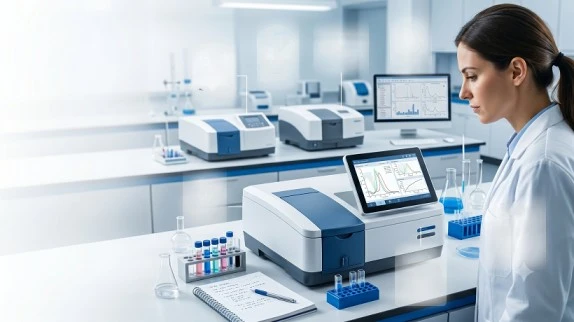
So you need a spectrophotometer for your lab. Maybe someone just handed you the responsibility, or you're setting up a new lab from scratch. Either way, you're probably staring at a list of models and specs that look like a foreign language. Don't worry. By the end of this guide, you'll know exactly what to look for and why it matters.
So you need a spectrophotometer for your lab. Maybe someone just handed you the responsibility, or you're setting up a new lab from scratch. Either way, you're probably staring at a list of models and specs that look like a foreign language. Don't worry. By the end of this guide, you'll know exactly what to look for and why it matters.
Let me walk you through it the way I wish someone had walked me through it the first time.
What Is a Spectrophotometer, Really?
Before we get into buying decisions, let's get clear on what this machine actually does.
You take your sample, usually a liquid, put it in a small container called a cuvette, and the machine shines a beam of light through it. Depending on what's in that liquid, some of that light gets absorbed, and some passes through. The Laboratory Spectrophotometer measures exactly how much light made it to the other side, and from that number, you can figure out a lot, like what's in the sample, how much of it is there, or whether a reaction actually worked the way you expected.
Where does this actually come up in real life? More places than you'd expect. A water treatment facility uses it to catch contamination before the water reaches people's taps. A pharma lab uses it to confirm that a drug batch has the right concentration before it ships out. A food manufacturer uses it to make sure their product looks the same shade of red or brown every single time it comes off the line. Even environmental scientists out in the field use it to track pollutant levels in soil or water samples.
Now that you know what it does, here's how to pick the right one.
Know What You're Actually Measuring
Different samples need different wavelength ranges. A UV-Vis spectrophotometer covers ultraviolet and visible light (roughly 190 to 900 nm), which handles most common lab work like DNA quantification, enzyme assays, and colour analysis. If you're working with infrared spectroscopy for identifying organic compounds, you need a completely different type of instrument.
If your lab primarily runs protein and nucleic acid assays, a basic UV-Vis model works perfectly. But if you're doing complex pharmaceutical analysis or trace metal detection, you'll need a wider range and higher sensitivity.
Ask yourself: what are the specific compounds or samples I'll be testing daily? That answer narrows your choices immediately.
Single Beam vs. Double Beam
A single beam spectrophotometer measures the reference and the sample separately. You run a blank first, then your sample. It's straightforward and affordable, which makes it great for routine, high-volume testing where speed and cost matter more than extreme precision.
A double beam spectrophotometer splits the light source and measures the reference and sample at the same time. This gives you more stable, accurate readings because it compensates for fluctuations in the light source in real time.
If your lab runs quality control checks all day and you need readings that hold up to scrutiny, go with double beam. If you're a smaller facility running occasional tests and budget is a concern, single beam does the job without the premium price tag.
Resolution and Bandwidth
Bandwidth refers to the range of wavelengths hitting your sample at any moment. A narrower bandwidth gives you sharper, more specific readings. A wider bandwidth is faster but less precise. For most routine applications, a bandwidth of 2 to 5 nm is more than sufficient. But if you're doing research that requires distinguishing between closely related compounds, you'll want 1 nm or even 0.1 nm bandwidth.
A real-world comparison: imagine trying to identify two very similar paint colours under different lighting. Narrow bandwidth is like a focused spotlight that shows you exactly what's there. Wide bandwidth is like overhead fluorescent lighting. Gets the job done, but you'll miss the finer details.
Sample Volume and Throughput
How many samples are you running per day? And how much sample volume do you typically have?
If you're processing dozens of samples daily, look for a model with a multi-cell holder or automated sample changer. It saves enormous amounts of time. Some labs I've worked with switched from single-cell to 8-cell automated models and cut their processing time by more than half.
If sample volume is limited, such as when working with rare or expensive reagents, look for microvolume capability.
Software and Data Management
Modern spectrophotometers come with software that handles data logging, report generation, compliance documentation, and sometimes even method storage so your team runs tests the same way every time.
If your lab follows FDA 21 CFR Part 11 or similar regulatory requirements, you need software with built-in audit trails, electronic signatures, and user access controls. Don't ignore this part of the spec sheet.
Also check whether the software integrates with your existing LIMS (Laboratory Information Management System). Manually transferring data is not just inefficient; it's a source of human error.
Final Word
Choosing a spectrophotometer is not about getting the most expensive model on the market. It's about matching the instrument to your specific work. Know your wavelength range, your sample type, your throughput needs, and your regulatory environment, and the right choice becomes much clearer.
Take your time, ask vendors for demo units, and if possible, run your actual samples on the instrument before committing.



Comments
Login to Comment