How India’s Spiritual Heritage Influenced Steve Jobs and Apple’s Design Philosophy
13 Mar, 2026
5345 Views 0 Like(s)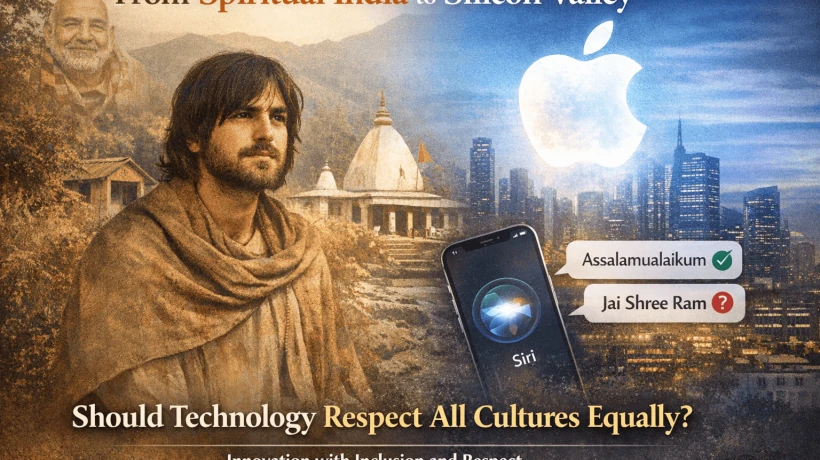
Steve Jobs’ journey to India in the 1970s exposed him to spiritual ideas that influenced his views on simplicity, intuition, and design. Many believe this experience helped shape Apple’s minimalist philosophy. Today, as AI and technology grow globally, an important question arises: should digital platforms treat all cultures and spiritual expressions with equal respect? True innovation becomes powerful when it reflects the diversity and values of the people it serves.
In 1974, a young Steve Jobs traveled to India in search of spiritual wisdom and deeper meaning in life. At the time, he was not yet the iconic technology leader the world would later recognize. Instead, he was a curious young man exploring philosophy, spirituality, and self-discovery. During this journey, Jobs visited the ashram of Neem Karoli Baba in Uttarakhand, a place known for attracting spiritual seekers from around the world.
Although Neem Karoli Baba had already passed away before Jobs arrived, the environment of the ashram and the broader spiritual atmosphere of India had a profound impact on him. Jobs spent time traveling across northern India, studying spiritual teachings, and reflecting on life’s deeper questions. The experience introduced him to concepts such as simplicity, mindfulness, and intuition—principles that later influenced the way he approached innovation and design.
When Steve Jobs eventually returned to the United States and co-founded Apple Inc. with Steve Wozniak, he carried many of these philosophical insights with him. Apple’s design philosophy became widely known for its minimalism, clarity, and focus on the human experience. Products were designed to be simple, intuitive, and elegant. Many observers believe that Jobs’ exposure to India’s spiritual traditions played a subtle yet meaningful role in shaping this mindset.
Apple later became one of the most influential technology companies in the world. From the Macintosh computer to the iPhone and iPad, Apple products transformed how people interact with technology. The company’s emphasis on simplicity and user-centered design became a standard that many other companies tried to follow.
The story of Steve Jobs’ journey to India often reminds us how ideas and inspiration can travel across cultures. India’s spiritual heritage, which has influenced thinkers and seekers for centuries, has quietly contributed to the development of modern innovation in unexpected ways.
However, as technology continues to evolve—especially with the rise of artificial intelligence—there is another important conversation emerging about cultural representation in digital platforms. Technology companies now build tools that interact with billions of people from different backgrounds, beliefs, and traditions. Because of this global reach, ensuring fairness and cultural respect has become increasingly important.
For example, some users have noticed that certain AI assistants respond differently to various cultural or religious expressions. This has raised broader discussions about whether global technologies should treat all cultures with equal sensitivity and recognition.
The goal of modern technology should not only be efficiency and innovation but also inclusiveness. As AI systems become more integrated into daily life, developers and technology companies must be mindful of the cultural diversity of their users.
Innovation becomes truly meaningful when it respects the values, traditions, and identities of people around the world. Just as Steve Jobs found inspiration in India’s spiritual wisdom decades ago, today’s technology leaders have an opportunity to build tools that reflect respect for all cultures.
In a connected world, the future of technology should be guided not only by intelligence and progress, but also by understanding, balance, and cultural respect.



Comments
Login to Comment