Emerging Industry Trends Influencing PGDM Specialization Program in India
20 May, 2026
1694 Views 0 Like(s)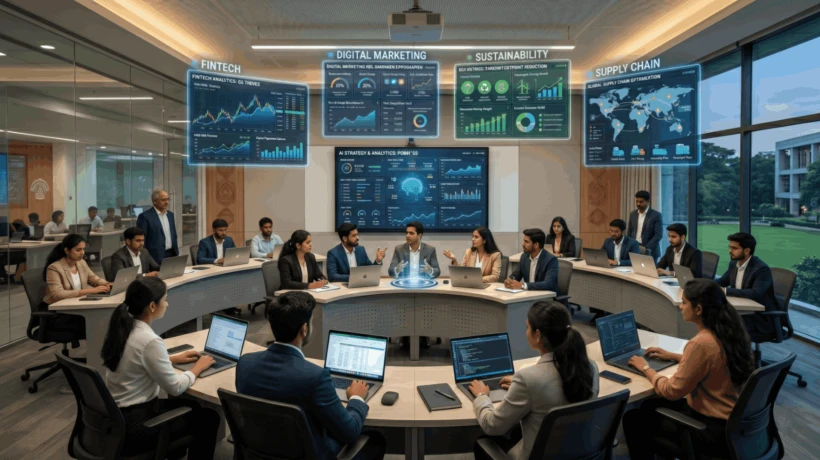
Discover the latest industry trends shaping PGDM specialization programs in India in 2026, including FinTech, ESG, data analytics, HR tech, digital marketing, and entrepreneurship.
If you have been thinking about pursuing a management program in India, you have probably noticed something: the options look very different from what they did even three or four years ago. The specializations on offer, the skills being taught, and the kinds of companies showing up for campus placements all shifted noticeably.
That shift is not accidental. Industries across India are changing fast, and management education is trying to keep pace. The PGDM specialization program in India, in particular, has been one of the more responsive parts of the education ecosystem. Because autonomous institutions run these programs and are not tied to a rigid university syllabus, they can actually change their curriculum when the market changes.
So what exactly is driving those changes right now? Here are the key industry trends that are shaping how PGDM programs are being designed and taught in 2026.
The Data Economy Is Reshaping Every Specialization
A few years ago, data analytics was a niche interest, something you pursued if you were specifically drawn to numbers and technology. Today, it is almost impossible to find a professional domain that data has not touched.
Marketing teams run A/B tests and track conversion funnels in real time. Finance professionals use predictive models to assess risk. HR departments are using workforce analytics to reduce attrition. Supply chain managers rely on data dashboards to monitor inventory across continents.
What this means for PGDM programs is that data literacy is no longer just a feature of the analytics specialization. It is bleeding into every specialization. Business schools have started adding modules on data interpretation, basic Python for business, and dashboard tools like Power BI or Tableau into core PGDM curricula regardless of what a student has chosen as their primary specialization.
If you are evaluating programs right now, pay attention to how deeply data skills are embedded across the curriculum, not just in dedicated analytics courses.
Sustainability Is Moving from Optional to Central
Environmental, Social, and Governance ESG reporting has gone from a buzzword to a business requirement. Indian companies with international operations or global investors are increasingly being held accountable for their sustainability practices, supply chain ethics, and carbon footprints.
This has created real demand for managers who understand ESG frameworks, can communicate sustainability goals to stakeholders, and can integrate responsible practices into business strategy. A few years ago, sustainability was mostly a topic you might encounter in an elective. Today, leading PGDM programs are building dedicated modules and in some cases full specializations around it.
Students interested in consulting, corporate strategy, or finance would do well to pay attention to this area. It is one of those topics where early knowledge creates a lasting edge, because most people are still catching up.
The Rise of FinTech Is Redefining Finance Education
Traditional finance education focused on accounting, financial modeling, corporate valuation, and banking fundamentals. Those things still matter. But the financial services industry itself has changed dramatically with the emergence of digital payments, neo-banking, blockchain-based transactions, and algorithmic investing.
India, in particular, has become one of the most active FinTech markets in the world. The success of the UPI ecosystem, the growth of digital lending platforms, and the expansion of investment apps have all created a strong domestic talent demand for professionals who understand both finance and technology.
PGDM programs with a finance specialization are increasingly incorporating subjects like digital banking, cryptocurrency regulation, financial product design, and API-driven finance tools into their syllabi. If finance is your area of interest, the question to ask any institution is not just about CFA prep or capital markets, it is about whether they are teaching the financial landscape of the next five years, not the last twenty.
Remote Work Has Changed: What HR Professionals Need to Know
The nature of the workplace has fundamentally shifted. Hybrid work is now standard across many industries. Managing distributed teams, maintaining company culture across geographies, and using digital tools for performance management are now core parts of what HR professionals do every day.
This has had a direct influence on HR specializations within PGDM programs. Once theoretical curriculum areas, such as organizational psychology, employee engagement and culture-building have become intensely practical. At the same time, HR analytics has grown into its own discipline. Understanding how to use data to predict attrition, measure employee productivity, and design compensation structures is no longer optional for someone entering people management.
Programs that have updated their HR specializations to reflect these realities are producing graduates who are genuinely ready for the workplace they are walking into not the one that existed a decade ago.
Supply Chain Complexity Is Creating Specialized Demand
The past few years have been a masterclass in how fragile global supply chains can be. Disruptions in one part of the world rippled into shortages and delays everywhere else. Companies learned, often painfully, that they needed professionals who could build more resilient, flexible, and responsive operations.
Operations and supply chain management have always been a solid PGDM specialization. What has changed is the level of sophistication now expected. Topics like supply chain digitization, vendor risk assessment, demand forecasting using machine learning, and sustainable sourcing are now part of what students need to understand.
For anyone interested in manufacturing, retail, e-commerce, or logistics sectors that are all expanding significantly in India, this specialization offers some of the most concrete and in-demand career paths available right now.
Entrepreneurship Is Being Treated as a Learnable Skill
India's startup ecosystem has matured considerably. There are more funded startups, more venture capital flowing into Indian companies, and a broader cultural acceptance of entrepreneurship as a legitimate career path. Many PGDM students are no longer treating their degree purely as a pathway to a corporate job. They are thinking about what it would take to build something of their own.
Business schools have responded by building entrepreneurship tracks and incubation programs into their PGDM structures. Students get access to mentors, pitch opportunities, seed funding possibilities, and a curriculum that covers business model design, product-market fit, fundraising, and legal basics for startups.
Even for students who end up in corporate roles, this exposure is valuable. Thinking like a founder understanding margins, spotting inefficiencies, moving quickly is a mindset that employers increasingly value.
Digital Marketing Has Become a Science, Not Just a Creative Exercise
Marketing used to be about big ideas and brand narratives. Those things still matter, but the mechanics of how marketing actually works have changed completely. Performance marketing, search engine optimization, content strategy, paid social advertising, and influencer marketing are all disciplines with their own logic, tools, and metrics.
PGDM programs with a marketing specialization have had to evolve accordingly. The best ones now treat digital marketing as a core competency rather than a module tucked at the end of a traditional advertising curriculum. Students learn how to run and optimize campaigns, interpret analytics, manage marketing budgets across channels, and use customer data responsibly.
For students who enjoy a mix of creativity and analysis, a modern marketing specialization offers a career path that is genuinely versatile relevant in FMCG, e-commerce, B2B tech, healthcare, and virtually every other sector.
What This Means for You
The trends shaping the industry right now are directly influencing what a PGDM specialization program in India looks like and what it prepares you for. The programs that are keeping pace with these shifts embedding data skills broadly, integrating sustainability, updating finance for FinTech, modernizing HR and marketing are the ones worth your serious attention.
The programs that are not making these updates are still teaching for a world that is changing around them.
When you evaluate programs, dig into the actual syllabus rather than just the brochure. Ask what electives are available. Look at who the faculty are and whether they have recent industry experience. Check which companies are recruiting and for which roles.
Management education, at its best, should feel like it is preparing you for what is actually coming not just what has already been. In 2026, the gap between programs that do this well and those that do not is wider than ever.


Comments
Login to Comment